
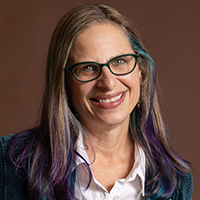

Elizheva Hurvich has often spent the weeks leading up to Purim planning an elaborate costume. It’s one of her favorite holidays, and she usually goes all out.
Not this year. The Oakland rabbinical student instead called stores trying to procure burlap bags for a grief ritual, which she enacted at a daylong “Tent of Mourning” event at Urban Adamah in Berkeley, presented by the Shalom Center with support from more than 20 organizations.
In observance of Ta’anit Esther, or Fast of Esther, the Shalom Center erected the tent to “honor and grieve both Palestinian and Israeli lives lost since and beyond October 7th,” the organization explained in a press release.
On Thursday, Hurvich donned a burlap sack over her clothes, as wearing sackcloth is mentioned in the Megillah as a grieving ritual.
“It’s incredibly uncomfortable and itchy,” Hurvich said. “It’s like a physical manifestation of what I’ve been holding inside since Oct. 7.”
The ritual that Hurvich chose took place at the Shalom Center’s first Bay Area “actifest,” or “activist festival,” which strives to transform how American Jews see and celebrate Jewish holidays into “portals for Jewish prophetic action.” The Philadelphia-based center was founded 40 years ago by Rabbi Arthur Waskow, an author and leader in the Jewish Renewal and Reconstructionist movements.

Rabbi Nate DeGroot, the center’s associate director, who will succeed Waskow this fall, said the Berkeley event, which drew about 200 people throughout the day, fulfilled the organization’s mission to “build a movement of sacred justice rooted in the Jewish calendar cycle.”
Inside the tent was an altar where people could sit and a wall where they could post small notes saying what they were grieving for.
“The loss of our collective humanity,” said one.
“Our Jewish sacred unity,” said another.
“The shock and heartbreak of friends and community silencing lovers of peace and justice,” said another, along with “Palestine + olive trees + olive oil.”
The tent also had stations for art projects. In one, participants could make a grief amulet, using herbs, buttons and other materials, either on their own or in a workshop led by Laura Rifkin of Emeryville.
“Sitting with our grief is part of what we’re being called to do right now,” Rifkin said. “We Jews know something about mourning; it’s built into our collective practices.”

DeGroot said given how life-altering the Oct. 7 Hamas attacks and ongoing war in Gaza have been, the fact that there is a traditional day of mourning and fasting before Purim was an ideal opportunity to reimagine a holiday usually characterized by boisterousness and merriment.
“The day of mourning is based on Queen Esther’s ritualized grief that she practices before she goes to the king and reveals her identity and asks him to save the Jews,” he said.
The Shalom Center chose to hold the event in the Bay Area because of personal ties, and as an awareness that many of the Jews who live here have been grieving the loss of both Israelis and Palestinians.
Hosting the event “felt like an important opportunity to work collaboratively to bring people together to share grief, which feels important as ever in our community and our world,” said Adam Weisberg, Urban Adamah’s executive director.
The day of mourning started with the lighting of a sacred fire at 5:50 a.m. and ended past 9 p.m. after a wordless song session led by the Niggun Collective, a collective meal and a closing ritual. Workshops held throughout the day included grief meditation sessions; one called “Wailing Our Grief” (“Do you need a place to just let it out?”); movement-based ways of mourning; kriyah, the ancient practice of tearing one’s clothes; nature connection as a way of self-care; and song circles.

In one segment, “Songs of Comfort During a Time of Mourning,” Rabbi Jennie Chabon of Walnut Creek’s Congregation B’nai Tikvah sang “Nachamu,” a song “begging God to give us comfort during this time,” she said.
There was a makeshift loom, with string between two trees, where people could weave in their own strips of black cloth to symbolize kriyah.
By midday, Nancy Newman of Berkeley was feeling lighter.
Newman had been struggling with the fact that many of those closest to her didn’t understand what she’s been going through since Oct. 7, she said.
Newman lived in Israel for several years and was active in the peace movement there; she has both Israeli and Palestinian friends.
“I haven’t allowed myself to be fully alive because they’re suffering so,” she said.
After two successive workshops, one called “Shechinah: A Guided Trance Journey” followed by “Moving With Grief,” Newman said she was able to “let all the feelings come out.”
While she knows she will live with the grief of this time for the rest of her life, having a day to mourn helped her move to a new stage, she said.
“These workshops helped me see that I have permission to not suffer with everyone there who is suffering,” she said. “I recognized that I want to be here, and be totally, fully me.”