
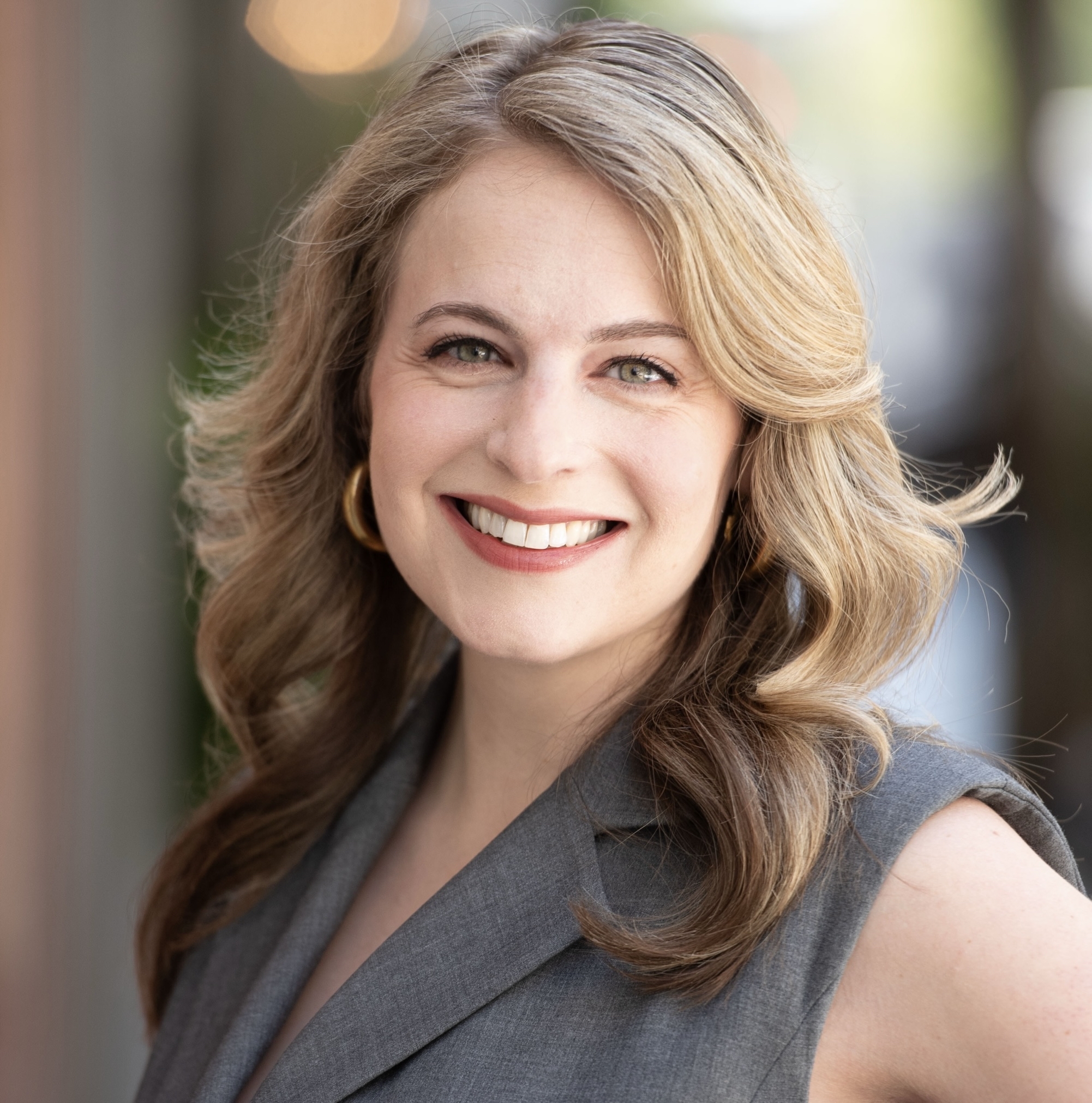

Behind every leading role on Broadway, there’s the understudy — the person who knows the role by heart and can jump in at a moment’s notice if needed.
Julie Benko went from understudy to star when she filled in for a month as Fanny Brice in “Funny Girl” in 2022, following actress Beanie Feldstein’s early exit. Once “Glee” star Lea Michele was cast as the new Brice, Benko was given the rare opportunity to continue performing the role one night a week.
From her roles in “Fiddler on the Roof,” “Funny Girl” and, most recently, Barry Manilow’s pre-Holocaust musical, “Harmony,” Benko has a strong appreciation for her Ashkenazi Jewish heritage and culture.
In 2020, she wrote, directed and starred in her first short, “The Newlywed’s Guide to Physical Intimacy,” a heartwarming comedy that follows a Hasidic couple on their wedding night.
J. interviewed Benko, 35, over Zoom shortly after she touched down in Los Angeles. She traveled from New York to California this week to perform “Standby, Me,” a new cabaret show that she co-produced with Jason Yeager, her pianist-composer husband. On Sunday, April 14, she and Yeager will perform it at the Venetian Room of San Francisco’s Fairmont Hotel.
The following Q&A has been edited for length and clarity.
J.: You talk a lot about being a Jewish person on Broadway and in the arts. What does Judaism look like for you? And are you doing anything for Passover?
Julie Benko: I’m going to go to seder at my parents’ house. I also wrote a song for Passover with my husband, Jason. We’re going to perform it at the Shabbat service at Park Avenue Synagogue [in New York] on the Saturday before Passover.
I’m really proud of it and excited for people to hear it. Cantor Azi Schwartz had the idea. I said, “Well, I’m not religious. I don’t know how to write a song about how much I believe because I’m not really a believer. I’m a Jew, you know, culturally.” And he said, “Oh no, I think we need to be writing songs for all kinds of Jews.”
I wrote the song about taking a step into the Red Sea and having the bravery to go forward into whatever it is that is ahead of you.
I think especially now with so much going on in the world that there’s so much fear about how to go forward. I thought it could be a very universal message of finding the strength to just take a step forward into the sea. Hopefully that will resonate with a lot of different kinds of people.
I want to ask about your role as Fanny Brice. What does it mean to play a real Jewish woman? Should non-Jews be cast in roles portraying real Jewish people?
It’s not a one-size-fits-all situation. I don’t think every Jewish character needs to be played by a Jewish actor. I think it really depends on the piece and on the history of that particular role. And also who’s the creator of the piece. I think there are a lot of elements that should go into casting.
But I do think, specifically, when it comes to Fanny Brice, there’s that number where she is wearing bagels and putting on a Yiddish accent. And she is very specifically a Jewish clown and making fun of Jewish stereotypes. I think there would be a lot of discomfort with somebody outside of that ethnic group portraying that role.
I have sort of stumbled into representing Jewish women on the Broadway stage, which is not something I ever thought I would do. It’s been very meaningful. So many Jewish women have come to me and said, “Thank you so much for the way that you use your voice and the way that you represent us as fully realized characters and not stereotypes and not tropes.” It’s been very meaningful to see that what I try to do seems to resonate with my community.
In “Harmony,” which was about the pre-World War II German singing group Comedian Harmonists, you played a Jewish community activist married to the non-Jewish pianist in the group. What drew you to that role?
This was the only time I’ve really seen a young Jewish woman being portrayed as an activist who is also still a love interest in a musical. The only time I could think of a Jewish activist was Emma Goldman in “Ragtime.” She’s not the love interest, right? She’s someone who’s kind of scary and abrasive.
What was cool about my character was that she was kind of the heart of the story, even though it wasn’t about her. She was more of a side character. But she ultimately brought the heart to the story and the tension and the drama because she’s the one who really ran headfirst toward conflicts. She was the only character in the show who stood up to a Nazi and told him what she really thought of him. And she ultimately paid the price for that.
She is the only one of all of the characters who perished in the Holocaust. All of the rest, the six guys, survived the war. She’s the one person in the whole show who really represents all those who perished. But she also does that in a way that has huge strength and guts and smarts and heart and humor. So I was drawn to the character for those reasons, and I was really grateful that I had the chance to do the show, particularly now.
How did the events of Oct. 7 impact the show, which opened shortly afterward?
We weren’t in previews yet when Oct. 7 happened. But then just to see the rise of antisemitism here at home so quickly, and suddenly I was reading: a girl gets beaten up in the subway in New York City because she looked Jewish, or swastikas are being drawn on Jewish storefronts in the Hamptons, or kids in Cooper Union locked in the library. Suddenly we were seeing the rise of antisemitism in our backyard. And that’s what “Harmony” is all about. As antisemitism was rising in Weimar-era Germany, people kept saying, “It’ll be fine.”
For me personally, I was really grateful to have it to go through some level of catharsis through the show. I was grateful to have that to really process what was going on.
You’re on social media. You’re a public person. Have you ever had to address antisemitism head-on?
When the neo-Nazis were protesting outside of the first preview of “Parade,” I made a TikTok video and talked about that.
What I’ve mostly done is just tried to do Jewish things publicly and not hide it. I’ve actually had a number of people write to me and say, “You just posting these Jewish things made me less afraid to be Jewish in my school — or just so you know, you made me feel less alone.” So that’s been the sort of tack I’ve tried to take because so much of the dialogue [about Israel] is too incendiary to have on social media.
Tell me about your cabaret show, “Standby, Me.”
It’s a show that I wrote about the life of an understudy and my specific journey as an understudy. Most people who have heard of me started hearing of me during “Funny Girl,” but I had been in shows for 10 years before that.
It’s kind of giving a peek into what that life is like and telling sort of funny stories about the stuff that’s happened to me, like the time Jessica Hecht almost broke my nose in “Fiddler on the Roof” on Broadway. And I got a nosebleed onstage.
There’s always stuff that goes wrong. There are other stories about my challenges, with either difficult feedback I’ve gotten from directors about my appearance or stuff that happened in “Funny Girl” that I thought, “Oh, my God, I’m going to be fired.” So all of the ups and downs, the joys and the terrors of the life of an understudy.
It’s your life.
It’s my life. And my husband is my accompanist. He also has managed to give himself so many more lines. He just has all the jokes now. He’s a whole character in the show.
Any special plans while you’re in San Francisco?
[Ursula Bootz,] the woman who was the real version of the character I played in “Harmony” — her daughter lives in San Francisco. She came to “Harmony” opening night, which was great and we got to know each other. We’re going to see her and hang out with her a little bit while we’re there.