
As an established Bay Area artist, I am looking forward to participating in the upcoming California Jewish Open at the Contemporary Jewish Museum.
The theme is “Connection” and, in this fraught time, I am particularly eager to see what other Jewish artists are thinking, feeling and making. Although some artists have decided to remove their work from the show for political reasons, I think it’s important to participate.
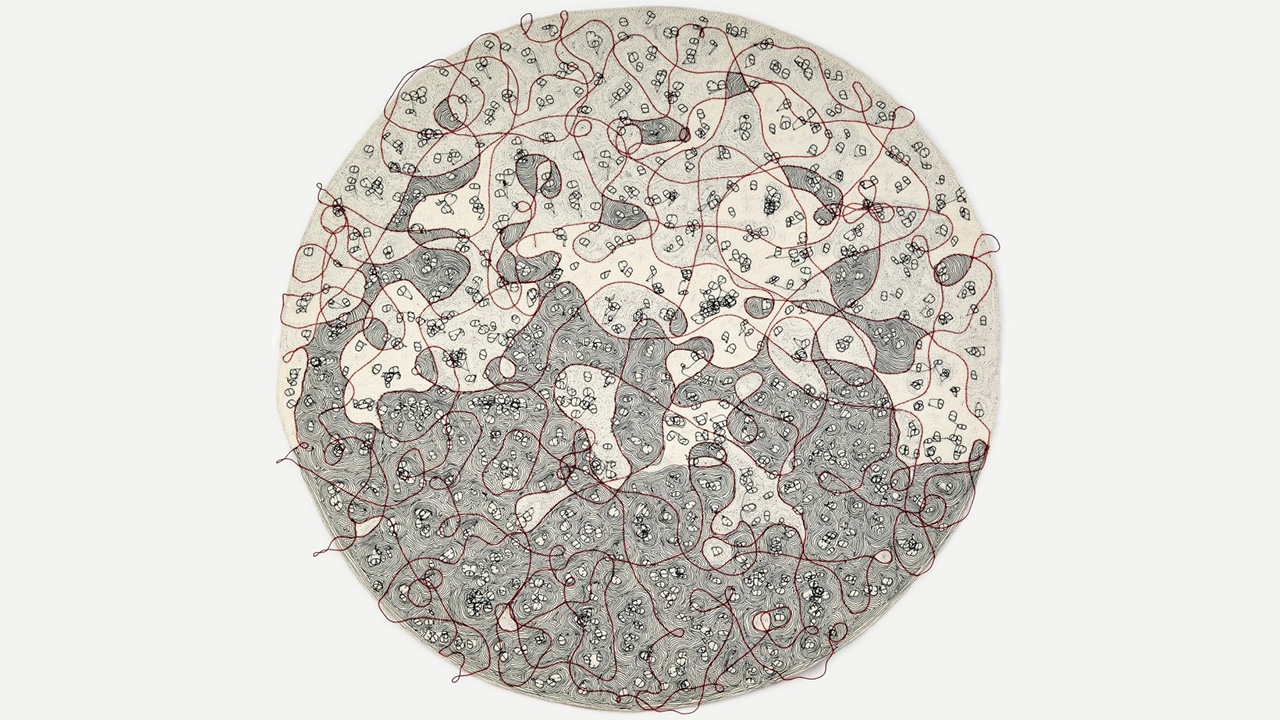
My work will be represented by “Red Line,” a stitched fiber piece that is part of a series called “The Wandering Alphabet,” in which I use a sewing machine as an improvisational tool and tap into chance as a collaborator. I meander through pre-set alphabets that are meant to be used in an orderly and meticulous fashion.
That is not the way I use them; I intentionally careen off in whichever direction occurs to me in the moment. Despite the random way the letters are used, they are all connected, albeit somewhat haphazardly. The distorted letters begin to resemble human heads. Groups of letters/heads form clusters linked together. Red lines made of cord separate the clusters. Most are confined within their black, white or gray areas, but others escape into neighboring territory in search of new connections.
One of the definitions of “red line” is “a limit beyond which someone’s behavior is no longer acceptable.” I was thinking about this while I was making the piece, specifically about what is happening in Gaza, which many experts describe as a genocide.
I have been an anti-Zionist for my whole adult life. Raised in a liberal, Zionist household, I attended Hebrew school where I learned what I later found out was an incomplete version of the history of Israel/Palestine. Once I left home, I found out that it was not “a land without a people,” as I was taught. I also began to see that the Jewish ethical values of love, compassion and championing of the underdog that I was raised with were at odds with the treatment of the Palestinians. How had Jews, who had suffered so much, become the perpetrators of so much suffering?
RELATED: Anti-Zionist Jewish artists pull out of Contemporary Jewish Museum exhibit when demands are not met
I have participated in many exhibitions at the Contemporary Jewish Museum, including almost all of the biannual invitationals, in which artists of all backgrounds are asked to respond to a specific Jewish ritual object or tradition. The fact that a Jewish museum welcomes perspectives from people who do not share Jewish faith/history/identification has always impressed me and made me want to be part of every exhibition I have been asked to participate in.
The upcoming California Jewish Open, which runs from June 6 to Oct. 20, is limited to people who identify as Jewish but will no doubt include many perspectives on the idea of connection, some of which will be similar to mine and others, undoubtedly, will not.
All of this brings up a fundamental question: What is the function of art? In my own life, art is as close to a spiritual practice as I have. I show up every day in my studio and make stuff. I have a lot of existential angst about the state of the world, the planet and all the isms and phobias that humans have invented. Making art keeps me sane. I like to say that I would be a menace to society if I didn’t have my art.
When I show my work, I hope for a conversation. Sometimes I hear interpretations I hadn’t thought of. This is the wonder of art; it can provoke both the viewer and the maker to think and feel in ways they hadn’t before. It can broaden views and perspectives. At the very least, it creates some sort of beauty and vibrancy that didn’t exist before.
My work is intentionally open-ended. In my 20s when I was an anti-imperialist activist, I thought that art could change the world. Now, approaching 70, my politics haven’t changed, although my lofty ideas about the role of art have.
I leave it up to the viewer to decide what they think and feel about what I make. In the words of the great James Baldwin, “The purpose of art is to lay bare the questions that have been hidden by the answers.”