

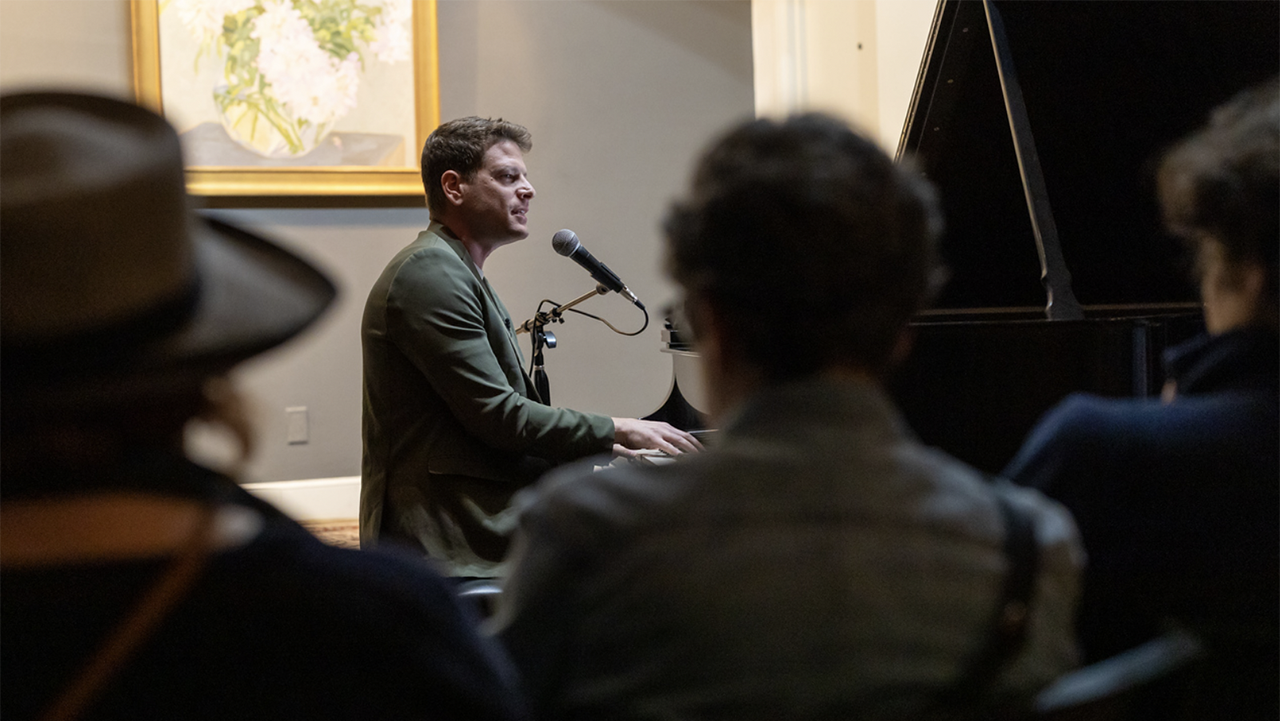
For Israeli musician Orion Stone, every day since Oct. 7 has been a month, and every month a day.
For the 35-year-old singer/songwriter and music producer, as for so many others in Israel, time stopped on the morning of the Hamas massacre. He and others are still reliving that day, over and over. He had family members killed, and others taken hostage. One is still in Gaza — he won’t give the name, so the hostage will not be targeted.
“Now is the time to let music bring us together, to remind us what we are fighting for, not just fighting against,” he told some 200 people gathered for a “Truth and Remembrance” event on May 15 at Piedmont Center for the Arts, an evening dedicated to remembering the 1,200-plus people murdered in Israel on Oct. 7, as well as the soldiers and civilians killed since.
Stone was in the Bay Area this past week on one of his several trips to the United States in the past seven months, trying to draw attention to the plight of the hostages and keep the issue “foremost in people’s minds,” he said. “We’ve seen 100 hostages released already. Advocacy works.”
The May 15 event, organized by the ad-hoc “Jewish Community of Piedmont” and sponsored by the Jewish Community Federation, Temple Beth Abraham, the Piedmont Education Foundation and the arts center, included a video presentation from the Eretz Israel museum in Tel Aviv, a photo exhibit of women helping women called “Sisterhood” from the Jewish Agency for Israel, and 1,538 yahrzeit candles representing civilian lives lost in Israel and Israel Defense Forces soldiers killed since Oct. 7.
“That number is already out of date,” said Jerusalem native Aliza Grayevsky Somekh, Oakland chef and Jewish educator, who put together the exhibit. She painstakingly found, cut out and pasted photos of those killed — Jews and Arabs, Druze and Christians, she said — on large poster boards that greeted people as they entered the building.
“Look into their eyes, their bright eyes so full of hope,” she told J. “See the lives they had in front of them, that all ended that day.”
Somekh was in Israel in February as part of a mission sponsored by UpStart, which helps fledgling Jewish nonprofits, and the I-Center, an Israel education initiative, to visit places and talk to people impacted by Oct. 7. The group visited the Eretz Israel museum, which on Oct. 6 had just finished curating “Local Testimony,” an annual competition featuring Israeli photojournalists’ best work of the previous year.
“The curators went to bed that night, and the next morning had to start all over again,” Somekh said.
The winning photographers were invited to send in new photos shot on Oct. 7 and the ensuing days for a revised exhibition. Those works were projected on a giant screen in a darkened room in Piedmont, in a continuous 22-minute loop. Drones, emergency workers, soldiers, tanks, funerals, more funerals, grieving families and friends, volunteers who labored to put together aid packages for survivors.
The first image was a video shot by photojournalist Roee Idan from one of the kibbutzim on the Gaza border. It showed a Hamas drone heading straight toward him. It was his final work; he was killed moments later.
“People say Oct. 7 didn’t happen, that it’s all lies,” Somekh said. “This is the proof.”

Also in the darkened room stood a dozen large poster boards, each displaying a photo of two women — one a victim of terror, and one a Jewish Agency staff member who reached out to help her.
The event was timed to Yom HaZikaron, Israel’s Memorial Day, which began the evening of May 12. It was also presented at Temple Beth Abraham and Pomella restaurant, both in Oakland, on May 12 and 13 respectively, without Stone’s musical performance.
Somekh pointed out that Yom HaZikaron coincided this year with Mother’s Day, very appropriate for the “Sisterhood” exhibit, the work of photographer Avishag Shaar-Yashuv.
“These photos show our resilience, the resilience of women,” she said. “Bad things can happen, but we are strong enough to help each other get through it.”
Gesturing to the memorial candles and photos of those killed, she added, “I wanted some hope, and these pictures show hope.”
Piedmont resident Sari Kaplan, 39, was gazing steadily at one of the Sisterhood photos. “I’m here because it’s important to remember and never forget those we lost and those who are mourning,” she said.
Across the room, fellow Piedmont resident Mark Cohen, 67, stood in front of another photo.
“Despite everything we have heard or feel we know about what happened, an exhibit like this, where you gather with other people and see these wonderful portraits of relatives of the victims, brings it home anew,” he said. “You might think there’s nothing more to learn. On the contrary.”
The evening was about remembering, but it was also a call to action. Those who attended had been asked to bring at least two non-Jewish friends. And at the end of the event, the audience was asked to go on social media and talk about what they’d seen and heard.
It was also a fundraiser for Kfar Galim, a boarding school for new immigrants and disadvantaged youth that has taken in many children whose families were killed or taken hostage on Oct. 7.
As Stone prepared to perform, he said his extended family got together in the weeks following the massacre to figure out how they could raise awareness of the hostages. His Aunt Tami, 86, is a resident of Kibbutz Nahal Oz, which was overrun by Hamas terrorists on Oct. 7. Her daughter Judith Raanan and granddaughter Natalie were visiting the kibbutz from their home in Evanston, Illinois and were kidnapped. They were the first hostages released, but the experience made Tami an advocate for the others still in Gaza.
“She told us, they are alive, they’re coming back, let’s get to work,” Stone told the audience.
“Seeing you all here, I wish the ripple effect from this room would reach the whole world. Keep on speaking up and speaking out. Your reach and influence is far greater than you can imagine.”