

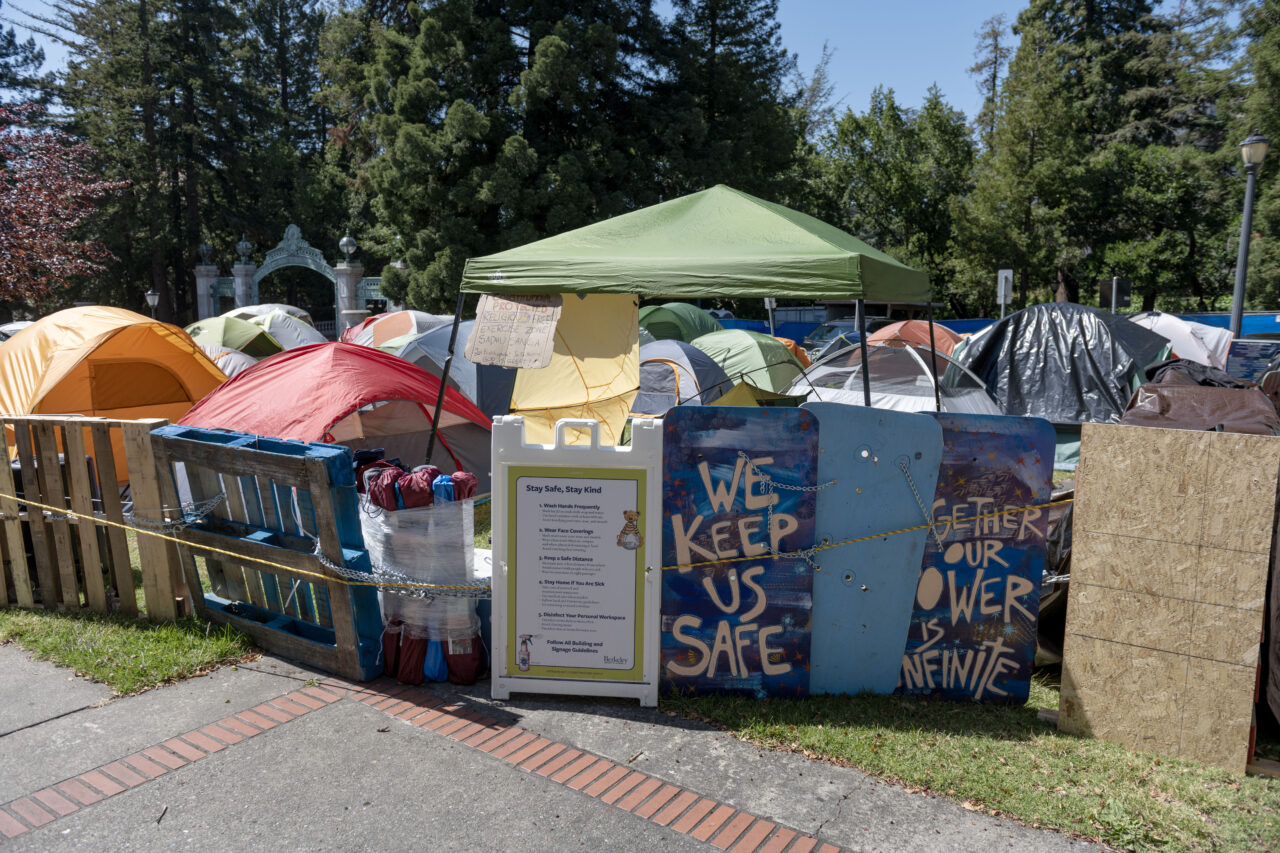
Robert Cohen, one of the foremost scholars of U.S. protest movements, suggests this spring’s pro-Palestinian tent encampment protests haven’t been as influential as one might think, with a tiny fraction of American college campuses taking part.
“I don’t think we should exaggerate how widespread it is,” said Cohen, a professor of history and social studies at NYU and an author of books about the Civil Rights Movement and the Free Speech Movement, which began at UC Berkeley in the mid-1960s.
Cohen has been a go-to expert for the media, from USA Today to the Associated Press, since tent encampments sprang up in mid-April at Columbia University and quickly spread across the country. Cohen spoke with J. about the current wave of protests within the context of U.S. history and what he predicts will happen next. The interview has been lightly edited.

J.: How do the campus tent protest movements fit into the history of American protests? Do they, or are they outliers?
Robert Cohen: I think there are similarities to earlier movements in some ways. The divestment movement against South African apartheid is one, and the Occupy movement, which wasn’t as often on campus — but there was Occupy Cal [at UC Berkeley].
Some of the actual demands are echoing the divestment movement against South Africa, but [the current boycott, divestment and sanctions] demands are not really demands that are going to go very far.
There was [BDS] organizing that went on decades before this latest movement by a group that wasn’t very successful. It’s not like they’re great organizers now, either. It’s just that the crisis in Gaza swelled a lot of campus support for trying to do something against the war. But I think that the demand [for divestment] has not much to do with the war itself. I don’t know if you want to call it stale or antiquated, but it’s not really a demand that’s going to go anywhere.
Will the current protest movement spread exponentially? It has seemed like every day there are more tent camps.
I don’t think — no. There are over 4,000 colleges and higher educational institutions in the United States, and it has only gone to about 100 campuses. You’ve got to be careful not to overstate its influence.
It’s reflected in the public opinion polls, too. Because it’s a presidential year, they’re doing a lot of surveys of young people, and the Gaza war isn’t anywhere near the top of the concerns.
I think this is an issue that resonates with people because of the tragedy in Gaza, but I don’t think we should exaggerate how widespread it is. It’s impressive in the context of the 21st century, which has not had a lot of mass movements on college campuses. But it’s not impressive compared to, say, May 1970, where over 4 million students were in motion [against the Vietnam War]. Five-hundred campuses had major demonstrations, including student strikes, and some violence at some campuses.
I just think it’s important to keep it in context.
Will this protest movement continue?
It’s very hard to sustain student movements over the summer, but a lot depends on what happens in Gaza. I think that if this war is still going on in the fall, then the movement is going to continue and probably grow.
I don’t want to be insulting to the organizers, because they have built something that I think is of some value in terms of raising people’s awareness of tragedy and what’s going on Gaza. But it’s not a movement that’s structured in a way to be broad. It may be a mile wide, but it’s kind of an inch deep.
It’s an antiwar movement to some degree, but it’s also mixed in with Palestinian nationalism. It’s not talking about what Hamas has done. It only talks about what Israel has done in terms of war crimes, so it’s limited in that way.
Ideally a movement can unite the campus, and this one, on some campuses, divided instead because there’s opposition to it. The two sides can’t even talk to each other.
Some of the things that happened, like taking over Hamilton Hall [at Columbia] and somebody in there with Palestinian garb, smashing windows with a hammer … how is that going to look on TV? How’s that going to look to people? Or these antisemitic incidents?
They should have worked harder to change their rhetoric so that they’re not alienating or frightening to Jewish students.
What should people keep in mind when thinking about these campus protests?
Student movements are always unpopular. Always. It was true even for the early ’60s movements. Like the Free Speech Movement — the majority of Californians opposed the movement. And why was that? Because of the tactics of civil disobedience.
People think that the role of students is to kind of shut up and study, respect your elders, obey the rules. I think that’s very strongly embedded.
It’s an objective fact that in all the polls from every one of these movements that we’re talking about, the majority oppose it. I’ve not seen any U.S. majority support for a student movement, even when the people start to agree with the objectives. The only thing more unpopular than the war was the antiwar movement.