

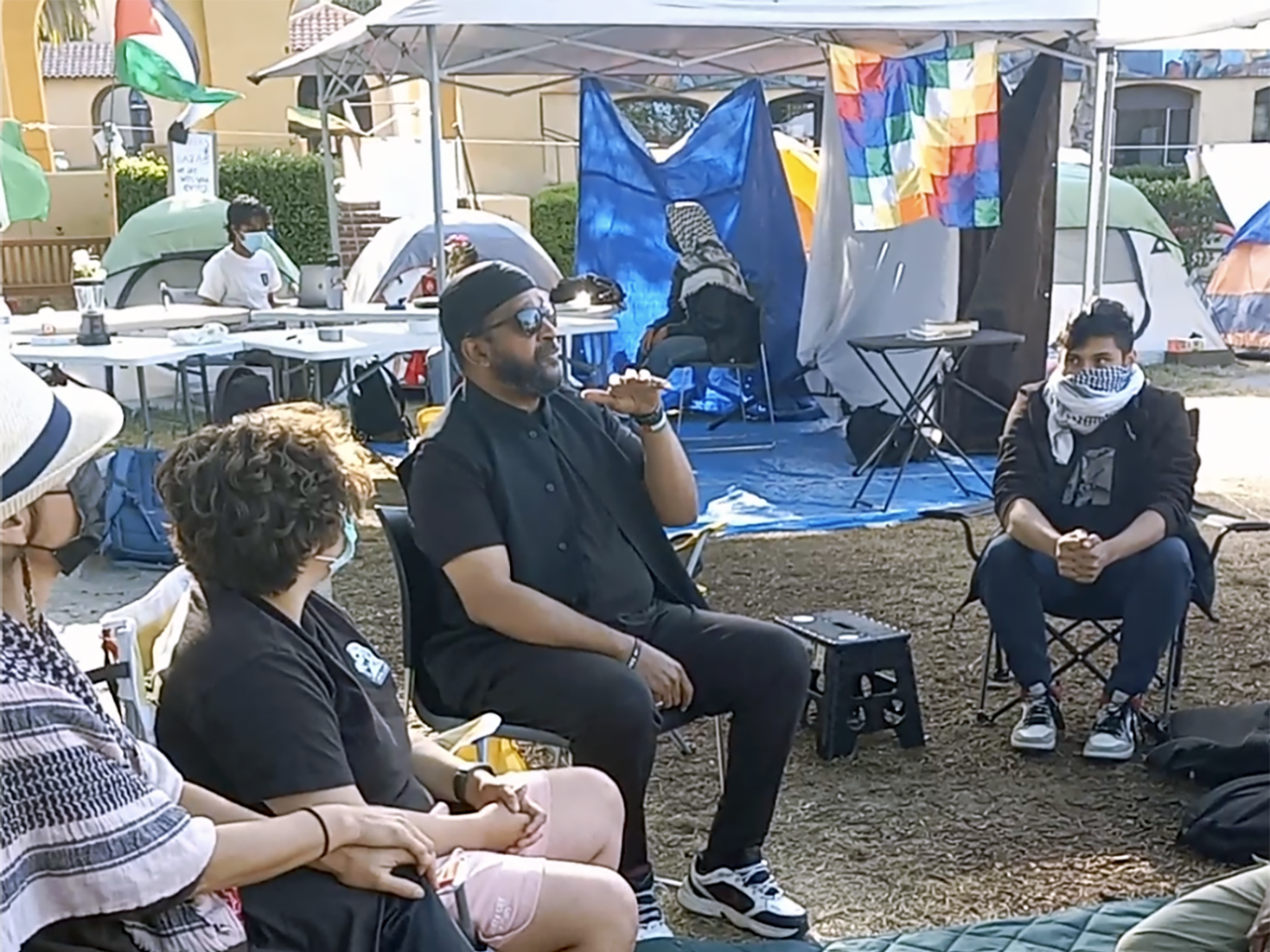
An imam with a long history of antisemitic statements spoke to a small group of pro-Palestinian protesters at their Stanford University tent encampment on Wednesday evening.
Amir Abdel Malik Ali addressed about 15 people, many wearing kaffiyehs and sitting on camping chairs on White Plaza, where the Stanford encampment is in its fourth week.
During his hourlong appearance, Ali said that Zionist Jews should “go back where they came from,” naming Germany, Poland and Russia. He painted an idyllic portrait of the Middle East before the arrival of European Jews, who he said “took white supremacy and mixed it with the Chosen People,” creating a “deadly mix.”
David Atri, a Jewish doctoral student at Stanford, attended part of the event to observe and challenge Ali and recorded a video that he shared with J.
During a Q&A, Atri asked Ali what he thought should happen to Jewish Israelis who came from Arab lands.
“Did they steal land?” Ali asked rhetorically. “They can go back to where they came from,” where they “will be treated fairly.”
“To Iraq, Syria, Tunisia?” Atri asked.
“If that’s where they came from,” Ali replied.
Much of the speech was “benign,” Atri noted. The imam spent a lot of time “talking about spiritual concepts” and repeatedly told attendees not to use drugs because drugs are used to “crush student movements.”
But Atri also recalled Ali saying that while it’s a “horrible time for Palestine,” there are “some beautiful things too. Our brothers and sisters are achieving martyrdom.”
During a segment in which he excoriated Zionist Jews’ treatment of Palestinians, Ali repeatedly pointed at Atri, who wears a kippah, and said, “You all should be more sensitive” because of the Holocaust.
“Y’all became like the Nazis,” Ali said, “seriously, literally.”
The audience members snapped their fingers.
Born Derek Gilliam, Ali is a California imam who the Anti-Defamation League and the Southern Poverty Law Center (SPLC) have long tracked due to his extremism. In 2011, the ADL described him as a leader of a movement called Sabiqun, a group “that advocates for the creation of a global Islamic state.”
The SPLC profiled the religious leader the same year in a report focused on “10 leading domestic jihadists.” Ali “promotes anti-Semitism, violence and conspiracy theories that blame the U.S. government and Jews for attacks by Islamic terrorists,” according to the report.
“He’s at his most hyperbolic when talking about Jews,” the SPLC report added, stating that Ali “argues that Jews run the U.S. government” and the media.
The Jewish Community Relations Council Bay Area reacted sharply Thursday, saying Ali’s invitation by Stanford protesters reflects a larger problem.
“Anti-Israel encampments insist they are not antisemitic, yet provide a platform for openly antisemitic speakers, as witnessed yesterday on @Stanford’s campus,” JCRC said in a post on X. “Some of the speaker’s past quotes include claiming ‘Zionist Jews’ were behind 9/11, Jews owned the media, and [he] has openly supported Hamas and Hezbollah violence,” citing the Southern Poverty Law Center.
State Sen. Scott Wiener (D-S.F.) called the Stanford event “disturbing.”
Stanford Students for Justice in Palestine advertised Wednesday’s event jointly with two other groups, alongside the message: “Disclose. Divest. Defend. Rise Up. Resist. Reclaim.” Stanford Against Apartheid in Palestine, a coalition of pro-Palestinian groups on campus, and the Palestinian Youth Movement Bay Area also published the digital flyer advertising the talk.
Ali has addressed campus activists before, including at UC Irvine in 2009 and UC Berkeley in 2004.
He also spoke recently at the pro-Palestinian encampment at San Jose State University, according to Sarita Bronstein, executive director of Hillel of Silicon Valley.
The invitation to speak at Stanford came amid considerable debate about whether the pro-Palestinian encampments across the country — many of which have disbanded as the school year winds down — have trafficked in antisemitism. Calls for “intifada,” an uprising associated with brutal violence against Israeli Jews, have been commonplace, as have chants of “Free Palestine” and “From the river to the sea,” which can be interpreted as a call for the elimination of Israel.
Many supporters of the encampments, however, have insisted their efforts are directed solely at the actions of the State of Israel, which they consider to be engaged in “genocide” and point to the participation of anti-Zionist Jews as evidence they do not harbor animus toward the Jewish people as a whole.
A number of Jewish students were “deeply disturbed” by Ali’s appearance at Stanford, including Aaron Schimmel, a Ph.D. student in Jewish history who, when he learned about the invitation, immediately wrote to high-level university administrators describing the event as “beyond the pale.”
“I kind of couldn’t believe it,” Schimmel told J. on Wednesday. Schimmel said he remains discouraged that Stanford’s pro-Palestinian tent encampment, erected on April 25, remains in place at the center of campus despite university policy prohibiting overnight camping.
“I keep thinking, OK, this is when the university steps in and does something,” Schimmel said.
Ali has spoken about Jews in other venues since the Oct. 7 Hamas massacre in Israel.
In December 2023, he delivered a sermon at the Muslim Community Association in Santa Clara, according to the Middle East Media Research Institute, in which he rejected that Jews are “semites” and called them “Europeans who converted to Judaism while in Europe.”
“We know they are not the Chosen People anymore. Muslims know that they are not the Chosen People anymore,” he said in the address, an excerpt of which was published on social media. “They assassinated Zachariah, and John the Baptist, and tried to assassinate Jesus.”
“Everyone sees you for who you really are. You are the new Nazis. That is who you are and that is how we’re coming at you,” Ali added.
Stanford did not respond to a request for comment sent to its media relations department and two spokespeople.
Neither Stanford Students for Justice in Palestine nor the Palestinian Youth Movement responded to requests for comment. Stanford Against Apartheid in Palestine does not accept messages sent via Instagram, and other contact information was not immediately available.