

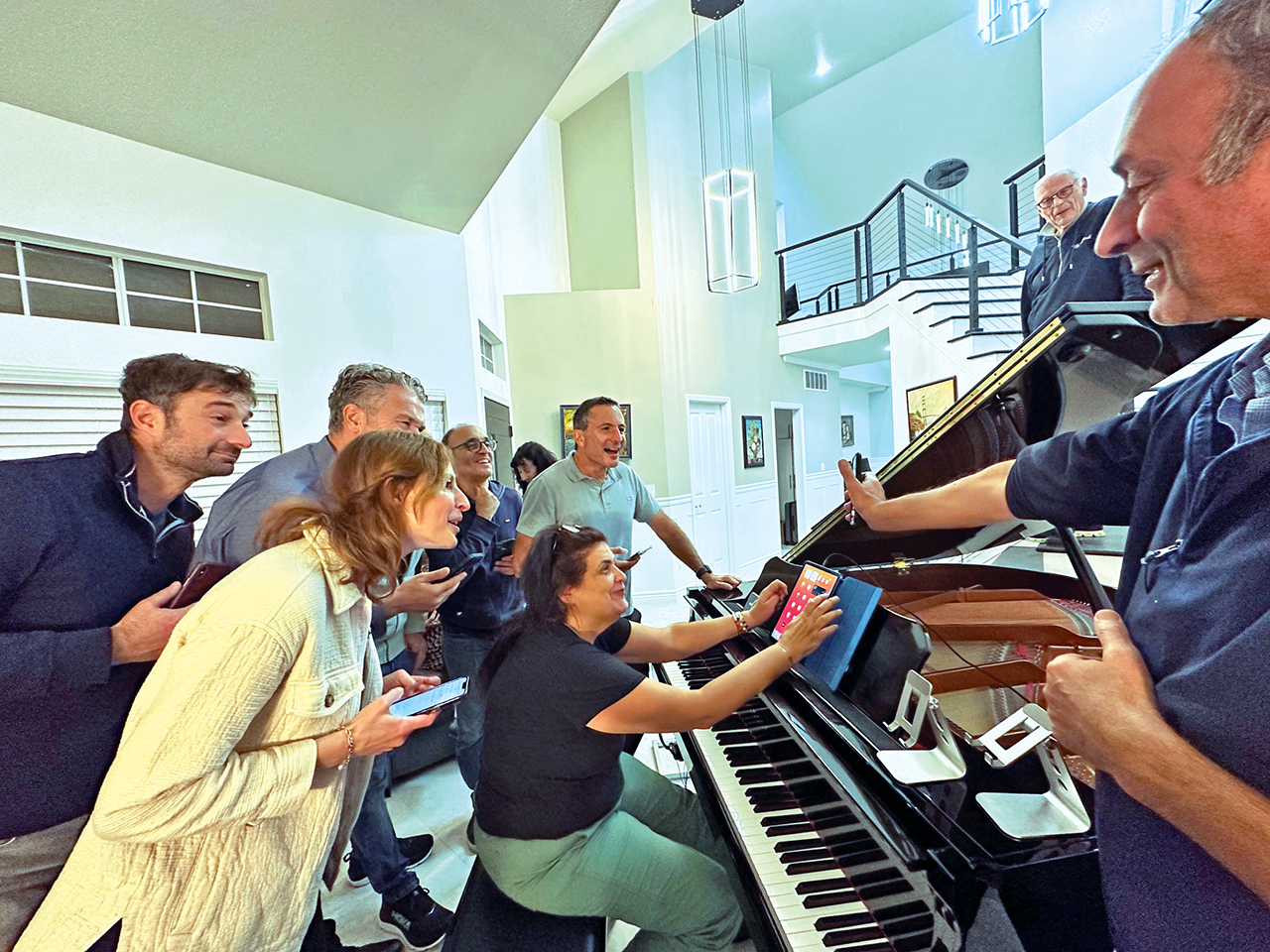
Before Oct. 7, the French Jewish expats living in the Bay Area mostly kept to themselves.
They gathered at each other’s homes for birthday parties and singalongs. They organized their own Sephardic-style Kabbalat Shabbat services, Passover seders and Mimouna celebrations. During the pandemic, their teens ran a summer camp for the younger children in the community.
But since Oct. 7, many local French Jews have stepped into the public arena as loud-and-proud activists for Israel.
On Sunday, several stood front and center at a rally across from Palo Alto City Hall while a pro-Palestinian demonstration was taking place. They waved Israeli and American flags and chanted “Free Gaza from Hamas!” In June, French Jews organized a solidarity rally outside the Israeli consulate in San Francisco, and some of them disrupted a demonstration by anti-Zionist Jewish artists at the Contemporary Jewish Museum.

In recent months, members of the community have also spoken against cease-fire resolutions at city council meetings, paid solidarity visits to the Stanford Jewish students’ Blue and White Tent on campus and raised thousands of dollars for Israeli charities.
Isabelle Marcus, a native of Paris who lives in San Carlos, attributes this surge of activism to her and her compatriots’ strong commitments to their Jewish identities and to democratic values.
“In France, we do not hesitate to say things as they are,” she said. “When we think something is not right, we will go into the streets.”
The community comprises 30 to 40 families, most of whom live on the Peninsula. They moved to the Bay Area over the last 20 years, many to work in the tech industry. They are mostly dual French and American citizens who maintain strong ties to France, summering there and speaking exclusively in French with their children. Around half of them are Sephardic, with roots in North Africa, and half are Ashkenazi. They are fiercely Zionist.
By all accounts, they view each other as part of one big family. Marcus described the collective as a “kibbutz.”
“We try to support each other always, in sad and joyful moments,” she said. “Each of us has our own skill set that we bring to the table.”
This month, J. interviewed several community members about their lives and activism. Here are the stories of six families.
Isabelle Marcus, entrepreneur, San Carlos
A petite woman with a big personality, Marcus became passionate about defending Israel while living in Geneva. She recalled attending the United Nations Durban Review Conference in 2009, where Mahmoud Ahmadinejad, then Iran’s president, demonized Israel in his speech.
“I realized that I cannot separate my Jewish identity from the situation in Israel,” she said. After the speech, she organized a rally in Geneva, with supporters waving Israeli flags.
Marcus moved to the Bay Area nine years ago when her engineer husband, Dan, also a French Jew, got a job at a large tech company. She runs a consulting firm that helps foreign-born entrepreneurs and artists move to and set up businesses in the U.S. She also serves on the board of the San Francisco chapter of the American Jewish Committee.
She organized her first rally in the Bay Area in 2021, when she and other local French Jews went to Civic Center Plaza in downtown San Francisco to mourn the murder of a Jewish woman, Sarah Halimi, in Paris and to raise awareness about antisemitism in France.
After Oct. 7, Marcus threw herself into pro-Israel activism, planning several events to “spread positive energy,” including a flash mob for Israel near the Golden Gate Bridge in January.

She recently co-founded a nonprofit, One Tribe One Star, along with another local French Jew, Laurence Mechali. On the group’s Instagram account, which is approaching 1,000 followers, they post pro-Israel messages and information about upcoming rallies.
Marcus, who has three children, said she is proud to be both Sephardic and Ashkenazi; her mother’s family is from Algeria and her father’s roots are in Romania.
“I have the optimistic mindset of the Sephardic, because they always try to bring joy, but also the realistic mindset of the Ashkenazi, because they lost so many members in the Holocaust,” she said. “My dad always told me, you are Jewish before anything else, even before French.”
Itai Dadon, VP at a lidar sensor company, Palo Alto
As the son of an Israeli diplomat, Dadon moved every few years during his youth. He was born in Jerusalem and lived in Panama, Mexico and then France, where his mother was born. He spent his formative high school and university years in Paris, where he met his Turkish Jewish wife, Sophie. They moved to the Bay Area in 2011, in part so Dadon could pursue his dream of working in Silicon Valley, and in part to escape antisemitism in France.

When Covid-19 began spreading, Dadon, 49, started a weekly Torah study group on Zoom for members of the local French Jewish community. The group — known as Ruach Ha’Maccabim, or Spirit of the Maccabees — now meets regularly for in-person Kabbalat Shabbat services at Chabad Palo Alto.
“It’s a way of creating opportunities for us to maintain some of the Sephardic traditions that we have,” said Dadon, who has Moroccan and Greek heritage.
After the Israel-Hamas War broke out, he became involved in local politics, attending dozens of Palo Alto City Council meetings, along with other French and American Jews. He credits their collective efforts for convincing the city council not to pass a cease-fire measure, as other local city councils have done, but instead to release a “unity statement” on May 6.
“We fought very hard,” he said, adding, “I want to stress that this is not anti-Palestinian. Our community is about defending Israel and striving for peace. It’s not against anyone.”
Dadon said members of the community are especially sensitive to anti-Zionist and antisemitic speech because of their own negative experiences in France. He said he has been called a “sale juif,” or “dirty Jew,” in the street there.
“It’s like you’re touching an old wound,” he said. “We came here thinking we wouldn’t have to deal with that, and now it’s catching up with us.”
Marilyn Crystal, teacher’s aide, Palo Alto
Growing up in Tunis, the capital of Tunisia, Crystal said it was “very easy to be a Jew.” But after Israel bombed the Palestine Liberation Organization headquarters near Tunis in October 1985, her family decided to move to France for their safety.
Crystal met her American-born husband during a Shabbat dinner at a mutual friend’s home in Paris, and they settled in Palo Alto in 2006. She works as an aide at an elementary school.

An avid cook, Crystal loves to prepare traditional Tunisian dishes, including nikitouches (chicken soup), kamounia (Tunisian chili con carne), pkeila (beef stew) and msouki (kosher-for-Passover vegetable stew). After the Hamas attack on Oct. 7, she decided to raise money for Israel by baking and selling challahs — first to the other members of the French Jewish community and then to the larger Jewish community. Between November and April, she raised around $3,600, which she donated to Magen David Adom, Israel’s national emergency service, and to a meal program benefiting Israel Defense Forces soldiers that was started by a French family who made aliyah from the Bay Area a few years ago.
“People have been very generous, giving me more than my actual price,” she said. “You support Israel, but at the same time you get the challah, so you get the Shabbat spirit.”
Crystal, 55, sent her three children to Jewish camp in France each summer. Last summer, the family took a trip together to Tunis, where they visited the Grand Synagogue. It was Crystal’s first time back in Tunisia in 23 years.
“It was wonderful to have a chance to have them see where I grew up,” she said. “But with the current state of the world, I don’t know that I would go today.”
Her husband, Alan, is Ashkenazi but told J. he feels like an “adopted Sephardic Jew.” (At the communal seders, he is fond of singing a song he wrote called “If I Were Sephardi,” to the tune of “If I Were a Rich Man.”) He said belonging to the French expat community has opened him up to a “whole different world” of traditions.
Asked why he thinks the community supports Israel so vehemently, he replied, “All Jews have a connection to Israel, but this community has lived in the Arab world and they’ve seen up close the challenges. They understand the need to stay close and stay strong.”
Marc Rapoport, product manager at a networking company, Palo Alto
For more than a decade, Rapoport has organized the annual seder for the French Jewish community. In recent years, it has taken place at the Oshman Family JCC in Palo Alto, with up to 100 attendees. The seder is conducted mostly in French and Hebrew and includes Sephardic customs. For one Moroccan custom, participants chant a phrase in Aramaic — “Bibhilou yatzanu mi’mitzrayim,” or “In haste, we left Egypt” — and pass a seder plate over their heads. The children reenact the Exodus of the Israelites in costume.
“There’s a special chemistry in the community, even though we are quite different from each other to some extent,” Rapoport, 55, said.
He was born into an Ashkenazi family in northern France and visited Israel regularly in his youth. (It only takes about four hours to fly there, he said.) His oldest daughters now live in Tel Aviv; one is in medical school and the other works at an AI startup.
His youngest, 19-year-old Talia, is a student at UC Santa Barbara, studying biochemistry. She hopes to work in biotech one day. She told J. she appreciates having grown up in a “community of adults to look up to who are very successful.”
During the past academic year, Rapoport visited with Jewish students on Stanford’s campus, which was roiled by protests over the Israel-Hamas war. “I was really feeling terrible for these students that were the target of antisemitism and bullying, and I felt the minimum I could do was to show them that they were not alone,” he said.
According to Rapoport, the situation for French Jews in France has “gone from bad to worse” since he left the country in 2007.
“They have started to remove the mezuzot from the doors and change their names on apps like Uber,” he said. “The French Jews here don’t have the same level of fear about their identity.”
Laurence Mechali, head of professional services at a software company, Hayward
Before Oct. 7, Mechali did not think of herself as an activist. “Now I’m wearing a Star of David. I’m wearing the pin for the hostages. I’m working on One Tribe One Star for the Jewish community,” she said. “We can’t just sit and be quiet.”
The daughter of Moroccan immigrants to France, Mechali grew up on the east side of Paris and was bullied at school for being Jewish. She and her husband, Patrick, moved their family to the U.S. for the first time in 2001. That winter she was pleasantly surprised to find Hanukkah displays in stores.

“I felt like we were in the right place, and now I feel really bad,” she said, referring to the pro-Palestinian protests. “I’m furious because of the lies [about Israel], because of the hate, because of the violence.”
The Mechalis returned to France after three years, then moved back to the Bay Area in 2012 after Patrick got a job offer. A talented pianist, Mechali hosts monthly singalongs at her Hayward home for members of the French community. They sing classic French, American and Israeli songs, often with Itai Dadon accompanying Mechali on guitar.
“It’s the highlight of the month for me,” Mechali, 55, said. “Music is very good to heal and to bring people together.”
With her eldest daughter heading to law school in the fall, Mechali said she worries about the tension on university campuses over the war. “We all have children on U.S. campuses at this point, and I’m really concerned about their safety,” she said.
Rebecca Scholl, VP at a tech consulting firm, Palo Alto
Scholl is one of a handful of converts in the community. She grew up in Paris, where her American-born parents exposed her to both her father’s Jewish traditions and her mother’s Protestant ones. She converted through the Masorti (Conservative) movement after meeting her French Jewish husband. They moved to the Bay Area in 1998 “with one baby, a suitcase and no jobs.”
Today, Scholl, 53, works in consulting and is very active in the French Jewish community. During the pandemic, she ran a theater club for children; they staged three plays, including one by the French playwright Molière, in the backyards of homes.
She also launched a podcast, “Next Year in Palo Alto,” for which she interviewed local French Jews about their lives. Since 2020, she has released 10 episodes and plans to record more.
“When we talk to the older generation, their memories fade, and I wanted to capture them now,” she said. “I’ve also included our children’s voices.” In one episode, a child says that she views all of the other children in the community as her cousins.
Scholl has four children herself between the ages of 15 and 27. All of them celebrated their b’nai mitzvah at Palo Alto’s Congregation Kol Emeth, where she organizes a “French Shabbat” each December, complete with a presentation about the French Jewish expats.
“There’s something kind of magical about this community,” she said.