
Food coverage is supported by a generous donation from Susan and Moses Libitzky.
Zach Bandler, a film director and screenwriter, was in his 20s when he lost someone close to him to vascular dementia. Watching an accomplished opera singer struggle in this way led him to make his first film about dementia, a short called “The Lightkeeper.” It’s a topic that won’t let him go; his grandmother has dementia now, and he has dedicated part of his career to learning more and shedding light on different aspects of the condition.

Bandler, who is also an Atlantic Fellow for Equity in Brain Health with the Global Brain Health Institute, has teamed up with Jake Broder, likewise an Atlantic Fellow from the entertainment industry, to use storytelling as a tool both for improving brain health and advocating for people with dementia. The institute is based at UCSF and at Trinity University Dublin in Ireland.
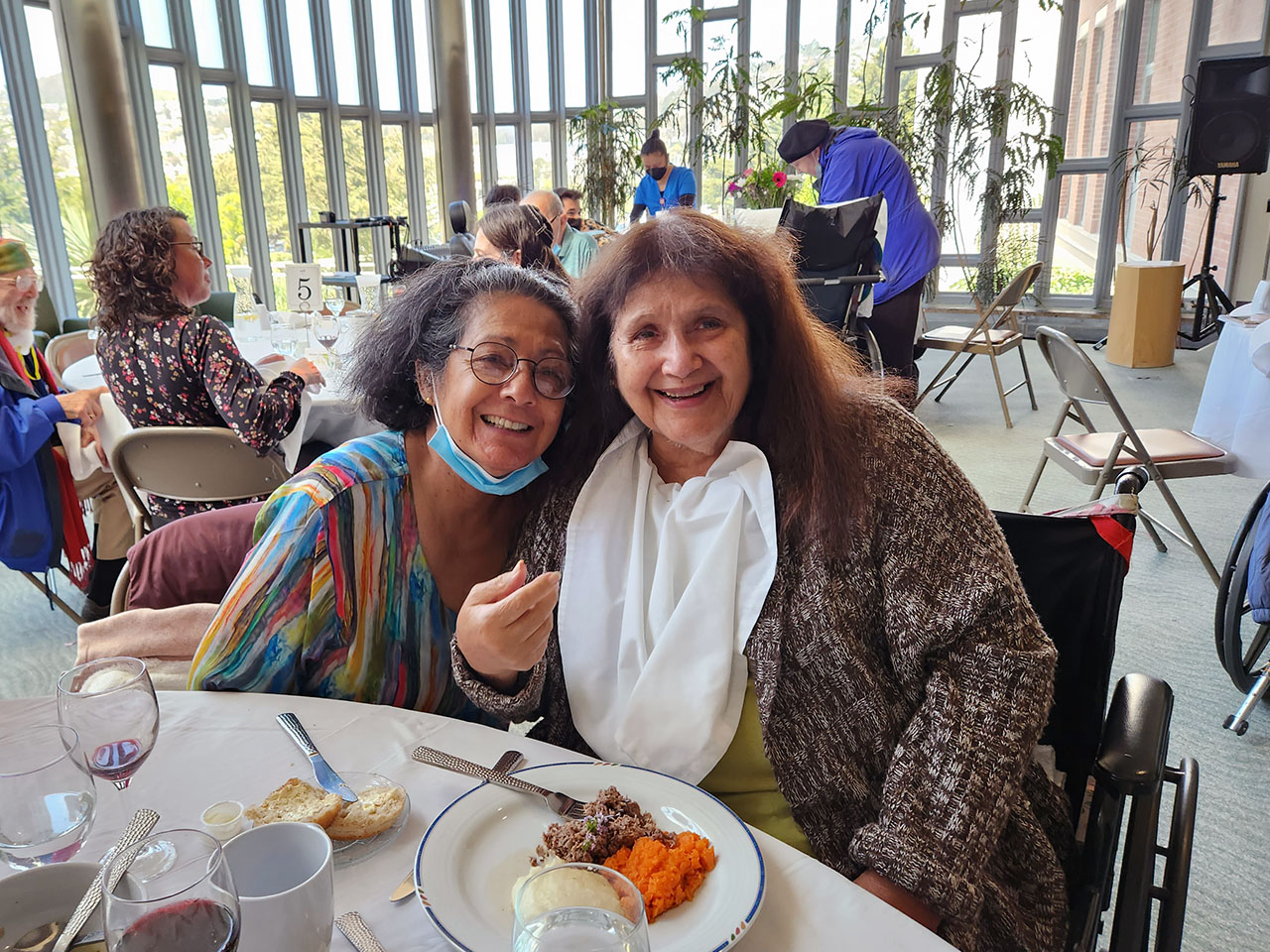
Last year, the two piloted a project seeking to help those with dementia access pieces of themselves by sharing memories of foods they love. Next month, they’ll bring the project to the San Francisco Campus for Jewish Living.
“It’s well known that art and music help and stimulate dementia patients in some form or other,” said Broder. “We’re also seeing that there’s a deeper tie to the inner workings of memory when you taste something.”
Their first “dinner party” took place in San Francisco’s Bayview District. (Bay Area author Peggy Orenstein wrote about it for the New Yorker.) They decided to base another round in the city too. Broder said thinking about food through a Jewish lens inspired the second location.
“Jewish holidays are often contained in the transmission of food,” said Broder, who like Bandler is Jewish. “The idea of food and memory profoundly go together.”
Ahead of the event, a handful of residents at the SFCJL will be interviewed about favorite food memories, with Bandler filming as each person talks about what certain dishes evoke. For the dinner party, the campus chef will make the dishes according to how the participants remember the recipes.
On Sept. 25, the evening after the dinner party, the public is invited to an installment of the SFCJL’s free “Reimagining How We Age” series to hear about Broder and Bandler’s project and to taste small portions of the chosen dishes. J. is a co-sponsor of the event, and I’ll be moderating a conversation with Broder and Virginia Sturm, a UCSF professor of neurology, psychiatry and behavioral sciences.
Residents of the campus come from many cultural backgrounds, and Broder and Bandler are capitalizing on that diversity. They recently traveled to San Francisco to select the participants, among whom are a Chinese woman who married an Italian man and an African American woman “who has generational views on mac and cheese,” Broder said.

“Sharing food is more about making a connection, as opposed to saying ‘remember when,’ because sharing food is active, and in the now,” Broder added. “In the making of it, there’s remembering. But in the giving of it to others, there is creating new memories, and that continuum is important. For people living with these conditions, to be at the center like that is very empowering.”
Broder, who is a playwright, actor, screenwriter and musician, has appeared in television series such as “Silicon Valley,” “The Morning Show” and, most recently, “The Patient.” His second play, “UnRavelled,” is about the connection between two creative geniuses, French composer Maurice Ravel and Canadian artist Anne Adams, both of whom suffered from advanced cases of dementia. While doing research for the play, he reached out to Dr. Bruce Miller, co-director of the Global Institute for Brain Health — at first writing him a fan letter.

It was after a conversation with Miller that Broder thought about how food and taste were sensory experiences, like music, that could possibly reach people through a different channel.
While there is no cure for dementia, Broder and Bandler believe there are ways to treat people with more empathy than now exists.
“Dementia takes people with it out of the center of their own story,” Bandler said. “They get disempowered, and the risk factors of their getting worse are isolation and feeling even more powerless.”
While this is only the second time the pair is putting on such a dinner party, they are planning events in other parts of the country and think the concept could easily be replicated by others.
“This is a low-cost, low-risk, high-impact intervention,” Broder said. “Everyone is eating anyway, and you don’t need fancy neurologists to do this. This is implementable by mindful midlevel practitioners.”
While the narratives around dementia tend to focus on “dread and doom,” according to Bandler, there can also be hope, joy, humor and connection.
“We’re not saying that the pain and suffering doesn’t exist,” Broder said. “But if we can fill the negative space with something beautiful, then it doesn’t have to be all anguish and dread.”