

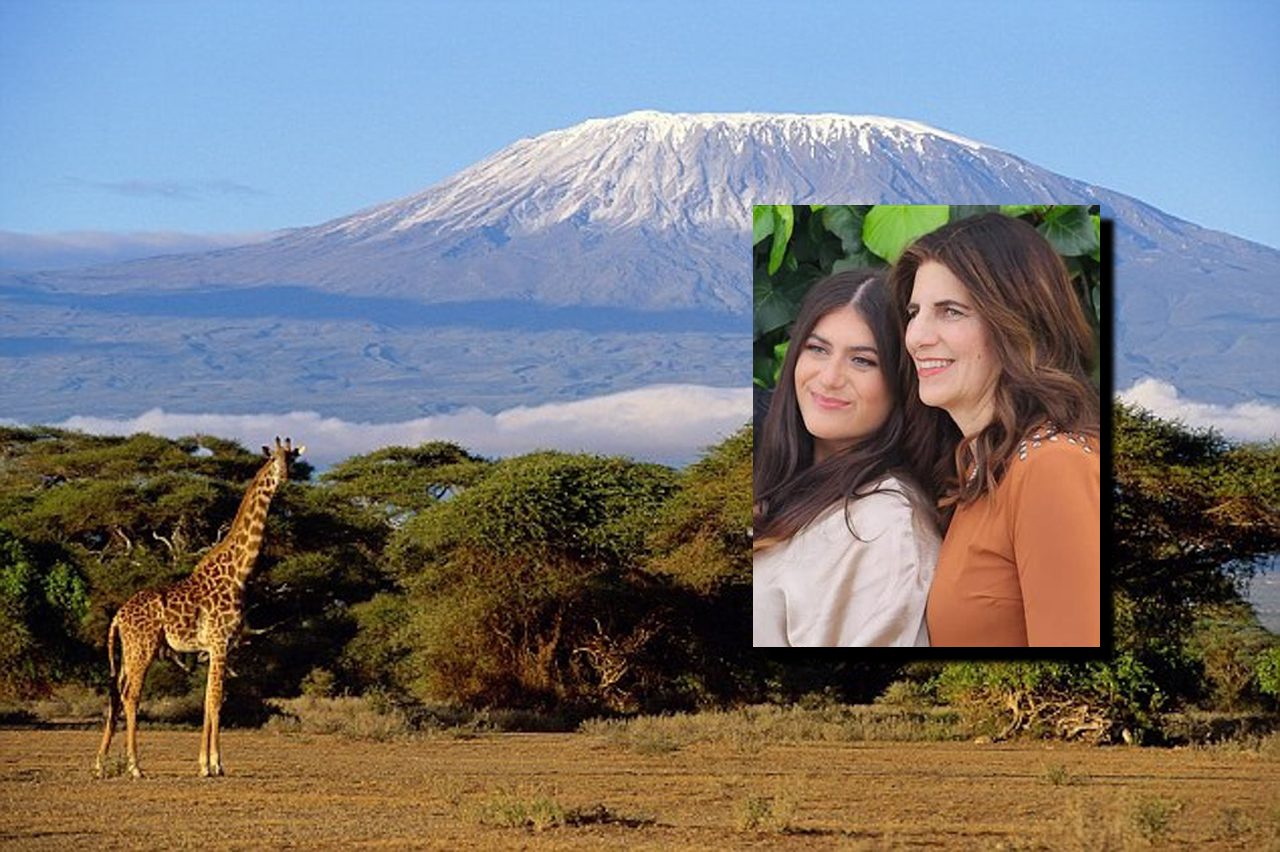
Miriam Ferris and her daughter Brachie are putting the “able” in charitable.
In December, the Berkeley-based rebbetzin and daughter are planning to climb Mount Kilimanjaro, the tallest mountain in Africa, to raise funds and awareness for Friendship Circle, a nonprofit serving special-needs children.
“We’re thrilled to be able to support this really meaningful cause,” Ferris, 66, said in a recent phone interview. “I’ve never been to Africa, and I said, ‘Maybe we can raise money for Friendship Circle and have a fun, interesting experience.’”
Mother and daughter hope to reach the summit, which at 19,341 feet above sea level is the tallest freestanding mountain in the world. It is a dormant volcano located in Tanzania.
Alongside her husband, Rabbi Yehuda Ferris, Miriam Ferris co-directs Chabad Berkeley, a Jewish center affiliated with the Hasidic Chabad-Lubavitch movement.
Their 20-year-old daughter Brachie, who was born and raised in Berkeley, now lives in New York.
The two are seeking to raise $15,000 for Friendship Circle, a Chabad-affiliated network of organizations serving children and teens who have special needs. As of Oct. 24, they had raised more than $3,700.
Ferris, a mother of 10 — Brachie is her youngest — said microdonations from her daughters’ friends, in amounts such as $18, have been “amazing.” Still, they have a long way to go.
“The fundraising is more of a challenge than the hiking,” Ferris said. “People want to rally, support a good cause, but you have to do the ask.”
The trip is scheduled for Dec. 8 to 19. In preparation, Ferris has been training locally, including on the Strawberry Canyon Fire Trail, a moderately challenging out-and-back 7.4-mile hike in the Berkeley Hills.
And while the altitude on the fire trail isn’t nearly as high as it will be on their Kilimanjaro climb, “it’s very steep,” she said.
Ferris attributed her concern about special-needs children to the teachings of Rabbi Menachem Mendel Schneerson, the late spiritual leader known as the Lubavitcher rebbe, or simply “The Rebbe.”
In the 1970s, in an ongoing correspondence with a child-development physician, Schneerson spoke about the importance of nurturing the relationships of special-needs children with Judaism.
Children with intellectual challenges shouldn’t be thought of as handicapped but as “special,” Schneerson contended. Synagogues and schools ought to be accessible to children with disabilities. And by exposing them to the practice of doing mitzvot — such as waving a lulav on Sukkot or giving tzedakah — special-needs children can engage with Judaism, their community and the world.
“These kids are very much part of the Jewish people, and we need to be as inclusive as possible,” Ferris said.
While Friendship Circle chapters operating in large Jewish communities primarily serve Jewish children, others cater to more diverse populations. The Palo Alto–based Bay Area Friendship Circle has programs designed exclusively for Jewish children, as well as some intended for children of all faiths.
“From a kids and special-needs standpoint, we have kids from everywhere, from all backgrounds,” said Ezzy Schusterman, executive director of BAFC. “As for volunteers, we have a large group of Jewish volunteers, and we have other volunteers who aren’t Jewish.”
Friendship Circle says on its website that the words of Schneerson inspired its mission. One of its main programs is to partner teens in the Jewish community with special-needs kids, cultivating lasting bonds between them.
Ferris — who has a grandchild with special needs — said Friendship Circle’s focus on providing a social outlet for special-needs children is invaluable.
“With special-needs kids today, they’re getting a lot of therapy, there are schools. But one thing that’s missing is true friendship,” she said. “As they get older and have a certain level of self-awareness — and we know a lot of kids in our community in this situation — they need a friend. That’s the foundation of Friendship Circle. That’s why it started.”
Brachie was introduced to Friendship Circle while attending an observant high school in Los Angeles, where volunteering in a local chapter’s Hebrew school showed her the importance of the mission.
“The kids would feel like they had a family and home and friends in a world where they could feel pretty isolated,” Brachie said.
When she found out about her mom’s desire to hike Kilimanjaro, she jumped at the opportunity. “This is so cool,” she told her mom. “You’re 66, I’m 20, I’m the youngest daughter. This would be so revolutionary. We should do this.”
The Ferris women won’t be hiking alone. They’ll be joined by other female climbers from around the country who are likewise raising funds and awareness for Friendship Circle. Professional guides will be accompanying them, providing kosher meals and snacks, as well as lodging, a pre-trip training plan and transportation.
They’ll ascend on a route that takes them though “cultivated farmlands … lush jungle, [an] alpine meadow and finally across a barren lunar landscape to the summit of Kibo,” the Friendship Circle website says.
Kibo is the highest of Kilimanjaro’s three peaks. The ascent will take six days, including a Shabbat devoted to rest and acclimating to the altitude. Oxygen tanks and equipment such as ropes, crampons and harnesses are not needed, although altitude sickness near the summit can occur if one doesn’t acclimate properly. The descent takes one day.
Among other preparatory guidance, Friendship Circle organizers have noted that it’s never too early to start wearing a pair of comfortable hiking boots.
“You know how it is with new shoes,” Ferris said. “They have to be broken in.”
To support or learn more about the Ferris’ campaign, visit their Women’s Kilimanjaro 2024 page.