

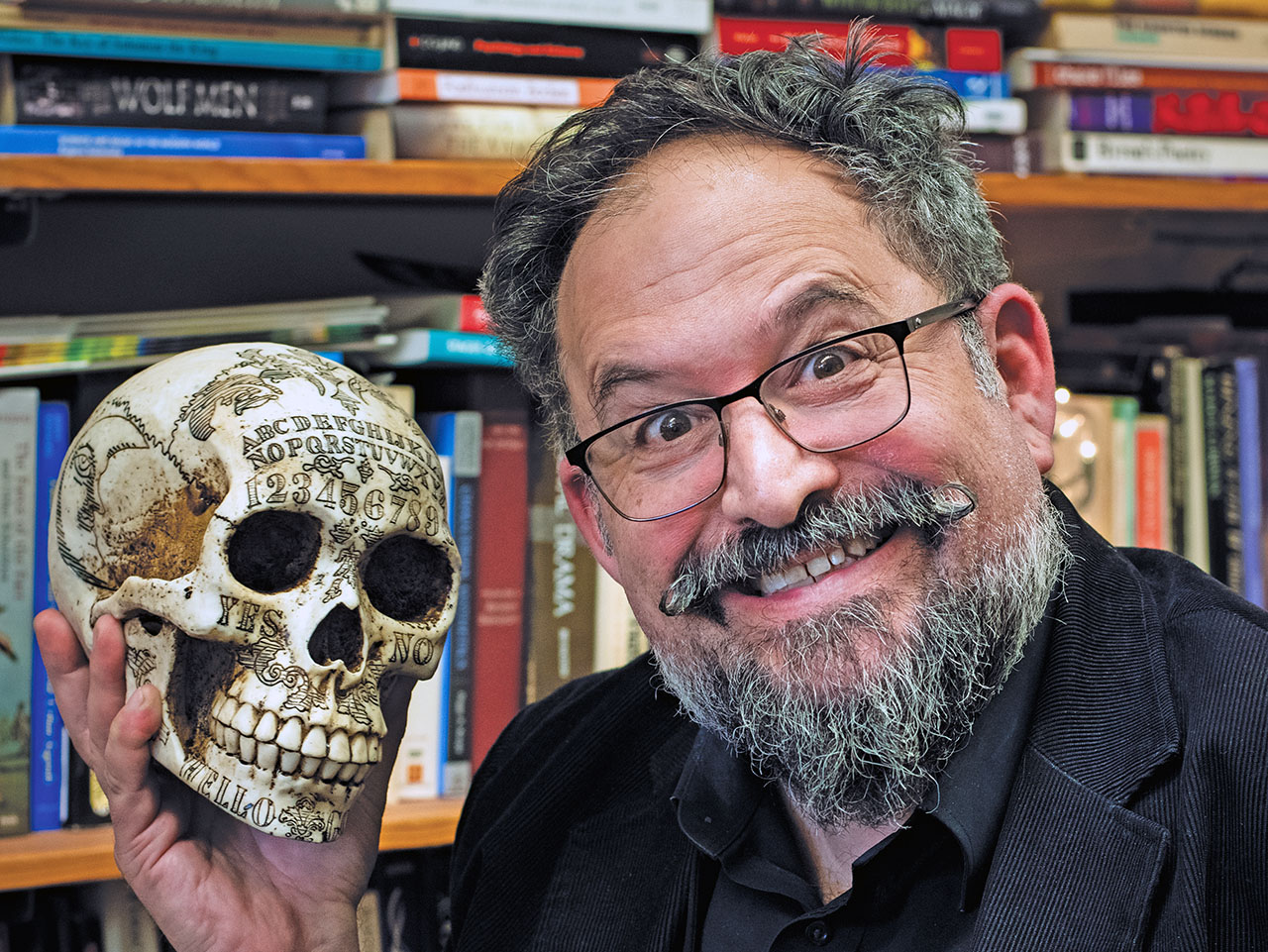
A theater historian and author, Michael Chemers, 53, founded the Center for Monster Studies at UC Santa Cruz in 2021. His books include “The Monster in Theatre History: This Thing of Darkness” and the newly published “The Figure of the Monster in Global Theater,” co-edited by Dartmouth theater scholar Analola Santana. On Oct. 16-18, he ran the annual Festival of Monsters at UCSC, an academic conference that, according to its website, “explores the way that monsters and tropes of monsters pervade our culture.” He is also a UCSC professor of dramatic literature and co-host of the podcast “The Show Where They Talk About Monsters.”
J.: What is the Center for Monster Studies? Is it really a thing?
Michael Chemers: We are, to the best of my knowledge, the only center for monster studies in the world, established in 2021 as a research hub specifically to advance scholarship on monsters. Our main function is to throw this conference every October that brings in scholars from all over the world to Santa Cruz to engage with one another and create a community of weirdos.
Is this a new interest among scholars?
Anthropologists and cultural critics and psychologists and philosophers have been interested in monsters for a long time, but the field of monster studies as a discrete realm of inquiry really dates back to 1996 with the publication of “Monster Theory,” a collection of essays edited by Jeffrey Jerome Cohen. He [describes] monsters as texts that can be read backwards to uncover the anxieties and also hopes and visions of the societies that create and sustain them.
The monster is almost always part of a process of the creation of an exclusion identity; the monster represents some form of deviance from the norm which is considered hostile and dangerous to the authorities, who can’t allow the deviance to happen because it’s a violation of their own mythic foundations. And then what you do is you take the monster that you’ve created and you map it onto a real person, and that sets you up to legitimize atrocities against that person.

So monsters have to do with marginalization?
Yes. This is obviously a central concern for Jewish scholars, because Jews have been made monsters of since the dawn of time — well, since the dawn of Judaism. I think the Jew is always already monstrous in popular culture, right? And that never quite seems to go away. We’ve enjoyed a period here in America of some safety and security against antisemitism, but those tropes are coming back now with a vengeance, and so I think there’s a reason why a lot of the more prominent folks in monster studies happen to be Jews.I think it’s because this resonates with us a lot.
You have written about how you became interested in monsters as a boy, when you were bullied for being, as you wrote, “dark, pudgy and nosed” surrounded by “blond, blue-eyed, slender Mormons.”
I was born and raised in Salt Lake City in the ’70s and ’80s, and that was a very strange place to be a Jew, because the dominant culture that had a stranglehold over all social life in Salt Lake City, and in Utah in general, was the Mormon Church, which has a very fraught relationship with Judaism. It says in the Book of Mormon that the only reason that Jesus was incarnated as a Jew was because only the Jews were wicked enough to destroy their own savior.
But don’t Mormons idolize Jews and Judaism?
They idolize certain aspects of it and they despise certain aspects of it. So when you have that kind of contradiction, that’s a great place for monsters to appear. And so for instance, when I was a child, I was asked on multiple occasions by my fellow classmates where my horns were.
I did not realize as a child that there was an aspect to this monsterization that I was experiencing that wasn’t personal. It was about antisemitism. But I thought it was about me personally. And so I very much internalized the monster in this period. That sounds depressing, but it’s actually not because it gave me a lot of power. As we said before, if you map monsters onto people, that legitimizes atrocities against them, but if you look at the monster and see yourself, you’re actually on the cusp of some very exciting psychological, maybe even spiritual, self-development.
What can you tell us about the golem, the most well-known Jewish monster?
The golem is a very important monster for Jews. It may date back in Jewish folklore as far as the eighth century. The golem usually appears in folklore as sort of a comic character. He’s commanded to fish, and he fishes all the fish out of the river. Or he’s commanded to dig a well, and he digs all the way through the earth. He’s a tool, but he’s a dangerous tool.
Eventually in these stories he is called upon to resist a pogrom, and when he does so, he keeps killing, and he has to be stopped by the rabbi who created him. In the 1900s the golem really emerges as a protector of the Jewish people, and this co-emerges with a rise in antisemitism, particularly in Eastern Europe.

But I think that the emergence of the golem as a really powerful, prominent monster in Jewish writings in the early 1900s actually owes a lot to stage adaptations of Frankenstein in that period, which were very, very popular. Sometimes the rabbi who creates the golem, usually Rabbi Judah Loew, the Maharal, uses the same kinds of language that [Dr.] Frankenstein, the creator of the monster, uses in some of these plays.
You are a theater historian, and you write about your interest in monsters from that viewpoint, as well.
I’m particularly interested in the Habima [theater troupe], which emerged in Moscow in the ’20s during a period of time when the Bolsheviks were encouraging ethnic theaters. Habima was very famous for writing and producing three plays: “The Dybbuk,” “The Eternal Jew” and “The Golem,” which was less famous.
“The Golem” is incredibly deep, a very powerful meditation on righteousness and the importance of and difficulty of ethical behavior in a world that doesn’t seem to respond to ethical behavior. The play was performed all over Eastern Europe, where sometimes it was received very well and sometimes it was received very poorly. Habima got out of Russia just before the crackdowns on Jews, and they wound up in New York, but they couldn’t get an audience for their play in New York because it was too depressing. The Jews in New York wanted to see plays with happy endings. They ended up in Israel, where they are today, but the Israelis also didn’t know what to make of “The Golem,” either. The critics didn’t, but the people loved it.
What is your next book project?
Analola Santana [of Dartmouth] and I have a a book coming out in a year or so called “Monstrous Utopias,” in which we explore the possibility that one of the reasons monsters are emerging so much in our culture nowadays is because there’s a sense that these are the end times. With the political chaos and the environmental degradation, particularly my students, I think, are extremely worried.
There’s a notion that the way to solve this problem is to become different, to take on a new identity. And those identities could be monsters. I think that has been showing up in our culture, for example in the Twilight saga and [Anne RIce’s] “Interview with the Vampire,” stories in which we are encouraged to identify with the monster rather than with the monster hunter.