
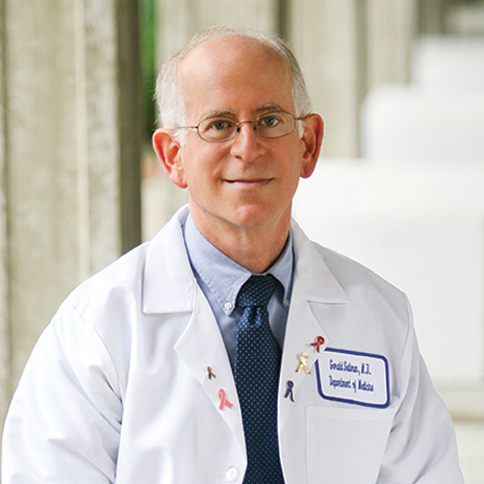
I began volunteering at the Samaritan House Free Clinic several years before I retired. I recall one of my first patients, “Martha,” presented with symptoms of anxiety. She had worked as a nanny in New Orleans, and when Hurricane Katrina hit in 2005, the family she worked for lost their home. Martha was destitute and migrated to San Mateo County, where Samaritan House (which has locations in San Mateo and Redwood City) provided her with food, clothing and shelter.
Martha was having unremitting symptoms, which her previous doctors assumed were due to anxiety. Martha was losing weight, though, and this concerned me. I ordered a CT scan of her abdomen that revealed a rare kind of tumor hiding in her small intestine called a carcinoid. This particular tumor releases chemicals that induce symptoms of anxiety and can be deadly if not caught in time.
When I told her the diagnosis, Martha bounded off the exam table and hugged me — bursting with emotion not because she had a cancerous tumor, but because she finally had a diagnosis.
It was the only time in my career that someone hugged me after being informed of cancer. I think I was the only doctor who had seriously listened to her.
San Francisco General Hospital internist Dean-David Schillinger’s recently published “Telltale Hearts: A Public Health Doctor, His Patients, and the Power of Story” makes the case for truly listening to patients’ stories.
In it, Dr. Schillinger writes of posing a question to his medical students: “Which medical tool or procedure do you believe saves the most lives?” The correct answer is the medical interview. He writes that in his own practice, “I have had to learn again and again the lesson that in the story lies the answers. And not to make assumptions.”
One day “Lucy,” a woman in her 40s, appeared in the Samaritan House Free Clinic with swollen legs. She was tall and slim and wore a skirt to show me her legs, which were swollen up to her knees. Both of her parents had died of heart disease, and before they died, they had swollen legs.
It was understandable why Lucy was worried.
She denied that she had any chest pain, shortness of breath or fatigue that would suggest a heart problem. I wondered what was causing her leg swelling. Intuitively I felt I was missing something important about her. But what was it? Had something happened to cause her swollen legs?
I looked further into her story: She had a job as a food preparer that required her to stand all day. When I asked her to describe her living situation, she hesitated and then disclosed that she lived in her car.
When she described her small Lexus sedan, I tried to picture her inside it, and the mental image was unsettling. There was no way she would be able to stretch out her legs, let alone elevate them. It was apparent that she had a medical condition called venous insufficiency.
The veins in our legs carry blood back to the heart. If the valves in the veins fail, or if calf muscles are tired and overwhelmed, blood pools in the legs and causes swelling. Because a patient can have more than one diagnosis, I ordered an EKG and blood and urine tests to exclude other causes of leg swelling. All of these test results subsequently returned normal.
Contrary to the common stereotypes of unhoused people, Lucy was not mentally ill and did not have a substance use disorder.
But, unlike Martha, Lucy was a casualty of an unnatural misfortune: low wages and unaffordable rent.
“Social marginalization can generate illness,” says Dr. Schillinger, who has spent his career taking care of indigent patients in San Francisco. Inequities and discrimination in society are indeed reflected in health consequences.
I advised Lucy to wear support stockings while she stood at work, and I demonstrated calf exercises that could help propel blood back to her heart. Most importantly, I urged her to contact her Samaritan House case worker to find housing — because what she needed most of all for her condition was a bed.
As much as I would like to know what happened to Lucy, she did not follow up with me. I think that once I reassured her she did not have heart disease, she may not have felt motivated to return. I’d like to believe her leg swelling was resolved when she obtained a bed to rest her legs.
As Dr. Schillinger illustrates in his book, and as I point out here, asking the right questions and listening to the answers are truly a doctor’s most important diagnostic tools — and something patients should always expect in their medical encounters.