
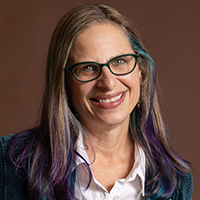
Hamze Awawde grew up in the early 1990s in a village near Hebron in the West Bank, during what he calls the “Oslo years.”
At the time, “I was very scared, not only of Israelis but of Jews,” he said. “All the soldiers and settlers I saw had guns, and I understood that at any moment they could kill me.”
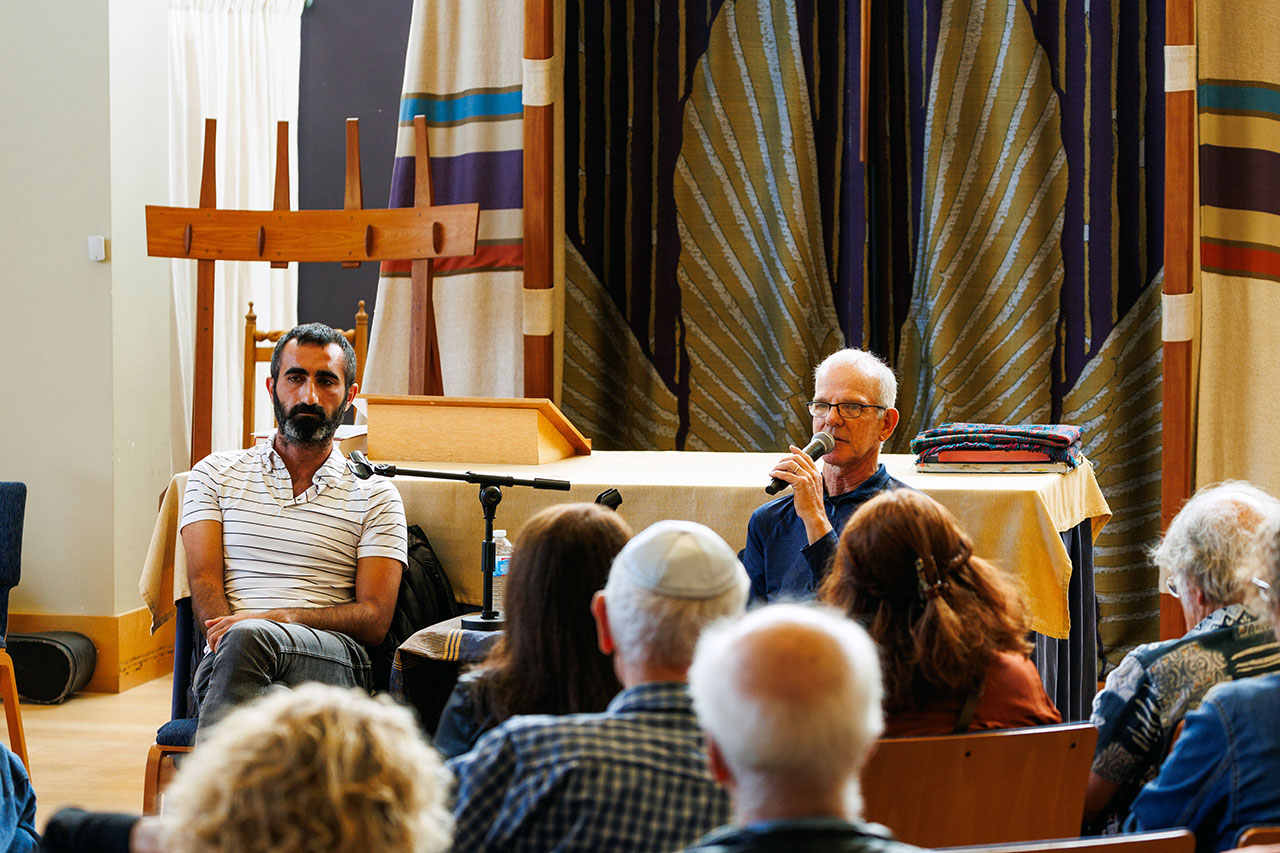
Awawde, 34, appeared on Oct. 27 at Berkeley’s Congregation Netivot Shalom. Since the start of the Israel-Hamas war, he has been living in Italy with his Italian ex-wife and their son; he said his main priority is keeping his child safe. He was on a speaking tour around the Bay Area supported by Standing Together, a grassroots group of Jewish and Palestinian Israelis that seeks to resolve the Israeli-Palestinian conflict, including an end to Israel’s occupation of the West Bank. It also works on issues such as economic equality, affordable housing and climate justice.
Awawde’s grandfather had been an official in the 1970s with Fatah, a political party within the PLO. But when the Oslo Accords were signed in 1993, and it seemed that peace between the two peoples could truly be on the horizon, his father, an entrepreneur, began doing business with Israelis.

“As a teenager, I didn’t like my family’s pragmatic views,” he said. “I wondered why my father speaks to Israelis, as they all want to kill us. I couldn’t understand it.”
When Awawde started college, he began reading about other world conflicts. He came to realize that “your enemy is not just one voice,” although it took time, as “all I knew about Israelis was informed by my own trauma.”
In a Raw podcast interview this summer, he said that for a Palestinian under occupation, it isn’t natural to be a bystander and that the impulse is to fight against it. Once he began meeting regularly with Israeli Jews, though, he saw that there would never be a solution through violence.
In the months before the Oct. 7 Hamas massacre in Israel and the subsequent war, Awawde was on the staff of a summer camp in San Diego called Hands of Peace that brought together Israeli and Palestinian youths. After returning home to the West Bank, he said his car was stopped by three Israeli soldiers who held their guns to his head in a case of mistaken identity. One told him: “If you wouldn’t have stopped, I would have killed you.” He left for Italy with his son shortly after.
When the current war began, Awawde was terrified for Gazans, but it also personally affected him in a different way, he said. Among the 1,200 killed and more than 250 kidnapped from Israel on Oct. 7, a few of them were his friends.
His desire to talk about his story — especially so often and to so many groups — came from those contradictions he lives with, he said. Initially, he was inclined to do nothing. But then he saw a television interview with Maoz Inon, an Israeli Jew. Both of Inon’s parents were murdered on their kibbutz on Oct. 7, and yet he was still taking every opportunity he could to articulate the need for peace.
“At first, I wanted to take a step back and not be involved, as it’s so painful,” Awawde said. “But then I realized that by being elsewhere, I can say things that people can’t say from [the region].”
Awawde was joined at each Bay Area appearance by one of three local Israeli expats. At Netivot Shalom, it was Itzik Goldberger, a former kibbutznik who lives in Lafayette. He has lived in the Bay Area for over 30 years since attending the Stanford Graduate School of Business.

Goldberger is involved locally with the liberal Israel advocacy group J Street and explained his evolution.
His first exposure to Palestinians was with workers on his kibbutz. Out of personal interest, he studied Arabic and Islam. He served as a military officer during the Yom Kippur War.
“Over 2,000 people my age gave their lives for the fantasy of the rulers of that time” in 1973, he said. “We grew up with the narrative of ‘no choice wars,’ to justify the price we had to pay. Ever since then, I’ve been very sensitive to this question of the Israeli narrative.”
Goldberger said that he began studying the Palestinian narrative out of curiosity and then taking opportunities to meet with Palestinians in the Bay Area.
“Whatever we think is correct, the other side has the completely opposite view of the world,” he said, adding that the truth almost always lies somewhere in the middle.
As for specific solutions, that was tougher. Awawde called for a cease-fire in the ongoing war and the return of the 101 hostages still in Gaza. Both men reiterated in different ways the need for understanding between both peoples and said that security will remain elusive unless everyone can live in safety and with dignity.
“There needs to be a just, peaceful solution, where Palestinians are seen as equal and their rights and connection to the land is acknowledged,” Awawde said. “Without that, there will always be violence.”