
A word to the wise. If Saul Dreier shares an idea that sounds outlandish, get out of his way.
For instance, no one thought that starting a band of fellow Holocaust survivors on the cusp of his 90th birthday made sense.
Not his wife. “She said in Jewish, ‘That’s meshuggah,’” he recalled.
And not his rabbi. “He said, ‘Saul, you’re almost 90 years old. You’re retired. Why do you need this? You’re crazy,’” Dreier said on a recent phone call between errands near his Florida home in Coconut Creek, about 40 miles north of Miami.
Precisely because these closest advisers told him it was crazy, he decided to do it, as he recounts in a 2020 documentary film by Tod Lending.
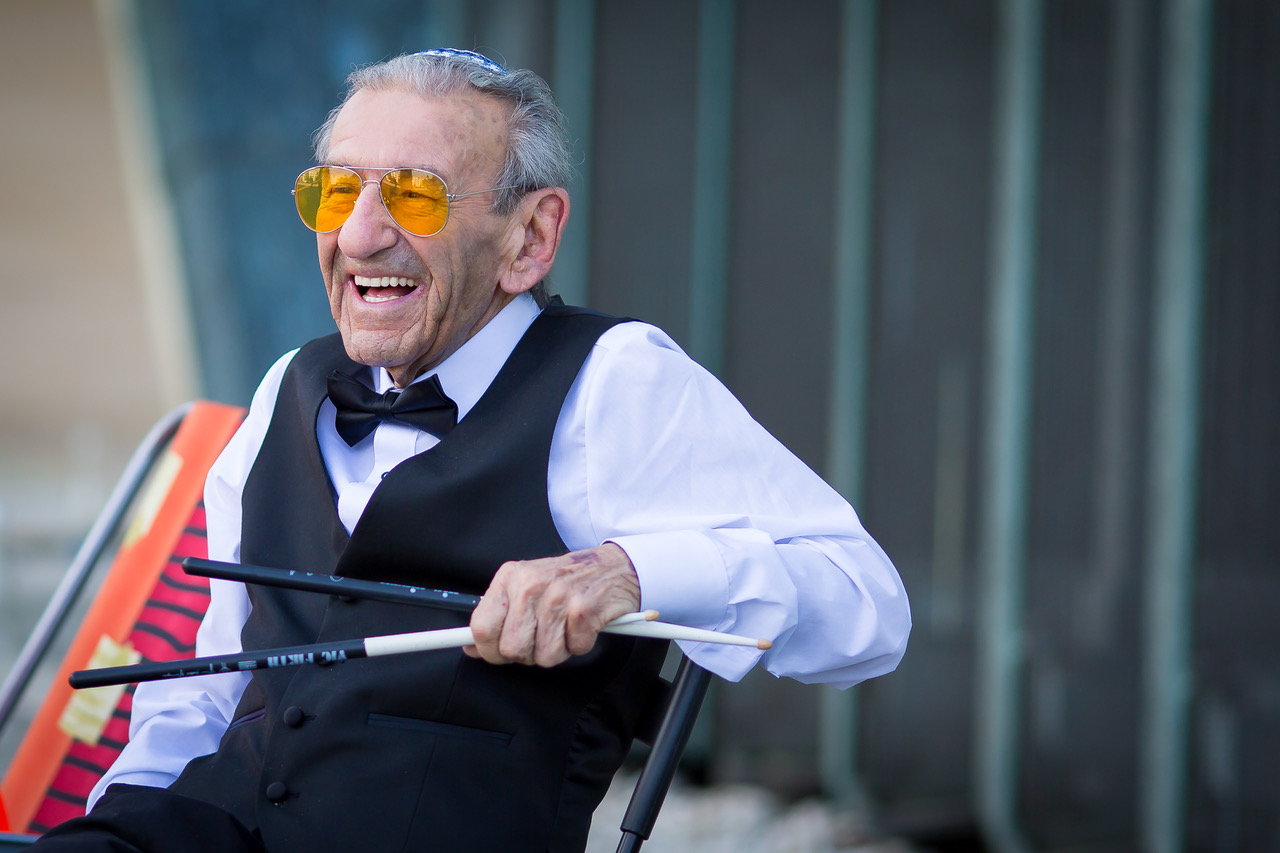
Still irrepressible at 99, Dreier has proved his wisdom in following his own council. Acquiring a drum kit, he launched the Holocaust Survivor Band, a group that has entertained and educated thousands of people around the country with a repertoire of klezmer music, Hasidic melodies and liturgical themes interspersed with harrowing tales from the dark years of the Shoah.
Later this month, Dreier will perform around Northern California with a klezmer combo led by Israeli-born clarinetist Asaf Ophir, who now lives in the Bay Area. The concerts, organized through Chabad centers and billed as “Survival Through Song,” are set for Nov. 18 at the Morgan Hill Community and Cultural Center in Morgan Hill, Nov. 19 at Cabrillo College in Aptos and Nov. 20 at Chabad of the Tri-Valley in Pleasanton.
The initial inspiration to form a band came when he heard about Czech-born Israeli classical pianist Alice Herz-Sommer, a Holocaust survivor who played daily almost until her death in 2014 at the age of 110.
“She was a piano player in Theresienstadt,” Dreier said, referring to the concentration camp in German-occupied Czechoslovakia that the Nazis used as a front to convince international organizations like the Red Cross that prisoners were treated well. “When she passed away, I thought I’d like to play in her honor.”
Like Herz-Sommer, who said that “music saved my life and music saves me still,” Dreier has found new motivation and meaning in his late-blooming passion.
“Without music I wouldn’t be alive today,” he said.
One reason he faced resistance from his wife and rabbi was that Dreier hadn’t laid down so much as a triplet or a paradiddle for six decades. Though his father was a musician who played saxophone, clarinet and piccolo, Dreier didn’t do any performing until he was in the Plaszow labor camp during the war repairing radiators for Germans planes in a factory run by Oscar Schindler. A close friend, a cantor, led some men in liturgical song sessions after a shift, and Dreier procured two metal spoons to accompany them on make-shift percussion.
He was later sent to the Mauthausen camp and then to the Linz camp where labored as a welder in the Haubwergstate factory. After the war, he spent years in a displaced persons camp in Italy, where young people passed time by singing. Eventually a truck delivered a piano and a set of drums.
“An English officer said ‘I’ve got two instruments. Who plays piano?’ and maybe a dozen volunteers put up their hands,” Dreier said. “‘Who plays drums?’ Everybody sitting quiet. I said, ‘I would like to play the drums,’ and I started to learn how to play. But when I came to America I didn’t play for 60 years.”
With the death of Herz-Sommer, who was thought to be the oldest Holocaust survivor, Dreier knew he wanted to do something to honor her and other survivors. But even in crossing the first item off his list, buying a drum kit, he faced skepticism.
At a local Sam Ash music store, his back and forth with the manager went like this: “‘I’d like to buy a set of drums.’ ‘What are you going to do with them?’ ‘What do you care? Play them.’ ‘But you’re an old man.’ ‘Yes, but I’ve got fresh money.’”
They managed to fit the drum kit into his car. When he arrived home, he coaxed his wife, Clara, downstairs by telling her he’d got her a present. She wasn’t pleased. “‘Gevalt! Either you go or the drums go.’”
It didn’t take long for Clara, who passed away in 2016, to relent and let him bring the drums into the house. He hasn’t skipped a beat since, performing around the world, raising awareness about Holocaust survivors and their experiences, and racking up numerous news stories and the 2020 documentary, which can be streamed for free on Amazon.
Still, most of the bandmates he recruited have passed away as the population of Holocaust survivors dwindles.
“We’re dying every day,” he said, even as the energy and strength of his voice suggest that he’s sticking around for a while. He was still buzzing from the gig he played the night before.
“I always play a couple of Hasidic tunes, but this was a Conservative place and we played ‘Avinu Malkeinu’ that I changed. I was conducting a nine-piece orchestra, so I turned my back to the audience and when we finished the song and I turned around, the whole congregation — 350 people — was crying.”
Saul Dreier of the Holocaust Survivor Band
7 p.m. Nov. 18. Morgan Hill Community and Cultural Center, 17000 Monterey Road, Morgan Hill. $15. Advanced registration required.
7 p.m. Nov. 19. Cabrillo College’s Samper Recital Hall, 6500 Soquel Drive, Aptos. $25-$54, free for students.
7:30 p.m. Nov. 20. Chabad of the Tri-Valley, 3370 Hopyard Road, Pleasanton. $25.