

Ziv Frailich, 36, saw his mother’s murdered body on a Hamas video, lying dead alongside other older kibbutz members right outside her front door.
Hila Rabinovich Escapa, 31, shivered alone in her safe room with her puppy before being evacuated on foot through terrorist gunfire, 11 hours after the Hamas attack began.
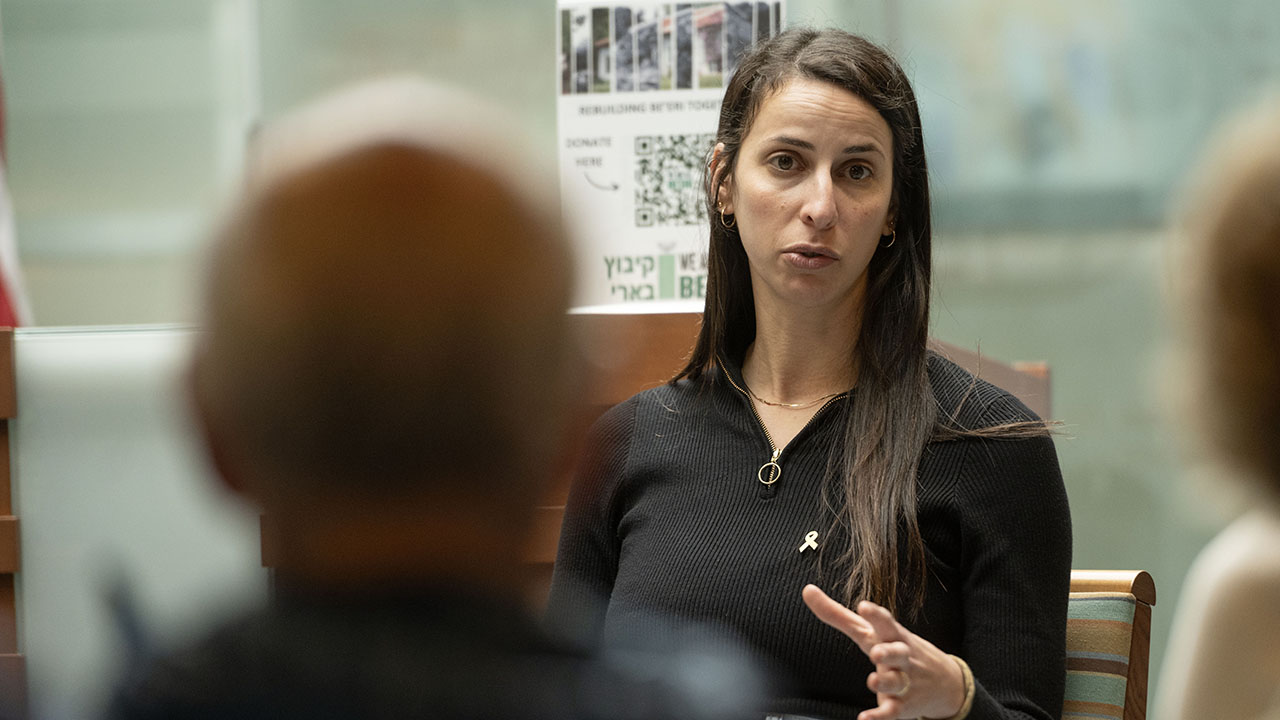
The two members of Kibbutz Be’eri told their stories Monday at Peninsula Temple Sholom in Burlingame, their first stop on a six-day speaking tour of the Bay Area. They are part of a seven-person delegation from Be’eri visiting D.C. and California this month to thank American Jews for their help after the brutal Hamas massacres of Oct. 7, 2023; to cement relationships between the diaspora and their kibbutz; and to collect “partners in reconstruction and rehabilitation,” as they put it, as the 1,100 or so surviving members try to put together their shattered lives.
“Oct. 7 is over, but we are struggling with so many things,” Escapa told the Burlingame audience. “Each of us left [that day] with nothing. I had shorts, a shirt and a dog leash. We have to rebuild from the ground up.”
Kibbutz Be’eri was established in 1946, one of the first Jewish settlements in the Western Negev. On the morning of Oct. 7, it had 1,200 members and was the largest, most prosperous kibbutz in the region. It was also two miles from the Gaza border, and the first Israeli settlement attacked.

In the early hours of Oct. 7, 600 Hamas terrorists infiltrated Be’eri, on foot, by motorcycle and in trucks. They murdered 102 residents, nearly 10 percent of the population, and took 31 hostages. Ten are still being held, although just three are believed alive.
Be’eri was ground zero for the Hamas attacks that day, which also wreaked destruction on the kibbutzim of Kfar Aza, Nahal Oz, Nir Oz and Kissufim, and the cities of Sderot and Ofakim. More than 250,000 Israelis were displaced from both the Gaza envelope and Israel’s northern border with Lebanon. Many have since returned home, but tens of thousands are still in temporary housing, including most of the residents of the hardest-hit southern kibbutzim.
Escapa was born and raised in Rishon LeTzion, just south of Tel Aviv. She followed her fiance, Tuval, to the kibbutz two years ago. They were planning a November wedding last year, and the night of Oct. 6 he was away for his bachelor’s party. She was alone when the sirens went off around 6:30 the next morning.
“I took my dog, and we went into the safe room,” she said. At 7:30 a.m., she began to hear gunshots nearby. “I’m not from the kibbutz, I didn’t really know what to do. I sat on the floor and tried to keep silent. I was terrified for my life.”
She didn’t know it at the time, but the kibbutz’s 10-man security team was facing off against the hundreds of infiltrators. Six of the 10 were killed, but they saved many of their neighbors, giving them precious time to get to their safe rooms.
Frailich was born and raised at Be’eri, a second-generation kibbutznik. “I love my kibbutz,” he said. “It was the best place to grow up. No one locked their door, it was so safe. Everybody knew their neighbors. It was a real heaven, a beacon for the whole area.”

He and his former girlfriend were in his home when they heard the first bombs, which hit even before sirens sounded. He remembers thinking that wasn’t normal. His house was just a few yards from the kibbutz perimeter. He heard shots from automatic guns that he did not recognize as IDF weapons.
Then he saw an Egyptian-made motorcycle go by, carrying two men in full combat gear. They had AK-47s and a rocket-propelled grenade, or RPG. Frailich realized the kibbutz was under attack. He and his girlfriend holed up in the safe room, turning off the AC, the TV and anything else that might indicate people were home.
“Hours passed,” he told the audience. “I remember thinking, where are the helicopters? Where is our army? All we heard was shouting and laughing in Arabic, like it was a festival.”
Frailich got his gun, loaded it, and told his girlfriend that if one terrorist entered the house, he would kill him. If more than one came, he would fight them outside on the doorstep. “I told her, the last two bullets are for you and for me. We will never walk into Gaza.”
Around 1 p.m. an IDF contingent reached the kibbutz and began evacuating residents. Escapa recalls fleeing on foot, dodging gunfire all the way to the kibbutz entrance, where a truck was waiting to evacuate people. Frailich was there too. He didn’t want to leave without his mother, who lived near him, but the truck was going, and they all got on.
Outside the kibbutz, all they saw was death. Dead soldiers, dead terrorists, burned cars, burned fields. “It was like the apocalypse,” Frailich said.
Later that day he saw a Hamas video of his mother being led away, barefoot, her hands behind her back. The next day, he viewed the video of her body lying alongside several of her murdered comrades, all people in their 60s and 70s.
The 1,100 survivors from Be’eri were moved to a hotel on the Dead Sea, where they remained for 10 months, traumatized, with nothing of their own. The first few weeks were the hardest, Escapa said; they had to organize 80 funerals, sometimes six a day. Just about every family lost someone.

In September, some Be’eri residents began moving into government-built temporary housing at Kibbutz Hatzerim, near Beersheva. About 150, including Escapa, returned to Be’eri, living in homes that had not been destroyed. When actual reconstruction begins, they will have to leave. Everything has to be rebuilt.
Most of the kibbutz members want to return to Be’eri, Frailich and Escapa said, despite the horrors they lived through. A minority probably will not return.
Reconstruction of the kibbutz will take from three to five years. But those are just the buildings. How will they rebuild the close, idyllic community they once had? Who will put back together the shattered psyches, heal the wounds that can’t be seen?
“We want to go back, despite everything,” stated Escapa.
Frailich pointed out the vital importance of resettling the Gaza border region, and as soon as possible. “If there is a vacuum, it will be filled by something,” he stated. “If there is no Kibbutz Be’eri, there is no Tel Aviv, and there is no Israel.”
The government will shoulder much of the rebuilding cost and has already provided therapy for kibbutz members. Be’eri’s current fundraising goal is $65 million, Frailich said. Hence this mission to the U.S.
Above all, the two said, they are here to thank the American Jewish community for its tremendous financial and emotional support. As of July, the Jewish Federations of North America had raised $833 million in emergency aid for Israel and allocated $433 million of that to 520 Israeli NGOs.
Of course, the two survivors are also in the U.S. to raise money, but they say making human connections with American Jews is foremost. “We are one people,” Frailich said.
“My mom came from Morocco at age 3,” he said. “She was so positive. She always told me, ‘Ziv, live your life. Make it meaningful.’ If she were here now she’d say, ‘Ziv, rebuild your life, rebuild the community. Don’t give up.’
“That’s why I’m here, to tell you we are continuing. They didn’t destroy us.”
Contributions to Kibbutz Be’eri’s reconstruction may be made via “Be’eri Will Thrive Again.”