

It’s time to play offense in the battle against antisemitic and anti-Zionist propaganda, panelists said Sunday at the annual Z3 Conference in Palo Alto.
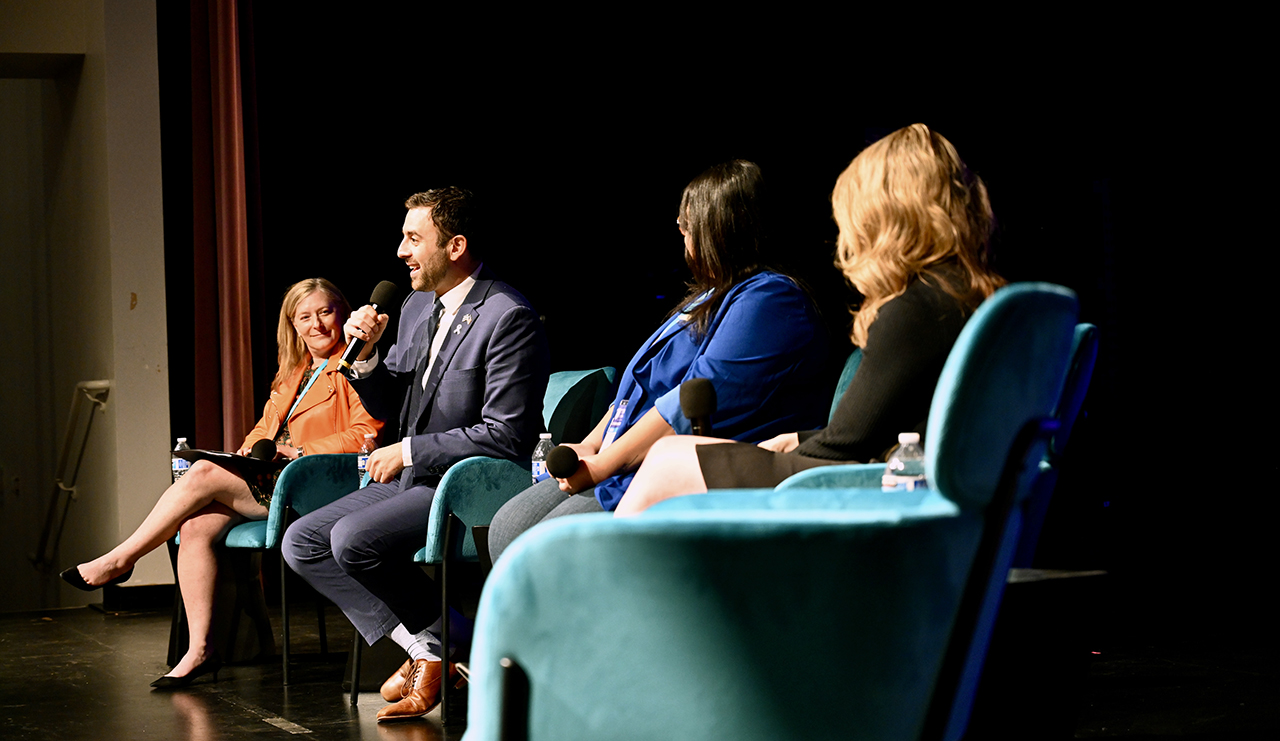
The panel, moderated by J. staff writer Emma Goss, was titled “Why are the People of the Book Struggling to Tell a Story?” included Amy Albertson, a social media influencer, Marnie Black, a public relations professional, and Eylon Levy, a former spokesperson for the Israeli government.
They discussed finding new ways to fight hate by arming Jews with a brave, proactive mindset, combating lies with truth and recasting the image of Jews, Judaism and Israel in the public imagination.
Albertson, a Chinese American Jew who has nearly 39,000 followers on her Instagram account @theamyalbertson, said she believes that antisemitism comes from both ignorance and misinformation.
“We have to be proactive storytellers, not in reaction to what people are saying about us. But what do we want to say about ourselves?” she said.
Albertson, who considers herself to be on the front lines of combating antisemitism and stark anti-Israel sentiment on social media, said that many of the people who write hateful posts have never met a Jew in person. That’s one of the reasons, she said, that individuals must take it upon themselves to humanize Jews by sharing holidays, traditions and stories with non-Jewish friends, colleagues and acquaintances.
The one caveat, Albertson said, is that people between ages 18 and 24 may be completely lost to the pro-Hamas propaganda on social media, which is where much of Gen Z gets the news.
“Do I have a solution for that? I’m not sure,” said Albertson. “In my opinion, I think we maybe need to go on to the next generation and prevent that generation from being lost.”
Levy, one of the most prominent advocates worldwide for Israel since Oct. 7, said that having difficult conversations offline is invaluable.
“You have to stick your neck out because if you keep your neck down, things are only going to get worse,” said Levy, who has hundreds of thousands of followers across social media and hosts the “Israel: State of a Nation” podcast.
He suggested that individuals who want to arm themselves with persuasive talking points turn to trusted sources, such as the content he has been developing as co-founder of the nascent Israeli Citizen Spokespersons’ Office.
“Take that information. Go to your neighbors, your colleagues, your friends, and have those difficult, awkward, uncomfortable conversations because no one else is going to do it. Otherwise you’re just going to leave them at the mercy of whatever propaganda machine is pumping poison in their brains,” he said.
Go to your neighbors, your colleagues, your friends and have those difficult, awkward, uncomfortable conversations because no one else is going to do it. Eylon Levy, Z3 panelist
Black, who for decades has worked on branding and public relations for media giants such as CNN, HBO, MTV and AMC Networks, is hopeful that research from her new project, the Global Jewish Communications Alliance (GJCA), can counter anti-Israel propaganda.
Black said it can be helpful to view the Jewish people as a brand that needs to actively promote itself.
When Goss pointed out that Jewish community is “playing defense, not offense” in the battle of storytelling in the media and online, Black shared the challenges she sees.
“We’re up against a propaganda machine,” Black said. “We’re up against the psyop operation, so there’s no question we don’t have the technology, we don’t have the tools, we don’t have the data, we don’t have the scale, and we need to build all of that infrastructure.”
That is what Black is trying to do. In the coming months, GJCA plans to release results from research that tested more than 400 narratives over eight months to find narratives that can shift people’s perspective away from being anti-Israel and antisemitic.
One paradox that Black shared: It’s nearly impossible to change someone’s mind by sharing facts.
The Jewish community has been arguing using reason, she said, but most people don’t form beliefs based on the rational mind.
“They form beliefs based on the subconscious mind,” Black said. “But you know what? It’s very movable, and I have a huge amount of hope.”