

Food coverage is supported by a generous donation from Susan and Moses Libitzky.
Somewhere in the ether, culinary lore dictates that you shouldn’t fry latkes in olive oil.
Dani Fisher begs to differ.
“I don’t know how the ‘smoke point’ myth became such a thing,” she said, “but it’s always the first thing people ask. Obviously, people in Italy and Greece have been frying and grilling and roasting and making incredibly delicious food in olive oil for centuries.”
The smoke point refers to the temperature at which an oil starts to break down, resulting not only in burnt-tasting food, but unhealthy properties. That can happen when deep-frying, where the oil reaches temperatures above 500 degrees; it’s why restaurants use more processed oils, such as rice bran or canola, for deep-frying. But in home kitchens, the temperature rarely gets that high, making olive oil fine for shallow frying.
The Oakland resident is co-owner of Like Family, an artisanal brand of olive oil with its own orchard in Carmel Valley. For latke frying, she recommends Like Family’s Fruity Extra-Virgin Olive Oil because the flavor won’t compete with any of the accompanying sides.
Fisher, 41, grew up in San Francisco, where her family belonged to Congregation Sherith Israel. She inherited her love of cooking and food from her grandmother Joan Litvak.

“She was a beautiful, simple cook, which I didn’t realize when I was a kid,” Fisher said. “She made her own yogurt. She made applesauce from the apple tree in her backyard. Her food just tasted different because she was making everything from scratch. My mom used to tell me I would sit on the classic pink and white linoleum floor in her kitchen while she cooked, with a pot and a spoon and a potato.”
Food was not considered a viable career path when Fisher went to college, but she followed it anyway and spent years working in marketing for food companies. When she became pregnant and could no longer drink wine, she became fixated on olive oil. Then during her maternity leave from Blue Bottle Coffee, she read “Extra Virginity: The Sublime and Scandalous World of Olive Oil” by Tom Mueller.
Comparing olive oil to products like wine and coffee, she said, “they are all beautiful food or beverage products that people go really deep into.”
Fisher said many food lovers still don’t know much about olive oil, and she aims to change that.
Home cooks should always have several different types, she said, and consider finishing dishes with a drizzle of a specialty olive oil and flaky salt, which can transform food as ho-hum as a rotisserie chicken or takeout pizza into something special.
“It’s such a magically complex ingredient and will add all this depth to whatever you put it on,” she said.
A bottle of Like Family’s chili oil lives on her dining table, she said, and she especially loves it on eggs.

A word about “flavored oils.” That is an industry designation, but Fisher said the proper term is “co-milling.” With Like Family’s chili oil and citrus oils (lime, Meyer lemon and Cara Cara orange), the fruit, peel and all, is milled right along with the olives, rather than flavoring the oil later.
“You can get these incredibly nuanced, detailed fruit oils,” she said. “These are accessible for people who don’t totally understand but who like the idea of a finishing oil and using it as a condiment.” (The day I met Fisher, I enjoyed an arugula salad with the Cara Cara Mia oil in my vinaigrette. It was a combination I never would have thought of, but the orange plays wonderfully with the bitterness of the greens.)
Like Family started off as a company called Other Brother, founded by Evan Loewy over a decade ago in Monterey County. Fisher met Loewy earlier in her career, while working for online grocer Good Eggs, and they became friends.
In 2022, when his attention turned toward brewing beer, she came on as a consultant. Since then, she has become a partner in the olive oil company, which they rebranded as Like Family. He remains a partner, but she has taken it to a new level of visibility. The oil is available in about 30 shops across Northern California, including San Francisco’s Bi-Rite Market and Oakland’s Market Hall Foods. It’s also carried by a small number of upscale markets across the country and sold online through Like Family’s website.
The brand’s Cí Cí Chili oil won a 2024 Good Food Award, the ultimate recognition in the artisanal food space.
As for where Fisher wants to take Like Family, she does not envision expanding to large grocery chains. “My goal is to stay as small as we can,” she said, “and make the business work.”
Recipe: Dani Fisher’s Persimmon Carpaccio
My grandma Joan introduced me to persimmons as a kid in San Francisco. It’s been my favorite fruit ever since. She used to slice crunchy Fuyu persimmons like apples and give them to me as a snack. Now, I do the same for my kids (and myself!), but I’ve also enjoyed finding ways to showcase persimmons in wintertime meals.
This Persimmon Carpaccio recipe — a California riff on the classic thinly sliced raw beef appetizer — has become a holiday meal go-to for our family. The simple recipe is a celebration of winter fruit and the magic of good olive oil — and will feature prominently on our family’s Hanukkah table.

Notes: The persimmons should be firm, so you can use a mandoline to easily slice them. A mandoline and a few glugs of my company’s Fruity Extra Virgin Olive Oil will transform hard, astringent Fuyu persimmons into supple melt-in-your-mouth slices. You can substitute the Fruity oil with any similar bright, medium-bodied extra-virgin olive oil.
Parmesan cheese and toasted pine nuts add rich umami, and olive oil-fried sage add texture and earthiness to each bite. The carpaccio is delicious immediately but also holds up well. As the olive oil seeps into the slices, the fruit continues to soften. — Dani Fisher
Serves 3-4
- 2-3 firm Fuyu persimmons
- 2 Tbs. pine nuts
- ⅓ cup Like Family’s Fruity Extra Virgin Olive Oil for persimmons
- ½ cup Fruity oil for sage
- 8-12 sage leaves
- ¼ lb. block of Parmesan
- Flake salt and freshly ground black pepper to taste
Use a mandoline to slice persimmons into paper-thin rounds. To slice with a mandoline safely, hold the green collar-like leaves on top of the persimmon and move from the bottom to the top of the fruit. Place sliced persimmons into a mixing bowl, add a few glugs of extra-virgin olive oil and toss, coating each slice. Set aside.
Toast pine nuts on the stove over a medium heat until lightly browned and fragrant, remove from heat and set aside.
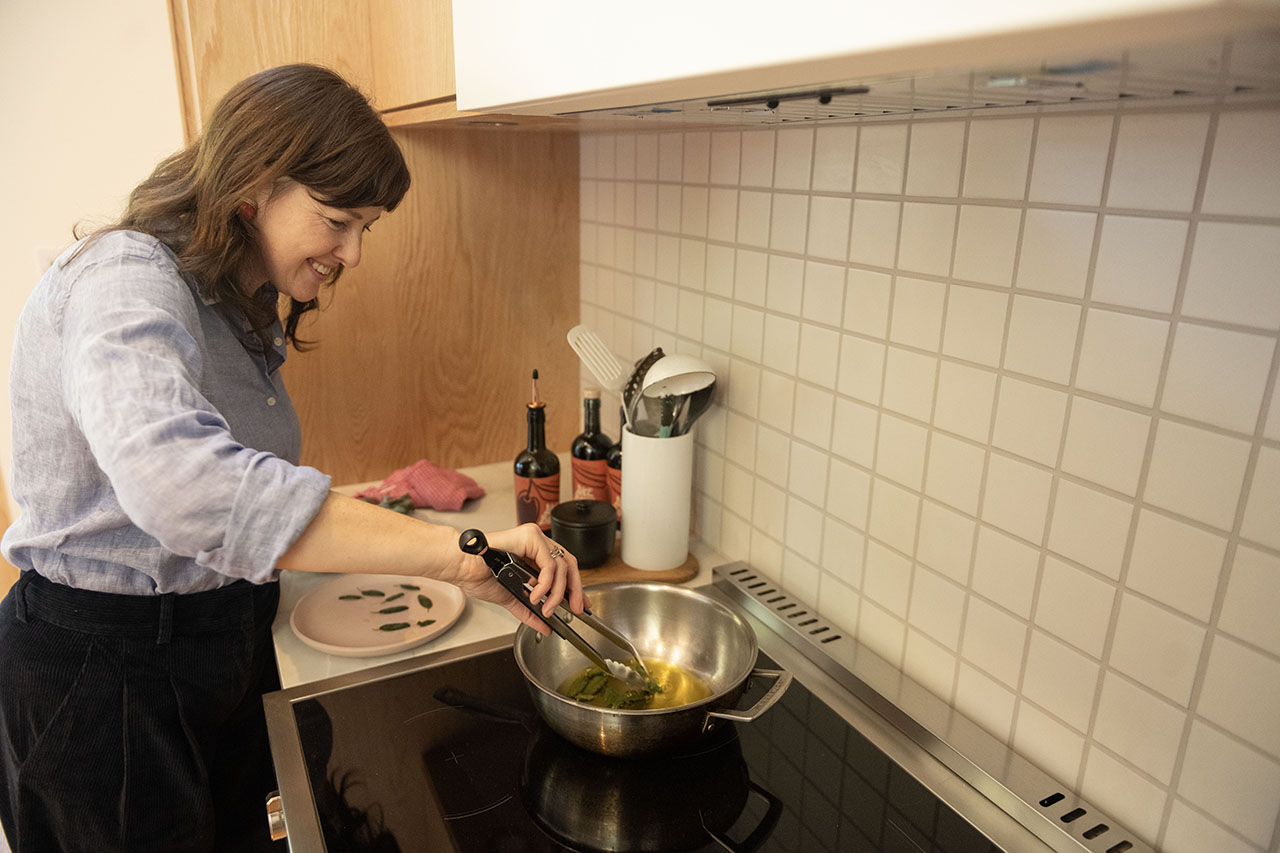
In a medium-sized pan, add enough extra-virgin olive oil to create a ½-inch pool of oil. Turn to medium heat. When oil shimmers, add sage leaves. The border of each leaf should gently sizzle when it drops into the oil. Fry each leaf until crisp, about 15-30 seconds. Using tongs or a slotted spoon, remove sage from oil and let drain on a paper towel-lined plate.
Use mandoline to shave slices of Parmesan. To assemble the carpaccio, arrange persimmon slices in a single layer on the plate — have fun with a pattern or keep it casual and loose. Layer Parmesan and fried sage on top, then finish with a dusting of toasted pine nuts, salt and pepper. Add a final drizzle of oil before you serve.