

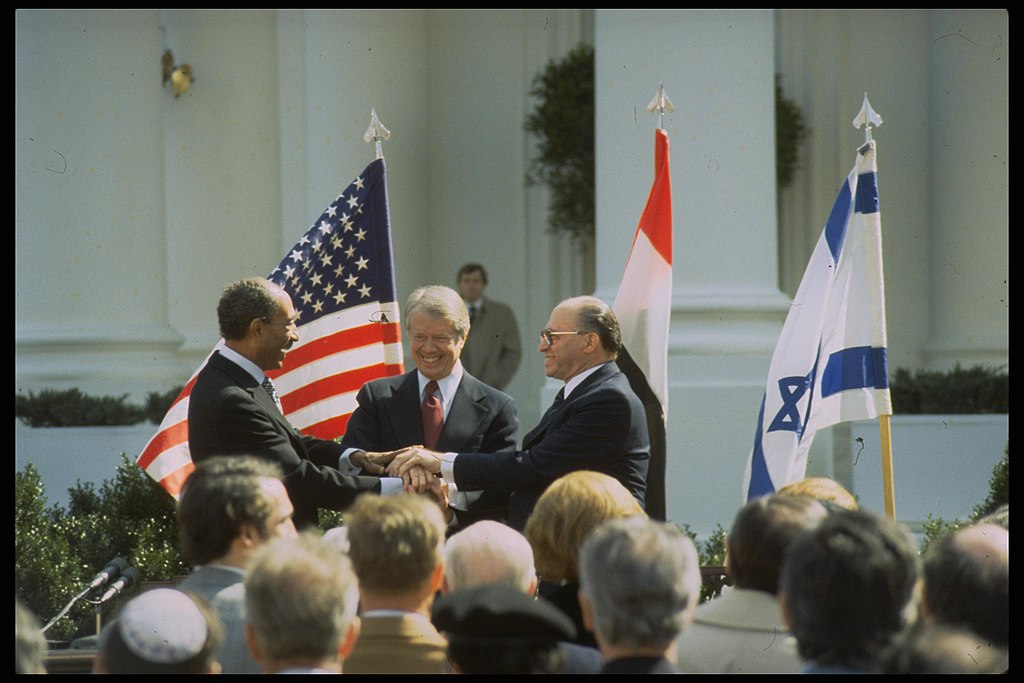
I had the pleasure of meeting President Jimmy Carter once and can testify that he was a thoughtful, decent mensch.
It was late 2006 and the former president, who died Sunday at age 100, had just published his controversial book “Palestine: Peace Not Apartheid.” His book created a great deal of contention among Jews, especially for its use of the word “apartheid.”
I was then serving as president of the Greater Phoenix Board of Rabbis. Carter was scheduled to do a local book signing on Dec. 12.
The board of rabbis decided to organize a protest against Carter. At my wife Karen’s suggestion, I reached out to Carter to ask if he would be willing to meet with a delegation from the board.
Carter responded: He would do his book signing, we should go ahead with our protest — and we could all meet afterward at his hotel.
At 10:30 p.m., a group of Phoenix-area rabbis spent well over an hour talking with Carter, who was then 82 years old. We were all impressed by his empathetic listening and his willingness to engage in respectful conversation. However, we walked out thinking, “That was a nice hour, but nothing will come of it.”
The next morning, my cell phone rang. It was the former president calling to say that he would issue an official letter to the Jewish community, reflecting on what he learned from our meeting and re-framing his perspective. When my cell phone dropped the call, he even called back — another sign of his graciousness.
In Carter’s Dec. 15, 2006, letter, which was nearly 1,000 words long, he wrote:
“I emphasized, as I had throughout the tour, that the book was about conditions and events in the Palestinian territories and not in Israel, where a democracy exists with all the freedoms we enjoy in our country and Israeli Jews and Arabs are legally guaranteed the same rights as citizens.
“We discussed the word ‘apartheid,’ which I defined as the forced segregation of two peoples living in the same land, with one of them dominating and persecuting the other. I made clear in the book’s text and in my response to the rabbis that the system of apartheid in Palestine is not based on racism but the desire of a minority of Israelis for Palestinian land and the resulting suppression of protests that involve violence.”
The letter continued:
“The chairman of the group, Rabbi Andrew Straus, then suggested that I make clear to all American Jews that my use of ‘apartheid’ does not apply to circumstances within Israel, that I acknowledge the deep concern of Israelis about the threat of terrorism and other acts of violence from some Palestinians, and that the majority of Israelis sincerely want a peaceful existence with their neighbors. The purpose of this letter is to reiterate these points.”
Carter dedicated his life after his presidency to securing peace and democracy around the world. Although I still would not use the word “apartheid” to describe Israel, I acknowledge that Carter was right when he wrote in that letter: “Palestinian people were being deprived of the necessities of life by economic restrictions imposed on them by Israel….”
The situation in the occupied territory of the West Bank is much worse today than it was in 2006. Israeli settlements expand and settlers forcibly expel Palestinians, while the army and the government turn a blind eye — and at times even assist their efforts. In Gaza, we witness the denial of humanitarian aid for starving families, the overwhelming destruction of civilian infrastructure and the deaths of tens of thousands of innocent Palestinians.
Carter was a true friend of Israel and the Jewish people. His warning of “apartheid” — which he also later clarified was meant to highlight the possible outcome if Israeli policies didn’t change — rings just as true today as it did in 2006. May we heed his warning and may his memory be a source of blessing and inspiration to us now.