

Just before Oct. 7, 2023, Israeli health-tech startup Emet Surgical was poised to sign an agreement with an Israeli investment company for $3 million.
“Of course, on Oct. 8, I got an email saying, ‘The money’s not coming,’” said founder and CEO Bob Witkow.
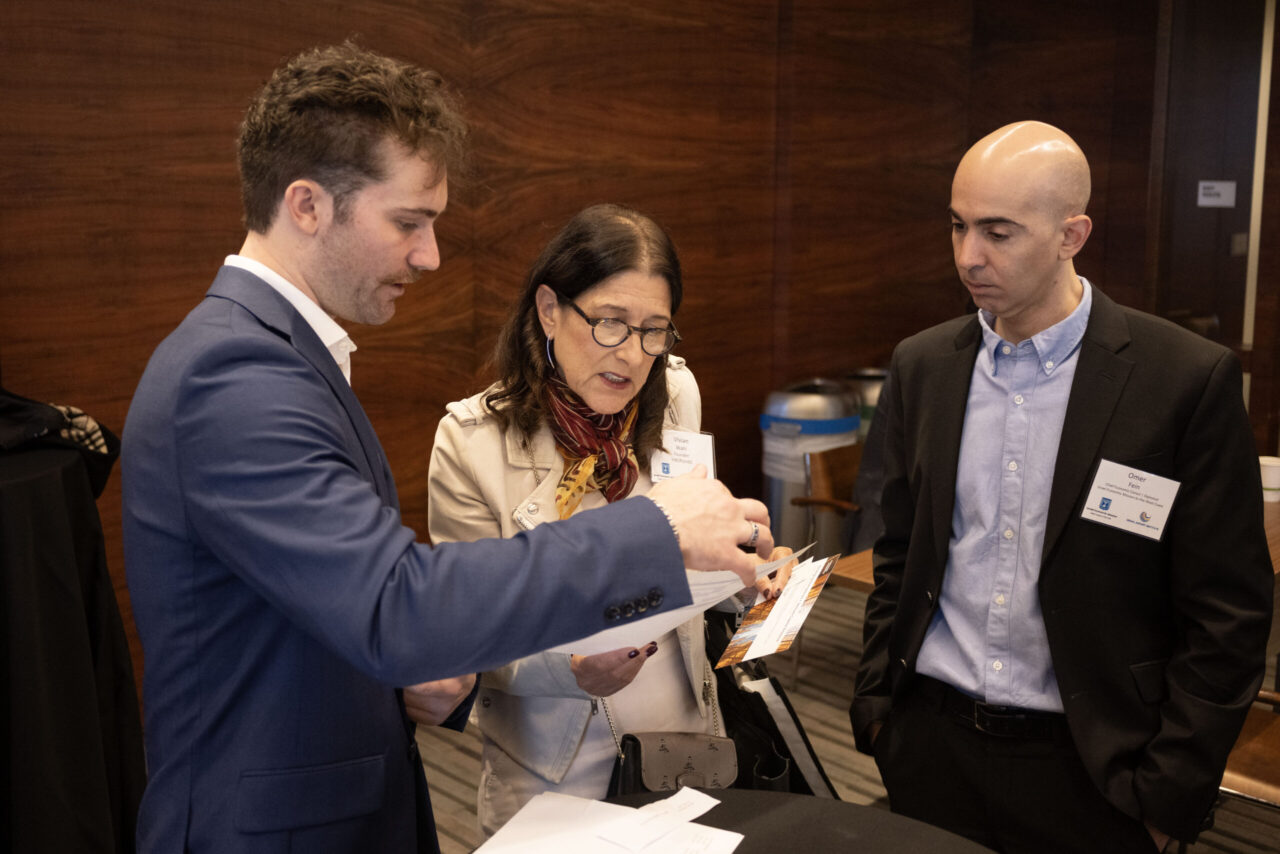
But that didn’t stop Emet Surgical, which is developing high-tech tools to help surgeons identify cancerous tissue. On Monday, Witkow was among representatives from 16 health-tech startups based in Israel that convened in downtown San Francisco to pitch and network as part of the 43rd annual J.P. Morgan Healthcare Conference.
“The Israeli industry — they are resilient,” said Omer Fein, head of the Israel Economic Mission to the West Coast, which has hosted the startup showcase at the conference since 2016.
The government group seeks to give an international edge to Israeli companies involved in every industry, including other high-tech fields such as cybersecurity, software development and artificial intelligence.
“I like to say we cover ‘from cyber to tahini,’” Fein said. “There’s a lot of interest to be part of the ecosystem here on the West Coast.”
Monday’s event featured companies from nearly every conceivable realm of the health-tech sector, including Bluespine, an AI platform trained to detect medical overbilling, and Zida, a therapy device that helps treat incontinence.
It’s been a difficult few years for Israel’s health-tech sector.
According to data aggregated by Startup Nation Central, the total annual funding of Israeli health-tech startups fell to $1.6 billion in 2023, down from $3.1 billion in 2022. The ongoing war following the Oct. 7, 2023, Hamas massacre has only further harmed the investment landscape, dropping the total funding to $1.2 billion in 2024.
“Uncertainty causes people with money to keep their hands in their pockets, protecting their money… An investor is risk-averse to begin with,” Witkow told J.
In addition, anti-Zionist activist groups have renewed their demand for economic isolation of Israel. Yet startups have still found support worldwide, albeit in more subtle ways at times.
Tsvi Shmilovich, co-founder of EZMEMS, which makes cost-effective high-tech sensors, told J. about his team’s recent visit to Europe.
“People are coming quietly and telling you, ‘We are with you, we support you, we love Israel.’ But they sort of look to the side to see that no one is listening,” he said. “This is what we feel, especially in Europe. We feel there is a big support… just that these people, usually, they are not loud, they are quiet.”
Though investment in Israel’s health-tech startup scene has wobbled, there is still room for optimism.
Chaim Friedland, partner at the Tel Aviv-based Gornitzky law firm, has traveled from Israel for the past four years to attend the startup showcase at the J.P. Morgan conference. From his work in assisting Israeli companies with international business transactions, Friedland said he knows that investors can see past the politics to the strengths of Israeli innovation.
“In 2024, our firm did a large number of cross-border transactions, in some cases with investors who, for the first time, invested in Israel with no Jewish connection… just because it was a good investment,” Friedland told J. “These are good companies. It makes business sense to invest.”