

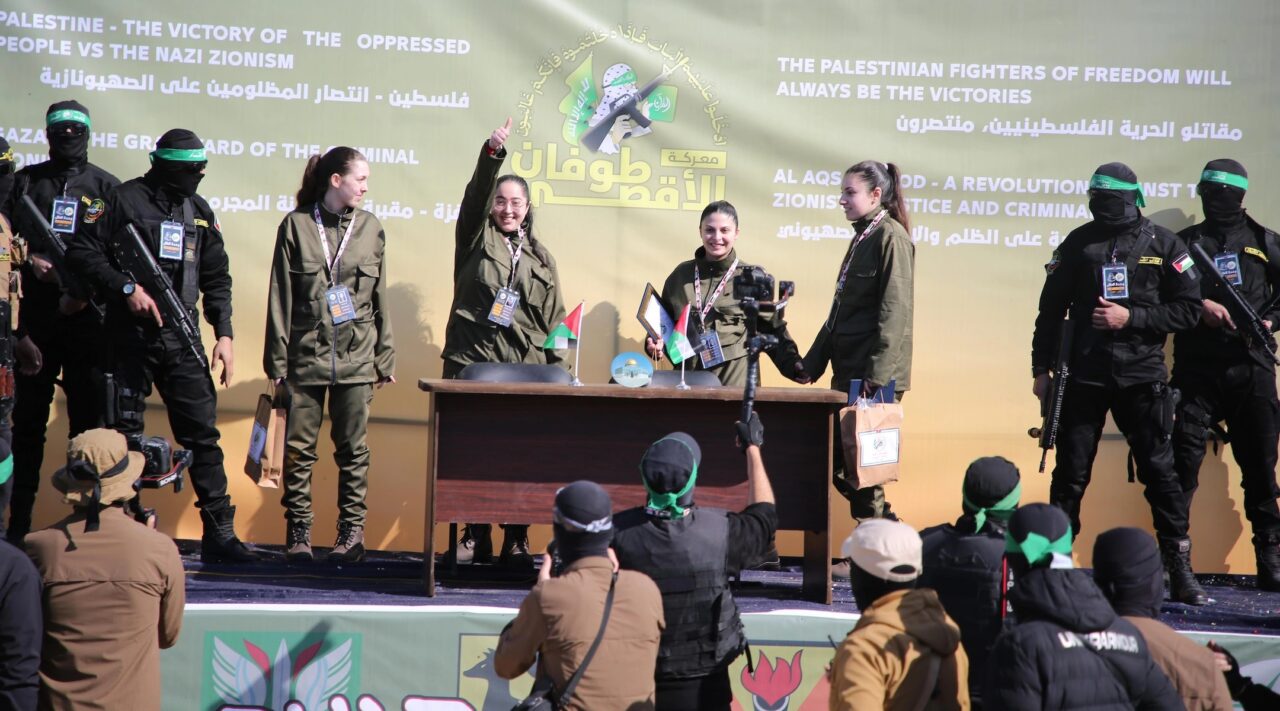
(JTA) — Hamas released four hostages on Saturday in a choreographed event in Gaza, making them the second group of captives to go free in the cease-fire that began on Jan. 19.
The four hostages released on Saturday — Liri Albag, Karina Ariev, Daniela Gilboa and Naama Levy — are all Israeli soldiers. Before they were allowed to return to Israel after nearly 16 months in captivity, they were paraded across a stage in Gaza wearing green fatigues, against a banner with English, Arabic and Hebrew slogans such as “Zionism will not win” and “Palestine — the victory of the oppressed people vs. the Nazi Zionism.” The four hostages also received “gift” bags.

The four young women, ages 19 and 20, smiled and waved as they walked across the stage in front of a crowd, which, according to Israeli media, was meant to be a show of strength in the face of their captors. The event contrasted with the release of three Israeli women hostages on Jan. 19, which came with images of the captives surrounded by a swarm of Hamas gunmen and supporters.
The release on Saturday came amid tensions over the first phase of the ceasef-ire deal, which is due to last six weeks.
Israel had expected the release of Arbel Yehud, a civilian, but she apparently is held by Islamic Jihad, another Gaza terror group, and did not go free. She is reportedly due to be released this week, along with American Keith Siegel and Agam Berger, another female Israeli soldier.

The other civilian woman still in captivity is Shiri Bibas, who was abducted with her children Kfir and Ariel. Hamas said early in the war that all three of those members of the Bibas family had been killed, but Israel has not confirmed that allegation. Yarden Bibas, Shiri’s husband and the father of the two boys, is also still in captivity.
In response to Arbel not being released, Israel delayed the return of Palestinians to north Gaza, which was due to begin on Saturday. Israel did release 200 Palestinian security prisoners in exchange for the four hostages, many of whom were serving life sentences for murdering Israelis and other acts of terror.
A total of 90 hostages are still held in Gaza, dozens of whom have been confirmed to be dead. Hamas was due to provide details as to the condition of some of them, though the extent of that information remains unclear.

The release on Saturday came six days after Hamas released Emily Damari, Romi Gonen and Doron Steinbrecher, all civilian women. In exchange, Israel released some 90 Palestinian security prisoners.
The release of the hostages has brought celebration and relief across Israel. Most Israelis are in favor of the cease-fire deal, but it has also drawn opposition because it includes the release of convicted Palestinian terrorists and potentially an end to Israel’s military campaign against Hamas in Gaza. President Donald Trump has pushed for the deal but also sounded skeptical about it lasting.

The hostage releases are part of the first stage of the Israel-Hamas cease-fire, which began on Jan. 19 and is due to last six weeks. Over the course of that period, Hamas is to release a total of 33 hostages, most of whom are thought to be alive.
The second stage of the cease-fire, which has yet to be negotiated, would see Israel fully withdraw from Gaza in exchange for the release of the remaining living hostages. A third stage would see the rest of the hostages be released as reconstruction of Gaza begins.