

Updated at 1:30 p.m.
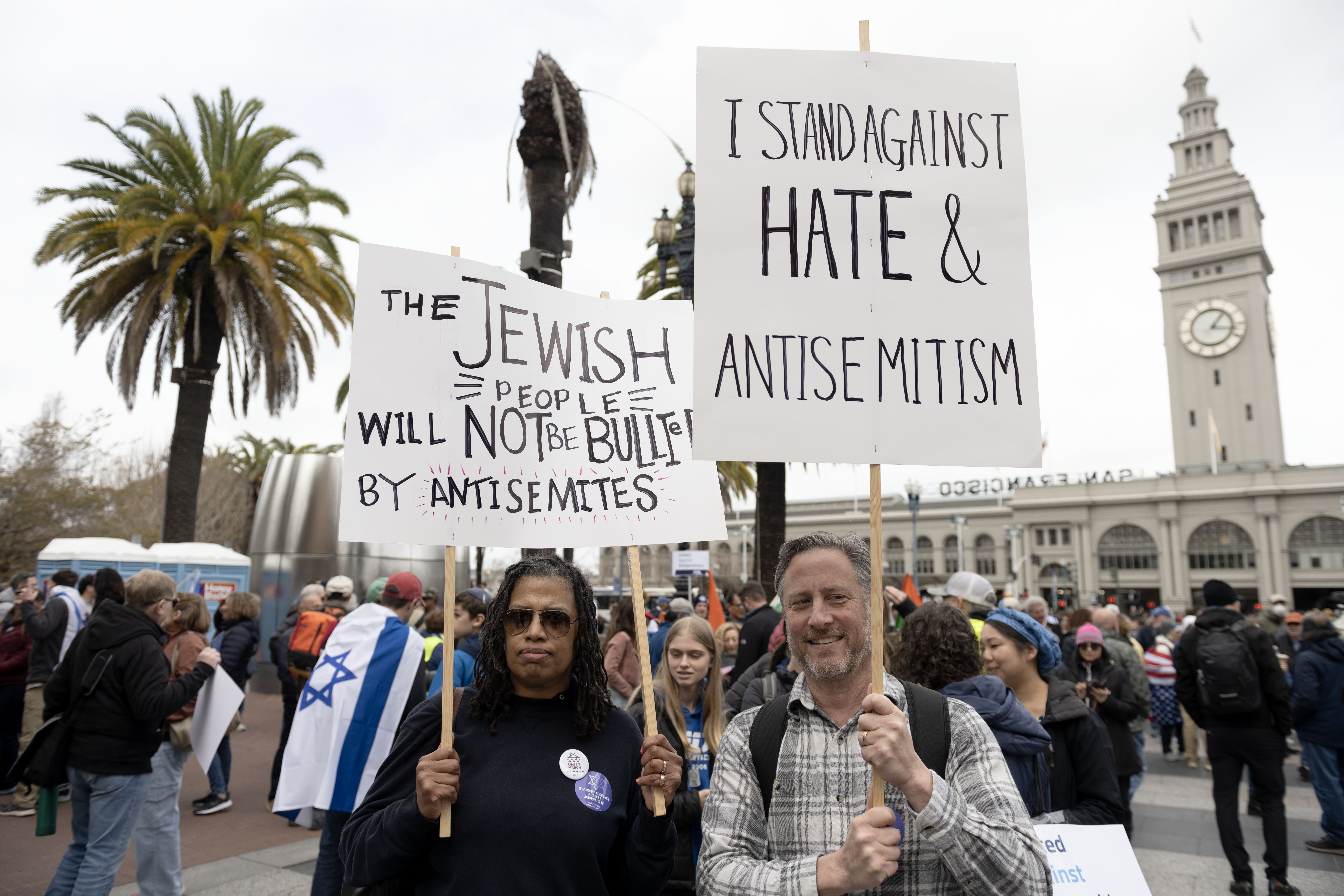
The Jewish Community Relations Council Bay Area surveyed local Jews in 2023 in the weeks after Oct. 7, when people were reeling from the shock of the deadly Hamas attacks, the intense opposition to Israel’s response and the sharp spike in antisemitism both locally and worldwide.
A year later, JCRC conducted another survey to measure whether those views have changed. Though antisemitism is still a major concern, respondents feel more satisfied with how local governments, schools and workplaces have been handling it compared with 2023. However, the emotional whiplash of the past year continues to have an impact, and a majority of respondents, 55%, still feel “less safe” than they did before Oct. 7.
The new survey, released Tuesday, was conducted before the start of Israel’s fragile cease-fire deals with Hezbollah and Hamas, and the first releases of Israeli hostages in well over a year.
“While we hope an end to this war may reduce some of the pressures our community faces, lasting damage has been done to many of our civic institutions,” JCRC CEO Tye Gregory said in an email to J. “If we are to begin to remedy this damage, we need solutions and concerted engagement from local leaders.”
The survey, conducted by Oakland-based market research firm EMC, included 800 people who identify as Jewish in the Bay Area’s nine counties. Like the 2023 survey, the 2024 survey was done in late November and early December. A similar survey from 2022 enables comparison for some data across the three years.
Responses to the “most important challenges in the Bay Area” remained the same between 2023 and 2024. Choosing from a list of general societal concerns, people placed affordable housing, homelessness, crime and cost of living at the top.
In 2023, 7% picked antisemitism as one of the top regional challenges. In the current survey, that dropped to 3%.
However, when the question was framed differently — asking whether antisemitism is the “most important problem facing Bay Area Jews today” — a majority of respondents agreed. The 52% who agreed in 2024 is similar to the 51% who agreed in 2023, compared with 37% in 2022.
The second biggest problem facing Bay Area Jews, according to 12% of respondents, is “Israel/Palestine,” compared with 10% who said the same in 2023.
One positive change in perception relates to how institutions are responding to antisemitism. Satisfaction with the response of local governments grew from 39% in 2023 to 52% in 2024. In K-12 education, satisfaction rose from 28% to 41%. And for colleges and universities, it increased from 19% to 32%.

“The volume of antisemitic incidents our team responds to day-to-day — most often in K-12 schools — remains far higher than pre-Oct. 7 levels,” Gregory said.
The satisfaction numbers also improved in relation to the response to antisemitism in “social justice spaces” (36% satisfied) and the workplace (67% satisfied). The lowest rate of satisfaction was with social media, at 21% — but still an increase from 13% in 2023.
How people feel about expressing their Jewish identity in public — 80% said they were at least somewhat comfortable doing so — was roughly unchanged from 2023. Among several new agree-disagree statements in the 2024 survey were “I have felt excluded at times” for being Jewish (40% agreed) and “I have lost friends” (19% agreed).
Asked whether they had witnessed or been the victim of antisemitism (either in person or online) in the past three years, 42% said yes, an increase from 39% in 2023 and 32% in 2022. Of those, only 30% said they had reported it “to anyone.”
Unchanged were feelings about Israel’s right to exist. In 2022, 2023 and 2024, 89% of respondents consistently said they agree that Israel has the “right to exist as a Jewish and democratic state.”
“This underscores our community’s enduring connection to and support for Israel,” Gregory said. “It also highlights how the far-left’s strategy of hiding behind anti-Zionist Jewish groups to deflect accusations of antisemitism is deeply problematic. These anti-Zionist groups do not — in any way — represent the mainstream Bay Area Jewish opinion of Israel.”
However, Gregory added, “supporting Israel” doesn’t mean agreeing with its political leaders. He compared the high percentage of people who support the country’s right to exist with the relatively low percentage who back its government.
“This year’s data shows that only 25% of our community approves of the job Israel’s current government is doing,” Gregory said. “These two data points are an important reminder that being pro-Israel is not synonymous with supporting the Israeli government’s actions.”
Though people’s comfort in expressing their views about Israel in public dipped after the Hamas attack, it rebounded somewhat: 76% had felt comfortable doing so in 2022. That figure dropped to 66% in 2023 before bouncing back to 70% in 2024.
The survey also included questions about the makeup of the Jewish community.
In terms of denomination, most affiliated respondents were Reform, at 26%. Another 28% percent identified as secular. Some 36% of all respondents said they “rarely” participate in Jewish activities. Nearly half — 47% — are part of an interfaith family. And 19% said their household includes at least one person of color.
Political identification of respondents was 36% liberal, 25% progressive, 25% moderate and 11% conservative.