
Food coverage is supported by a generous donation from Susan and Moses Libitzky.
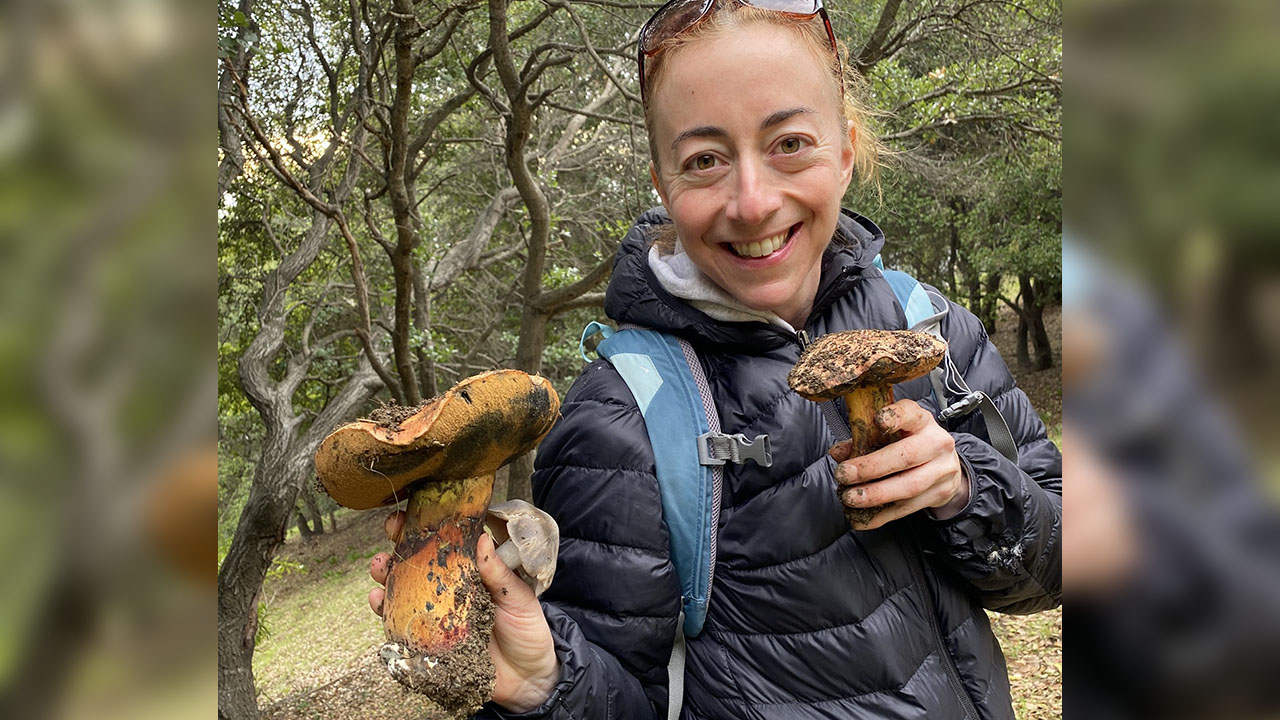
By her own admission, Carrie Staller is obsessed with mushrooms.
“They’re beautiful, mysterious and delicious,” she said. “You get embodied when you’re in the hunting mindset, and it can be so exciting and rewarding. You get a shot of dopamine when you find one. It can almost put you in an altered state.”
Staller, 45, of Berkeley, is the founder of Fork in the Path, an educational organization that leads workshops on foraging for food. While mushrooms are her own personal favorite, there are also events on harvesting wild foods like seaweed and acorns and dyeing with mushrooms.
Coming up on Feb. 15, Fork in the Path has a Jewish mystical offering in honor of Tu Bishvat, the new year of the trees, in Berkeley’s Tilden Park. Staller will collaborate with Jonathan Furst on a guided walk to offer “a celebration of the interrelationships of trees, humanity, fungi and the unseen world. Learn how blessings, angels, and a Jewish approach to ethical harvesting can deepen our connection to the natural world as we amble through the forest.”
The East Bay park system doesn’t allow foraging, so it will not be included in the Tu Bishvat event. Fork in the Path’s mushroom foraging workshops take place further afield, in places like Salt Point State Park and Mendocino.
Mushrooms have a mycorrhizal relationship with trees, Staller explained, which means in the underground networks where mushrooms grow, they have a symbiotic relationship with nearby tree roots, sharing nutrients and perhaps information. Mushrooms also can be saprobic, which means they help organic matter decompose and become food for living organisms around them.
“To hunt for common mushrooms like chanterelle, porcini or morels, one must know what their tree partner is,” she said.
Staller grew up in Milwaukee, attending Jewish day school. Her foraging was limited to the raspberry patch in her backyard, she said. She had drifted away from Judaism as a young adult, but her drumming at a Hanukkah party was noticed by someone looking for a drummer for Shabbat services. Now she’s the percussionist in three different bands familiar in Jewish circles and has found a home in the earth-based communities of Wilderness Torah and Urban Adamah.
She traces her interest in mushrooms to a lecture she attended by Paul Stamets, a prominent mycologist. From there she went on to participate in a retreat where foraging for mushrooms was the focus. That shifted her interest into a passion.
“After that, my whole life changed,” she said. “I started spending all my free time in the forest and lurking in online mushroom groups. It was not like a slow descent, but rather falling off a cliff into deep curiosity.” Foraging can be addicting, she warns.
Staller has had to be creative in how she earns a living after being diagnosed with long Covid. She still is experiencing many symptoms and needs a lot of downtime, though she said wearing a nicotine patch has reduced some of her brain fog.
She introduced her company, Fork in the Path, last year. It is so named because foraging created a fork in her own life path, she said.
“My hope is that it will create some small transformation for others,” she said. “Some people begin to feel such a deep sense of being compelled to hunt and gather, and such a deep longing to connect more deeply with nature and their food, that it really transforms their life.”
Upcoming events include a Jan. 31 talk by mycologist Christian Schwarz on the aromas of fungi, and a Feb. 1 edible and medicinal plant walk in Berkeley. Staller hopes to grow the company and offer more workshops; 14 instructors are currently on the company’s website at forkinthepath.org.
Staller said she vets people carefully to ensure they “have deep respect of the land, and an understanding of how to harvest sustainability,” as well as respect for the Indigenous peoples who tended the land before. Fork in the Path donates a percentage from each program to Native American causes.
While foraging is the central focus of her endeavor, Staller also appreciates how the workshops help foster connection among the people who take them.
“There’s this whole hunter-gatherer chapter of humanity that’s been forgotten in this modern world, but when we return to that and do it together, we’re claiming the birthright of being human,” she said. “It’s very powerful to go into the forest, look for food, find it, cook it and eat it together. There’s something very primal and ancestral and forgotten about that, as not a lot of people know how to do it.”