
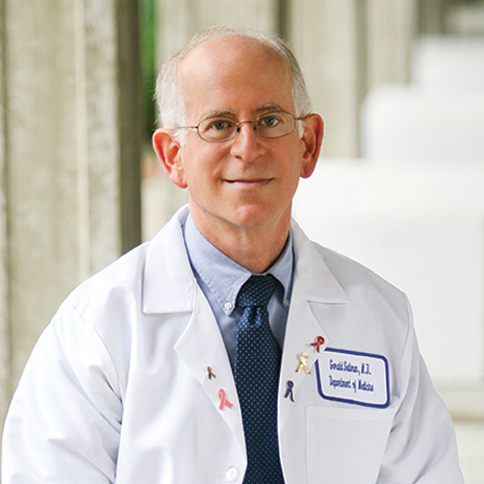
This is a story about kindness and gratitude, but first I need to tell you about evaluating patients with back pain to set the context.
One would think that the most important part of the physical exam to rule out anything serious for a patient with low back pain would be to examine the back, but oddly it’s the feet. If the spinal nerves are compressed in the lower spine, there can be muscle weakness or loss of sensation of the foot, or loss of the ankle reflex.
Another reason to examine the feet in someone with back pain is to rule out peripheral vascular disease. Patients with that disease may have low back pain that comes on with exertion and is relieved by stopping to rest. Before I would examine patients with back pain, my medical assistant at Kaiser always asked them to remove their socks and shoes and, if necessary, helped them do so.
In the mid-1990s, a businessman in his early 40s came to see me with an acute onset of low back stiffness. It was clear that he could barely move. Luckily, examination of his feet was normal so I was able to reassure him that he did not have serious pathology. I told him to avoid sitting for more than 15 to 20 minutes at a time and showed him some simple back and hamstring stretches.
It was apparent that there was no way he could put on his socks and shoes, so I put them on for him without giving it a second thought. I did not expect to ever see him again. He wasn’t a regular patient of mine, and I predicted he would recover in a few days.
In summer 2001, Peninsula Temple Beth El held an outdoor Shabbat service at Beresford Park in San Mateo. After the service ended, my wife and I headed back to our car, and a man approached me. He asked, “Do you recognize me?” Feeling guarded about a stranger approaching me in a park, I responded “no.” He then went on to say, “A few years ago, I saw you for back pain, and I want to tell you how much it meant to me that you put on my shoes when I was unable to do so myself.”
I thanked him for telling me this, and he quickly walked away. I then remarked to my wife, “Darn, I never asked him his name. I guess I’ll just have to think of him as ‘shoe guy.’”
More than two decades later, in spring 2023, the Peninsula Jewish Community Center hosted an outdoor evening celebration to mark its 75th anniversary. My wife was off talking with former colleagues and friends. I was meandering around, scouting the food options.
A man came up to me and told me he appreciated my recent J. column about gratitude. He then told me a story about contemplating what to give a 95-year-old retired teacher for her birthday. He had decided that a 95-year-old must have everything that she desired by now. But after reading my column, he sent her a letter of gratitude. After she received his letter, she left a voicemail telling him that it was one of the nicest gifts she had ever received. It sounded as if she were crying on the voicemail because she was so moved by his letter.
I am often amazed how small acts of kindness and gratitude can have huge impacts, and I felt compelled to tell this man about “shoe guy.” Until then, I had never shared this story with anyone other than my wife. As I was telling him the story, his eyes got wider and wider, and he began staring at me intently. When I got to the part about the “shoe guy” approaching me in the park, he couldn’t restrain himself any further and exclaimed, “I am your shoe guy!”
I stood there speechless for a few seconds before I could exclaim, “Wow!”
Here is an epilogue: In my 2023 column about gratitude, I told the story of a Samaritan House Clinic patient who had been grieving the death of his son for several years. He was overwhelmed with grief when I saw him in 2023, and I suggested that focusing on gratitude might help mitigate his loss. He understood my point but said it would be hard to change his thinking.
He returned to the clinic in fall 2024, complaining of neck pain, but I noticed that he had no hint of sadness. I asked him to explain: He had moist eyes but wore a smile on his face as he told me that he now imagines his family as a large beautiful garden. (Besides his son who passed away, he has three daughters and five grandchildren.) His son was a beautiful flower plucked from his garden, but he was still grateful for the flowers that remain. I thanked him for sharing this wonderful imagery.
After he left the exam room, I told my nurse practitioner student who was with me that day, “This is why I love being a physician.”
What will be your next act of kindness or expression of gratitude?