

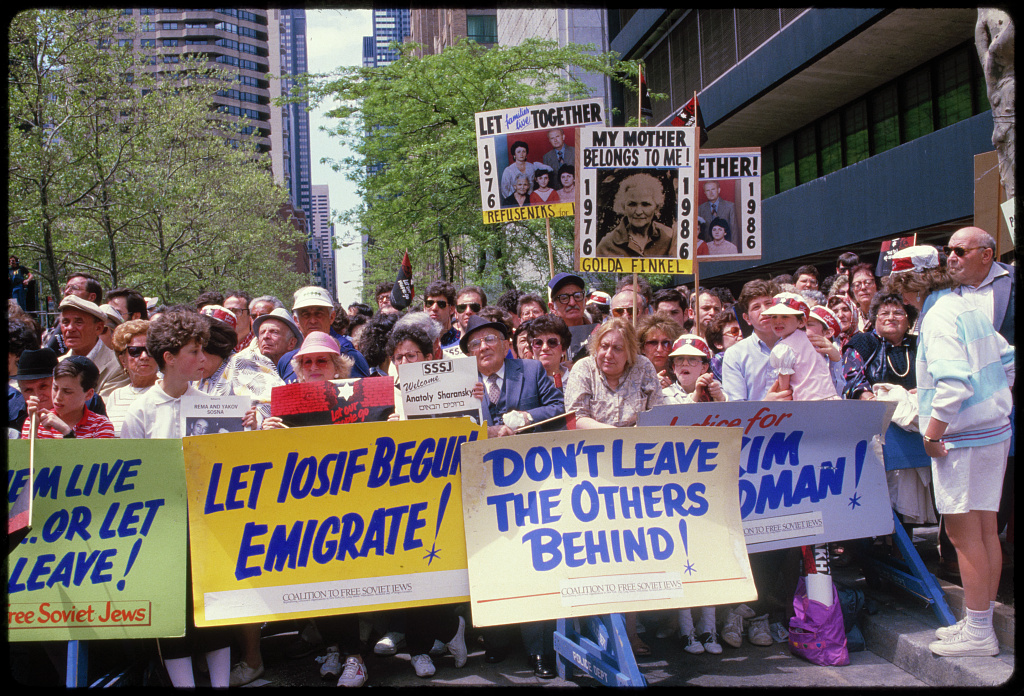
For generations, Jewish organizations have been at the forefront of immigration and refugee rights, carrying forward our people’s legacy of resilience and renewal. But today, as immigration policies grow more restrictive and American hostility toward immigrants reaches alarming levels, major Jewish institutions are largely silent when it comes to defending even the Jewish immigrants within our own communities.
As a formerly undocumented American Jew, I know the intense fear that undocumented immigrants are living with right now. I also believe the Jewish community has a meaningful opportunity to step up and support immigrants in impactful ways — if we come together with the will and commitment to do so.
Since President Donald Trump returned to the White House, immigration enforcement has intensified. In just the first week of the new administration, Immigration and Customs Enforcement arrested more than 3,500 undocumented immigrants — a staggering increase compared with prior years. While the administration claims it is prioritizing criminals, officials have made it clear that any undocumented person is a target, regardless of their history or contributions to society.
In response, many immigrants are retreating into the shadows, skipping work and keeping children home from school. They are fearful of even the most basic interactions, whether it’s a visit to the DMV, a doctor’s office or even a place of worship. The new policies don’t just remove people from the country; they instill terror, destabilizing entire communities.
Despite the gravity of this moment, only a handful of legacy organizations and synagogues have stepped up in meaningful ways so far. Some, such as declared sanctuary synagogues, HIAS and local refugee agencies working tirelessly to support new arrivals, are leading the way. Their efforts are commendable, but we need more Jewish organizations to join the movement.
Many Jewish immigrants and their loved ones are currently navigating complex legal systems — often alone, with limited resources and overwhelming uncertainty. They are fighting to remain with their families, to access basic rights and to build secure lives in the face of immense barriers. This is not just their crisis — it is ours.
As Jews, we are commanded to love and protect the stranger. As a people who have known the pain of displacement, we must ask ourselves:
Where is our chesed (lovingkindness) and compassion in this moment?
Where is our commitment to recognizing the dignity of every person — that we are all made b’tzelem Elohim (in the image of God)?
Where is our arevut (mutual responsibility) when our own community members are in danger?
I grew up undocumented. For 15 years, I lived in constant fear, knowing that my life could be upended at any moment. It’s surreal to think that today I am on the other side of that fear, but the reality is that fear for my community still grips me.
Through my work at Jewtina y Co., an organization led by and for Latin Jews, I have had the privilege of working with undocumented individuals and people from mixed-status families. Their stories mirror my own. There is a particular kind of survivor’s guilt that comes with having gained stability while knowing so many others remain trapped in the same cycle of fear that shaped my childhood.
I know that I’m not alone in feeling this way. Many of us who have made it through find ourselves overwhelmed by the magnitude of the crisis, leading to retreat, emotional flight or mental disengagement.
Of course, that exhaustion extends beyond the immigrant justice space.
It has been more than 500 days since Oct. 7, 2023, and in that time, we have been carrying an unbearable weight: the heartbreak of yearning for the return of all hostages, the desperate hope for a cease-fire that endures and the pursuit of lasting peace.
While many Jewish institutions have long supported immigrant justice, we must ask whether they are doing enough for Jewish immigrants right now. Here is what we must expect of our community:
1. Move from words to action. Statements of support are meaningful, but real impact comes from direct aid: legal assistance, bail funds, translation services and public education on immigrant rights. Every synagogue and Jewish organization should be equipping its members with the knowledge to protect and support vulnerable members of their communities.
2. Center Jewish immigrant voices. Jewish institutions often focus solely on broader refugee populations, which is essential, but they must also recognize the Jewish immigrants within our own communities. Many Jews — especially Latin Jews, Israeli Jews, Mizrahi Jews and Jews of Color — live with precarious immigration statuses. Their voices must be uplifted, protected and heard in decision-making spaces.
3. Fund community-led support systems. Legal aid is crucial, but so are mental health support, community spaces and cultural connection. Jewish organizations must recognize the full spectrum of needs that Jewish immigrants have and invest accordingly.
So what now? What does resilience look like when everything feels like too much?
Perhaps our answer lies in how we’ve always endured. Like our ancestors in the wilderness, wandering through uncertainty, sustained only by manna and faith, we must take this one step at a time. The Israelites didn’t know how long their journey would last, and we cannot know how long this moment of darkness will stretch. But what we do know is this: We keep moving forward.
We take things day by day, moment by moment, doing whatever is in our power to choose courage, action and hope — not because we are naive but because we know that despair has never been our final chapter.
If history has taught us anything, it is that we were not placed here to stand still. We are here to keep building, fighting, dreaming, loving — and carrying each other forward.