

This article originally appeared on Haaretz. Sign up here to get Haaretz’s free Daily Brief newsletter delivered to your inbox.
Omer Wenkert, one of the six hostages released on Saturday, lost 65 pounds in captivity, his parents said. Hisham al-Sayed “cannot speak,” his father said. And Omer Shem Tov was held alone in a tunnel for 450 days, his mother said.
Family members spoke Sunday at a joint press conference and released statements regarding the six men freed from Hamas captivity the previous day in the latest phase of the Israel-Hamas cease-fire. Four of the men were abducted on Oct. 7, 2023. Two of them had been held since 2014 and 2015 after they entered Gaza on their own.
The parents of Wenkert, 23, said that he “lost over 30 kilograms in captivity, but he came back stronger in spirit. He committed to joining the fight until all hostages and friends he left behind are released.”
Sha’ban al-Sayed, whose son Hisham al-Sayed, 36, was released after nearly a decade, said that Hisham “cannot speak, he has no voice, no memory of anything,” adding that “Hamas is playing politics at the expense of a mentally ill person, and has killed Arabs and Bedouins. We want the Arab world to give its response to that.” The al-Sayed family are Muslim Bedouin Arab Israelis.
Shelly Shem Tov, mother of Omer Shem Tov, said her son was held alone in a tunnel for 450 days in difficult conditions and suffered starvation and psychological abuse. He is 22.
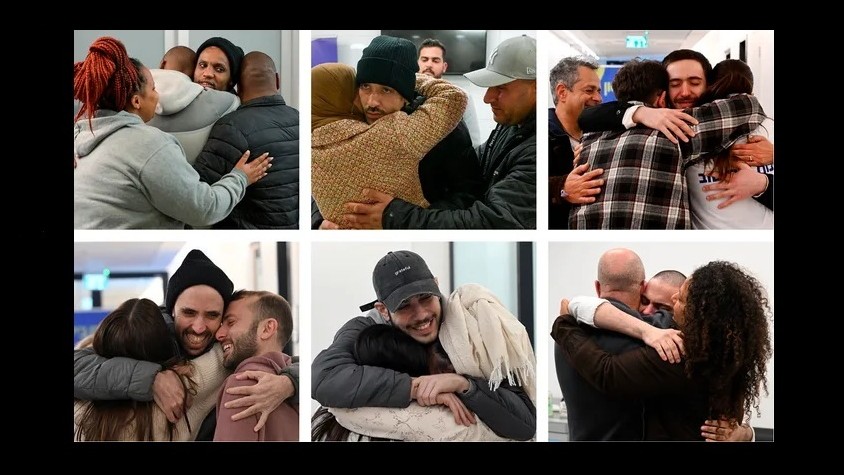
“Omer told us that when he crossed the border and reached the Israeli soldiers, he breathed a sigh of relief. The first face he saw was of a psychologist who introduced herself, and the first thing he did was ask her permission to give her a hug, because he was thirsty for human contact, warmth and love,” she said.
“Apart from shedding a tear in great pain, we hugged our Omer tightly and promised him we would never stop hugging him and loving him,” she continued. “We got our Omer and we are heading for the task of rehabilitation, personal and familial. And we can say that our life’s mission has been completed.”
She also addressed Prime Minister Benjamin Netanyahu: “The national mission is still incomplete. We must urgently return all of our hostages: the living to rehabilitation and the dead for burial. We, as a family, will continue fighting with the [hostages’] families until they are all returned.”
Ilan Mengistu, whose brother Avera Mengistu, 37, was released after more than a decade in captivity, said his family is “thrilled to no end, but we are also aware that the road is long. The rehabilitation from captivity is a complex, difficult process that takes time, patience and support.”
He added, “We can’t let this situation continue. I am begging you. Don’t let the pretty photos of the returning hostages fool you. Behind the smile and momentary happiness are emotional and physical scars that are irreversible. We are all obligated to apply moral pressure on the government and decision makers, so they work to immediately return all hostages.”
Sigi Cohen, whose son Eliya Cohen, 27, was also freed on Saturday, said that all families of the 63 remaining hostages deserve to experience what she did. “They must all come back home before it’s too late,” she said.
She specifically addressed Alon Ohel, who was held with her son and remains in Hamas captivity. “Alon Ohel and all those who can hear me, from the depths of the earth, I want to tell you: You are not alone, and we will fight for you until you come home.”
According to a report by Israel’s Channel 12 News, Eliya Cohen noticed the car from which hostages Guy Gilboa-Dalal and Evyatar David were forced to watch the release ceremony. Gilboa-Dalal’s and David’s reactions to the ceremony were filmed by Hamas, as they repeatedly begged Netanyahu to sign a deal that will allow them to return home.
The report added that Cohen and Ohel found it difficult to say goodbye to each other.
Mor Korngold, sister of newly freed hostage Tal Shoham, 39, thanked the Israeli public “for not leaving us alone in the fight. Everyone who took part, please continue until every family gets this reunion.”
“In this significant moment in our lives, our only request is to use the window of opportunity that was created, to bring a deal that would return home fathers to their children. Kids need a father,” she said.
“We believe that it’s possible, we believe returning our brothers and sisters does not come at the expense of our safety in our country, but the opposite is true. It’s the basis on which that safety lies,” Korngold added.
The bodies of four more hostages are set to be released in the coming weeks, marking the end of the first stage of the cease-fire. After that, 59 hostages will remain. Of them, 24 may still be alive, while 35 are confirmed dead.
In exchange for the six hostages, Israel was due to release 620 Palestinian security prisoners. The group includes more than 450 arrested following Oct. 7, as well as a number who were convicted earlier of lethal terror attacks. But in early Sunday local time, Israel announced it had delayed their release, demanding confirmation of the next hostage release and an end to Hamas ceremonies.
Late Friday, Hamas also released the body of Shiri Bibas. Just hours before the six hostages were released, Israel confirmed that the remains did, in fact, belong to Bibas.
The identification came two days after Hamas released the bodies of Ariel and Kfir Bibas, her young sons, who were killed in Hamas captivity. The boys were 4 years old and 9 months old when they were kidnapped. Their mother was 32. On Thursday, Hamas released a body that it claimed was Shiri Bibas, but which Israeli forensics analysis found belonged to an unknown Palestinian woman.
The body of Oded Lifshitz, 83, was also released on Thursday.