

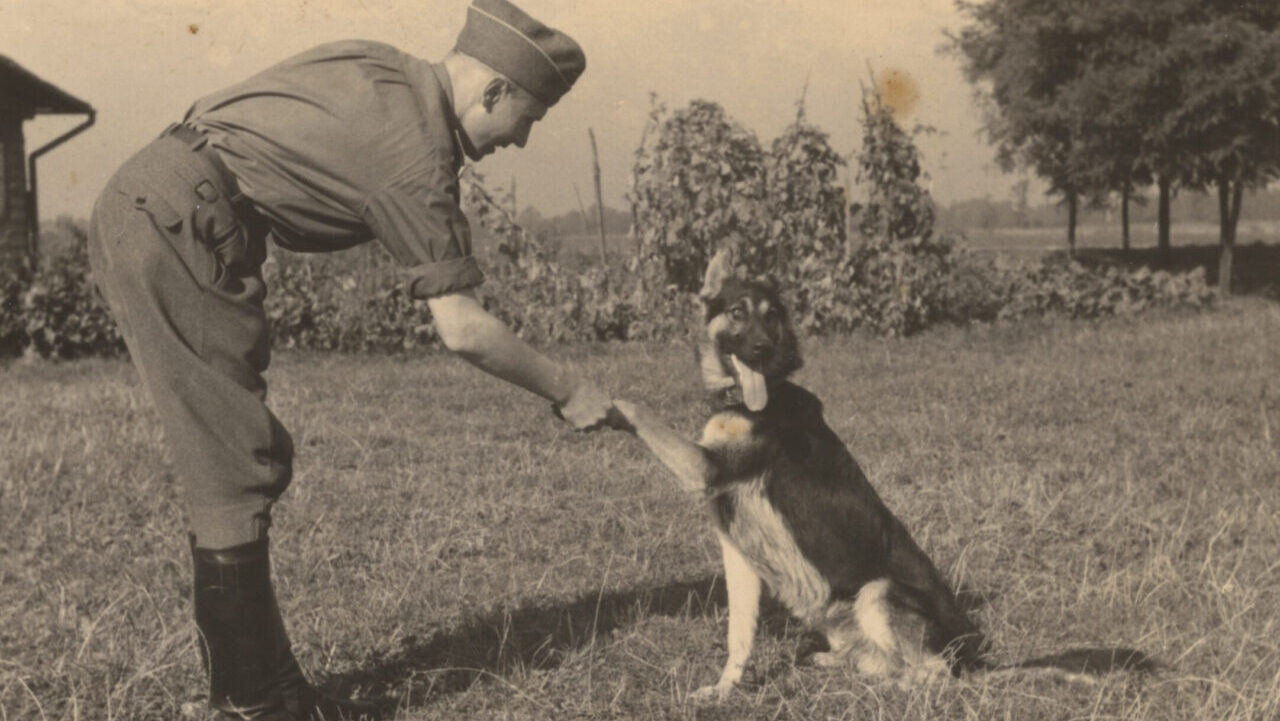
Hannah Arendt’s “banality of evil” thesis posited, among other things, that ordinary people are capable of committing horrendous crimes. That thought is unavoidable if you look through the photo album that inspired “Here There Are Blueberries,” a finalist for the 2024 Pulitzer Prize for drama coming to Berkeley Repertory Theatre in April.
The album contains more than 100 black-and-white photographs of Nazis who worked at the Auschwitz extermination camp. Compiled in 1944 by a young SS officer, Karl Höcker, the photos show the men and women during their leisure time: soldiers laughing as one of their rank entertains with an accordion; a group of young women sitting on a fence eating blueberries; Nazi officers grinning at the camera.
After the war, a lieutenant colonel with the U.S. Army found the album and kept it to himself for 60 years. In 2007, he turned it over to the United States Holocaust Memorial Museum, where a young archivist examined it and quickly recognized its significance.
No other photographic record of its type is believed to exist.
“Though Höcker’s album does not depict any criminal or immoral actions, one is struck by the amorality of the album. His album contains no photographs of gas chambers, torture chambers or even forced labor,” according to the museum. “Instead it captures SS officers going about their business, socializing, enjoying the beautiful weather and mourning fallen comrades, seemingly oblivious to the magnitude of the crimes which they are either perpetrating or enabling.”
“Here There Are Blueberries,” the 2018 play conceived and directed by Moisés Kaufman and written by Kaufman and Amanda Gronich, uses the photographs in the extraordinary album to examine questions of ethics and culpability. The play will run at Berkeley Rep from April 5 to May 11.
“Both Amanda and I come from Holocaust survivor families,” the Venezuelan-born Kaufman told J. “I always wanted to write a play about the Holocaust, but it’s one of the stories that has been most written about already. I thought, I don’t have anything new to say about it.”
The album changed that.
“When I saw these photos, I thought, this is something we didn’t know before,” he said. “How can you play an accordion or eat blueberries or light a Christmas tree when you are killing 1.1 million people?”
The album itself becomes a central character in the play. The actors interact with the photographs, sometimes reenacting the scenes they portray.
“We are asking the audience to step into the selfies of an SS officer,” said Gronich. “Slowly, the album sort of takes over the stage, literally. There are these huge projections of the images, and the actors are interacting with the images, almost like they’re scene partners.”

Gronich describes the play as a kind of detective story.
“What do these photographs show us? What are they revealing about life at the camp that we did not know before? How did the perpetrators see their actions? Why did Karl Höcker make this album, what did he want to show?”
To write the play, Kaufman and Gronich turned to the interview technique that Kaufman had previously used in his 2000 play, “The Laramie Project,” about the murder of gay college student Matthew Shepard.
Interviewing the residents of Laramie, Wyoming, where Shepard was killed, was markedly different from asking the descendants of Nazis pictured in the album to talk about their relatives, the playwrights said.
“We’re showing pictures to the people we interviewed. They are looking at the pictures and we’re saying, not ‘What do you think of this?’ but ‘Oh, that’s your father, right? That’s your grandfather?’ So for them, this is personal. What it’s asking of them is to reconcile their own legacy, their family’s legacy, with the history of their country,” Gronich said.
“I’m always struck by people’s willingness to share their story, that they feel the telling of their story is important to the understanding of the material, to understand the questions the play poses.”
Kaufman said he was inspired by Rebecca Erbelding, the archivist who received the former U.S. officer’s album in the mail in 2007. It was she who realized that some of the photographs included major Nazi figures, such as physician Josef Mengele, the so-called “Angel of Death” in charge of prisoner selection at Auschwitz and the architect of atrocious medical experiments, as well as camp commandant Rudolf Höss.

To see these men in casual, leisure mode led to new insights about their character and the way that Nazi men and the helferinnen, or young women who worked as secretaries and aides, compartmentalized their home and work lives.
“When I first interviewed [Erbelding], I fell in love with what she does,” said Kaufman. “The fact that she devoted her entire life in an archive to looking at the minutiae of history in order to extract from it something that might help us survive in the present, I find there’s great nobility in that. So in a way, the play is an ode to that, to the historian. What can the historian do to make our lives more bearable and more survivable?”
Throughout the play, Kaufman and Gronich examine the relationship between guilt and innocence.
They started writing the play during the first Trump administration, and the issues it raises, Kaufman said, are even more pressing today.
“We’re now in a moment where we have to decide for ourselves in America whether we’re going to be culpable, whether we’re going to be complicit, or we’re going to be complacent,” he said. “And that’s what the play asks us to think about. What is the difference between culpable, complicit and complacent? “
The secretaries at Auschwitz didn’t kill anyone, he pointed out.
“All they did was send faxes to Berlin about what trains had arrived when. But they were complicit, right? And Höcker, the man who took the photographs — he never killed anyone. But he ran a camp that killed 1.1 million people,” Kaufman said.
“So I think we can say that all of us are on that spectrum: culpable, complicit or complacent. And the play asks us to own that and to have more agency in deciding where we want to land.”
“Here There Are Blueberries”
April 5 to May 11, Berkeley Repertory Theatre’s Roda Theatre, 2015 Addison St., Berkeley. $47 to $134. berkeleyrep.org
“Talkback” conversations, sponsored by Fellowships at Auschwitz for the Study of Professional Ethics, will be held directly after some shows; check berkeleyrep.org calendar for details.
A Jewish Community Night will be held at 5:45 p.m. April 27, hosted by Berkeley Rep in partnership with the Jewish Community Federation and Endowment Fund, Jewish Family and Children’s Services, Taube Philanthropies and J. The Jewish News of Northern California. Includes live music, food and wine. Event is free and open to all; a paid ticket is required for the 7 p.m. “Blueberries” performance.