

Food coverage is supported by a generous donation from Susan and Moses Libitzky.
It’s hard for me to remember a time when matzah brittle, matzah buttercrunch, matzah toffee crunch, matzah crack — or whatever you want to call it — wasn’t part of Passover.
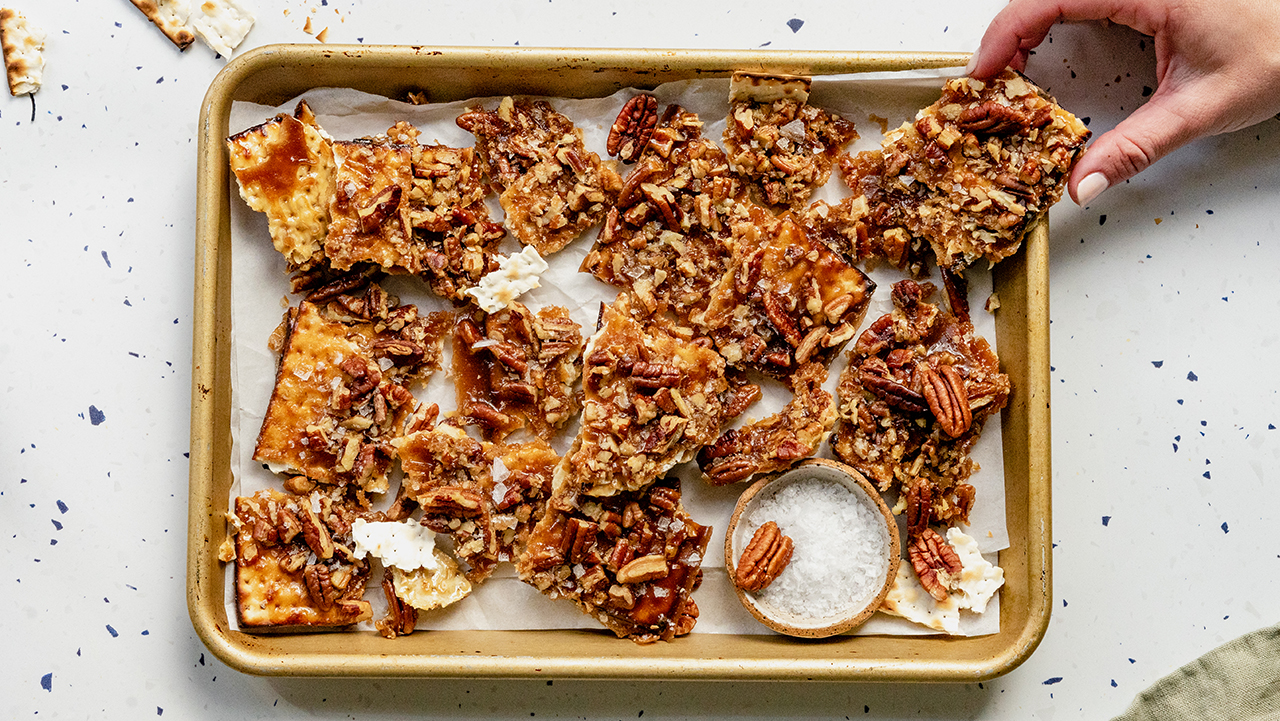
The confection, which is made by pouring a bubbling mixture of brown sugar and butter or margarine over matzah, and then topping it with chocolate and sometimes nuts or dried fruit, is credited to Marcy Goldman, a pastry chef, master baker, cookbook author and Jewish recipe writer who lives in Montreal.
The recipe is so beloved and widespread that, according to Goldman’s blog on her website betterbaking.com, it was presented to the Smithsonian Museum as an example of how something could go viral before the internet. The treat has been written about or highlighted in some way by everyone from Jewish food maven Joan Nathan in the New York Times to home-and-kitchen icon Martha Stewart.
But last year, I was contacted by a J. reader named Lawrence Lipman, telling me that his wife, Karyn, if not the true originator of the recipe, came up with the same idea at about the same time, around the mid-1980s to early 1990s. Naturally, I was curious to know more.
Originally from Chicago, Karyn Lipman graduated from UC Davis with a degree in food science. For about a decade between 1989 and 1999, she worked for Sunset, based in Menlo Park. She wrote for the magazine and authored nine Sunset cookbooks with themes such as low-fat Mexican food.

Being the “token Jew” on the Sunset staff, she said, it fell to her to regularly develop Jewish holiday recipes for the magazine. She always ran her recipes by the Northern California Board of Rabbis, she noted, to make sure they met kosher dietary laws.

Lipman, who most recently worked as a chef for the Hillel in Davis and the Chabad house in Vacaville, moved to Cuenca, Ecuador, earlier this year. I spoke with her via video chat.
She recalled seeing a recipe for toffee and soda crackers in the late ’80s and described it as her initial inspiration. If the recipe could be made with soda crackers, she figured, it could just as easily use matzah.
Her recipe, called “Butter Pecan Matzo Crisps,” was first printed in the July 1990 issue of Sunset magazine. (She sent me photos as proof.) Why Sunset chose to publish it in July — months after Passover — is anyone’s guess.
The chocolate on top, now an elemental part of the recipe, was optional in her recipe, she said, because back then it was hard to find dairy-free chocolate. The assumption was that the dessert would be eaten as part of the seder, a meal where meat was normally served. This is also why her recipe called for margarine or butter.
Meanwhile, Goldman traces the origins of her recipe to 1986, saying she wanted to create a Passover dessert that her picky son would enjoy. As numerous publications tell it, her recipe was first published in February of that year in the Montreal Gazette.
Out of curiosity, I wanted to see if I could track it down. I posted on Facebook to see if anyone had access to a database that could find it. A friend with ProQuest offered to be my research assistant. Within minutes, I had Goldman’s 1986 recipe in front of me.
Interestingly, it had nothing to do with Passover. It’s made with unsalted soda crackers, not matzah, and the headline is “Buttercrunch Easy to Make with Crackers.” (She gives credit for the idea to the cookbook “Farm Journal’s Choice Chocolate Recipes.”)

In 1998, an updated recipe appeared in Goldman’s popular cookbook “A Treasury of Jewish Holiday Baking” — now made with matzah and dubbed “My Trademark, Most Requested, Absolutely Magnificent, Caramel Matzoh Crunch.”
My friend/research assistant could find no evidence of any other “buttercrunch” recipe by Goldman in any publication other than the one with soda crackers in 1986. When I wrote to Goldman and asked her if another existed, she declined to respond.
Meanwhile, Lipman told me she had contacted Goldman two years ago asking the same question and got no reply. Lipman said she decided to speak with J. to show that more than one person can have the same great idea at the same time.
“I remember going to the Jewish Federation in 2012 for a holiday party, and they served it there,” Lipman said. “I made it for my own parties and widely shared the recipe and knew it was a hit. But then to be seeing it in the outside world and for sale at Whole Foods? All I could think of was ‘wow.’”
The recipe has only grown in popularity. Food writers such as David Lebovitz, a Paris pastry chef who once worked at Berkeley’s Chez Panisse and San Francisco’s Zuni Cafe, and Deb Perelman, who has built a devoted fan base for her Smitten Kitchen website and cookbooks, have created their own versions.
I called Dianne Jacob, a San Leandro writing coach and author of “Will Write for Food” who also happens to be Jewish, to get her take. She has often been consulted about the topic of “who owns a recipe” and noted that a blog she wrote about this very subject back in 2010 is one of her most popular posts of all time.
Recipes can’t be copyrighted, Jacob said, and food bloggers, in particular, are notorious for using the recipes of others without proper attribution.
“Matzah crack is the thing Marcy Goldman is most famous for, and many people over the years have said it’s theirs,” Jacob said.
I shared the two recipes with Jacob and asked for her thoughts. She echoed what I was already thinking.
“Yes, the recipes are in agreement,” she said. “There’s no way to know. These two women were on opposite sides of North America, and most likely didn’t see each other’s work.”
Added Jacob, “Recipe inspiration can come from anywhere. A lot of people think something came out of their heads, but most of the time they saw it or ate something like it, and it’s just in their subconscious somewhere.”
Here is Lipman’s recipe as it appeared in the July 1990 issue of Sunset magazine.
Butter Pecan Matzo Crisps
Thin, crisp unflavored matzos make a neutral base for these candy-coated snacks. This is a two-step operation: cook the candy, then spread it on matzos and bake (line baking pan with foil to avoid sticky bubble-overs).
- 2 unsalted matzos, each about 6 inches square
- ⅓ cup (⅙ lb.) butter or margarine
- ⅓ cup firmly packed brown sugar
- ⅓ cup chopped pecans
- ½ teaspoon vanilla
- ½ cup semisweet chocolate baking chips (optional)
Lay matzos, side-by-side, in a foil-lined 10- by 15-inch rimmed baking pan. In a 1½-
to 2-quart pan, melt butter over medium heat. Add sugar and pecans and stir often until mixture comes to a rolling boil, then boil until big, shiny bubbles form, 1 to 2 minutes. Remove from heat, stir in vanilla, and at once pour hot mixture equally onto matzos. Spread sugar mixture quickly and evenly with back of spoon or spatula up to but not over edges of matzos.
Bake in a 375° oven just until matzos are crisper, 3 to 6 minutes. Remove from oven. If desired, scatter chocolate over hot matzos; when chocolate softens, spread evenly with spatula. Let cool.
Break cool candy-topped matzos into small chunks. If made ahead, cover airtight and store in a cool place up to 4 days; freeze to store longer. Serves 8.
Small Bites
In 2021, I wrote that Sagie Kleinlerer, the general manager for Berkeley kosher winery Covenant Wines, was striking out on his own with his own nonkosher label, Kleinlerer Wines.
At that time, he joked that “it’s the greatest nonkosher wine made at a kosher winery in the world.” The only reason the wine wasn’t certified kosher was because Kleinlerer, who is Jewish, isn’t observant. Because he handled the wine, it couldn’t be labeled kosher.
Right out of the gate, Kleinlerer managed to attract the attention of some local fine-dining restaurants. That has only continued over the past few years.
However, Kleinlerer has changed his mind and decided to certify his wine as kosher so observant Jews can drink it, too.
“Wine is all about bringing people together,” he said. “So why exclude anybody? Some of the closest people in my life only drink kosher wine. And it led me to the realization that I’m excluding people from drinking and enjoying something that I put my heart and soul into.”
What has changed as far as production goes?
“Nothing. Except that now I do a lot more pointing at barrels and hoses than actually touching them,” he said.
Kosher consumers should know that only his new releases, the 2024 Kleinlerer Dancin’ Sophie Red Wine ($25) and the 2024 Kleinlerer Cuvée Sacha & Nitza Rosé of Cinsault ($29), are kosher.
On a related note, these two wines are not flash pasteurized and therefore are “nonmevushal” in Jewish law. This means they can only be handled by observant Jews, even when being poured into a glass, to maintain their kosher status. Both can be purchased at Kleinlererwines.com and will ship in late March, in time for Passover, which begins at sundown April 12.