
This is “The J. Interview,” a new series of Q&As, where we introduce you to leaders in the Jewish community, both lay people and professionals, who help make the Bay Area a hub for Jewish creativity and dynamism.
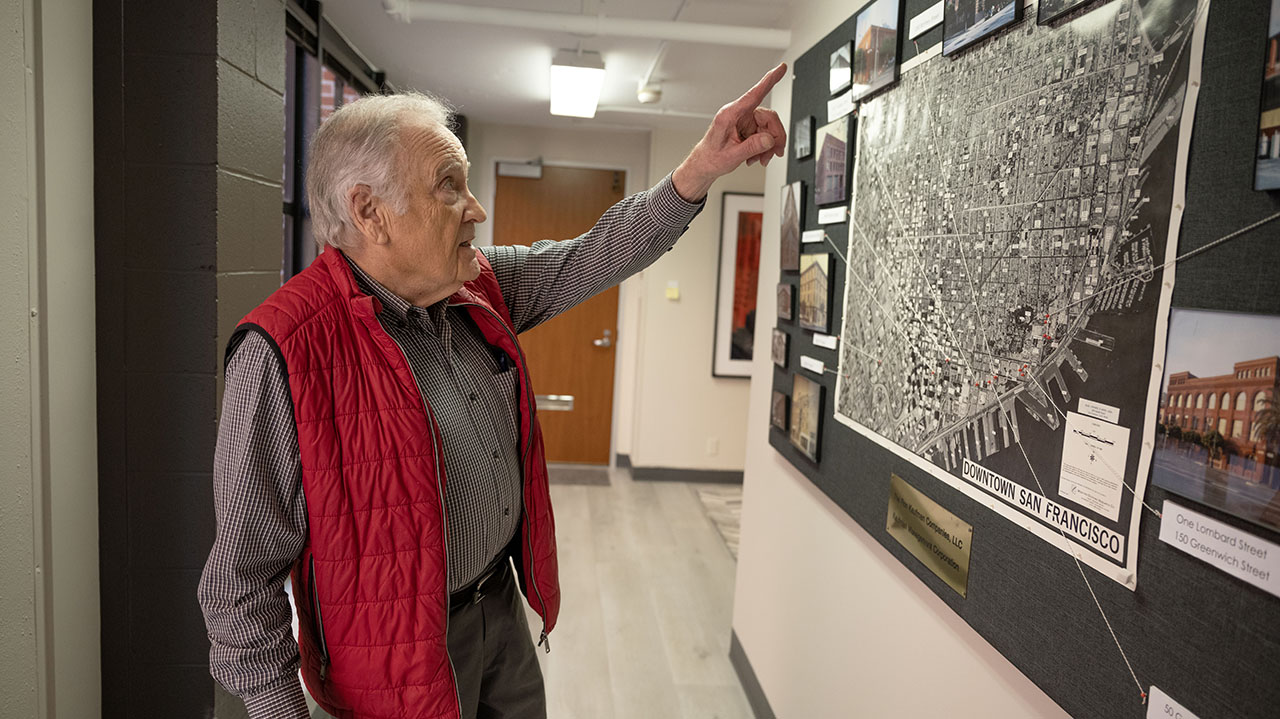
When I meet Ron Kaufman for lunch at the Royal Exchange, San Francisco’s landmark restaurant and sports bar on Sacramento Street, I quickly realize he is a regular. Everyone who works there seems to know him. Kaufman explains, “I restored this building in 1973.”
Kaufman, 90, has a long history of reviving treasures of the past. His commercial real estate firm, the Ron Kaufman Companies, helped save the Old North Waterfront area of San Francisco from demolition in the 1960s by restoring and repurposing the old brick buildings.
“He was enough of a romantic to think there was a way these buildings could be saved,” said Alan Rothenberg, a longtime friend. “He was one of the first people to realize that there was a reuse opportunity to these brick buildings that others just perceived as an earthquake risk.”
Rothenberg served on the Jewish Community Federation and Endowment Fund’s board in the mid-1980s when Kaufman was the president. Earlier Kaufman had served as president of S.F.-based Jewish Family and Children’s Services and in other leadership posts, including Jewish Vocational Service, the Hebrew Immigrant Aid Society and the regional chapter of AIPAC, which he co-chaired with his wife, Barbara.
The couple has been married for 70 years. Barbara, 91, stepped into civic leadership, too. After hosting a top-rated consumer advocacy radio show, she was elected to the San Francisco Board of Supervisors in the early ’90s and became board president in 1997.
Kaufman could easily be enjoying a life in retirement. But instead, he’s spent years working on another revival project: “M.M. Diaries,” a Holocaust-era work of fiction he co-wrote with author Terence Clark. Published in 2023, it tells a dramatic story of a Jewish developer of the V-2 rocket guidance system used by the Nazis.
J. spoke with Kaufman about his hopes for the future of San Francisco, what he sees ahead for the Jewish community and how his new book, like his old buildings, bears modern significance.
This interview has been edited for clarity and length.
J.: Did you always plan to go into real estate, or did you have other aspirations?
Ron Kaufman: When I got to UC Berkeley I had just turned 17. I envisioned that I was going to be a research doctor, but about two weeks into pre-med, I realized that the world around me was very different. It was 1952 — McCarthy, the Russian Cold War, etc. — and I felt that being locked in a lab for eight years wasn’t going to be a way to know what’s going on. So I switched to political science and history with an emphasis on European democratic history. Later I went into real estate research in urban land economics at the Graduate School of Business at Berkeley.
How did you and Barbara meet?
My sophomore year at Berkeley, I went home to Tucson for Thanksgiving break. My older brother, who was at the University of Arizona, fixed me up for five dates. Barbara was one of them. We really did connect. We had a long-distance romance for two years. When we got married I was 20. I had to get my parents’ approval!

How did you start your career?
I had a number of offers from large companies, and I didn’t want that. I wanted to work for a firm where my efforts paid off faster. So I went to work for a one-person firm — the boss and myself. In those days, there was a huge need for new industrial properties and new warehouses. That was like a hangover from the Second World War, where a lot of these buildings were simply worn out. That led from one opportunity to the next. In 1963 I started my own firm, the Ron Kaufman Companies.
What got you interested in revitalizing buildings?
In the ’60s, most people said we’ll tear [the Old North Waterfront] down and put up a new building. Well, the new buildings that I saw then were like refrigerators with four solid sides and some windows and nothing. I thought the old buildings were architecturally unique buildings that could never be duplicated. So I started focusing on that area and wound up restoring a good number of them.
How did you get involved with the Jewish Federation?
They recruited me. They said, you’ve got to come be on the real estate committee. I go, “OK.” I had no idea what it was going to involve.
You’ve traveled to Israel several times. When was your first visit?
Barbara and I led a couples mission to Israel in April of ’74, shortly after the Yom Kippur War. That was my first time. We put together a wonderful program where we went to different places that had real historical significance, including to the Golan Heights, where you could see hundreds and hundreds of Russian tanks that had been hit by Israel just lying there. The Syrians were still shelling at that time, so we had to scramble for the bus to get out, because we started hearing this boom. I was 39, our son was 13. I had [my adult] bar mitzvah on Masada.
Having lived in San Francisco for so many decades, what are your thoughts on the current state of the city? Are you optimistic about its future?
I kind of think it’s overbuilt, and unfortunately for the people that own large buildings, I think they’re going to lose a lot of their value. I believe rents will adjust, and it will attract people. It’s going to take time. The pandemic was something that nobody could have imagined, and it has affected building occupancy tremendously. Hopefully that will come back. I’m hopeful that our new mayor will deliver. He doesn’t have the political chits to pay off, so he can be, I think, much more independent than prior mayors. I take nothing away from the prior mayor, but I think [Daniel Lurie] … can clean house a lot better. When Barbara was a supervisor, the city budget was like $3.5 billion. Today it’s maybe $14 billion. Something’s out of whack that’s got to be corrected.
What do you make of the changes you’ve seen in the Bay Area Jewish community over the decades?
I think the synagogues are trying hard to do a good job. If you look at the statistics of our Jewish communities, at every level they have become welcoming and nurturing for interfaith families. Our survival depends on how well we can deal with that. For instance, 18 Doors. They put out some wonderful material for interfaith families. That’s something that I feel is extremely critical.
In 2022 you self-published “Entries in the M.M. Diaries.” A year later it was published by Itasca Books as “M.M. Diaries.” What inspired you to write a novel about how a Jewish man helps save his family by developing the V-2 rocket system for the Nazis?
The motivation goes back to the Yom Kippur War. I was just appalled that, at the time, Israel was surprised when Russia sold Egypt thousands of tanks. They sold Syria and Iraq thousands of tanks, and those tanks were moved to the border. How could they not know that? And it was almost a disaster. But fortunately, a few hundred soldiers on the Israeli side of the Golan Heights held the line.
There are so many books written about dictators and about the Holocaust, I thought I’d like to write something that’s a new twist, where there’s an unusual hero, and use the diary format so that people could read a little bit at a time, and the facts were woven into each diary entry. It took from 1974 to 2020, because I actually had no leisure time in my life. I had 16 thick notebooks of material to boil down.