
My childhood was all about the joy of Judaism. It was preschool songs about tzedakah and Shabbat. It was Friday night with candles and white grape juice. It was stories of Moses and Esther that felt as real to me as any fairytale.
I was fortunate enough to be born in Pittsburgh in 2003, after my parents and brother emigrated from the former Soviet Union.
For my brother, who spent his early years in Moscow, Judaism was something distant, something he knew about but never fully understood. It was something he feared and, dare I say, resented. He grew up in a place where being Jewish meant knowing when to lower your voice, when to be careful and when to disappear. I grew up in America where I could wear my Judaism proudly, like the first Magen David my father gave me.
It’s said that for a ba’alat teshuvah, one who becomes Orthodox as an adult, faith is something the neshamah, the soul, has always yearned for. That’s my story too.
Looking back, I think my soul always knew where it belonged. Even before I knew what tzniut (modesty) meant, I felt it. As a toddler, I refused to wear jeans, leggings or anything that resembled pants. No matter how much my mother and grandmother tried to convince me, I threw tantrums until they let me wear dresses, even in the freezing, snowy Pittsburgh winters. I couldn’t explain why. I just knew.
Years later, after summers at a Chabad camp, I begged for long skirts, wanting to wear them the way my counselors did, wanting to hold onto that piece of Judaism long after camp ended. It was the way I brought Shabbat into our home, teaching my parents everything I learned at Hebrew school and camp. My father wasn’t much of a cook, and my mother worked 12-hour shifts at a hospital, so at just 10 years old, I took it upon myself to make full Shabbat meals. By the time my parents came home, the candles were lit, the table was set, and we could sit down together, something that rarely happened during the week.
At the time, I didn’t think of any of this as religious observance. It was just instinct. Just the way I felt most like myself.
Then I arrived at UC Berkeley in 2021, and for the first time, I was forced to explain my Judaism, forced to explain myself.
I had always assumed that antisemitism was a relic of my parents’ past, the reason they had to flee the only country they had ever known. I thought I had escaped that history. But at Cal, I learned quickly that antisemitism wasn’t history.
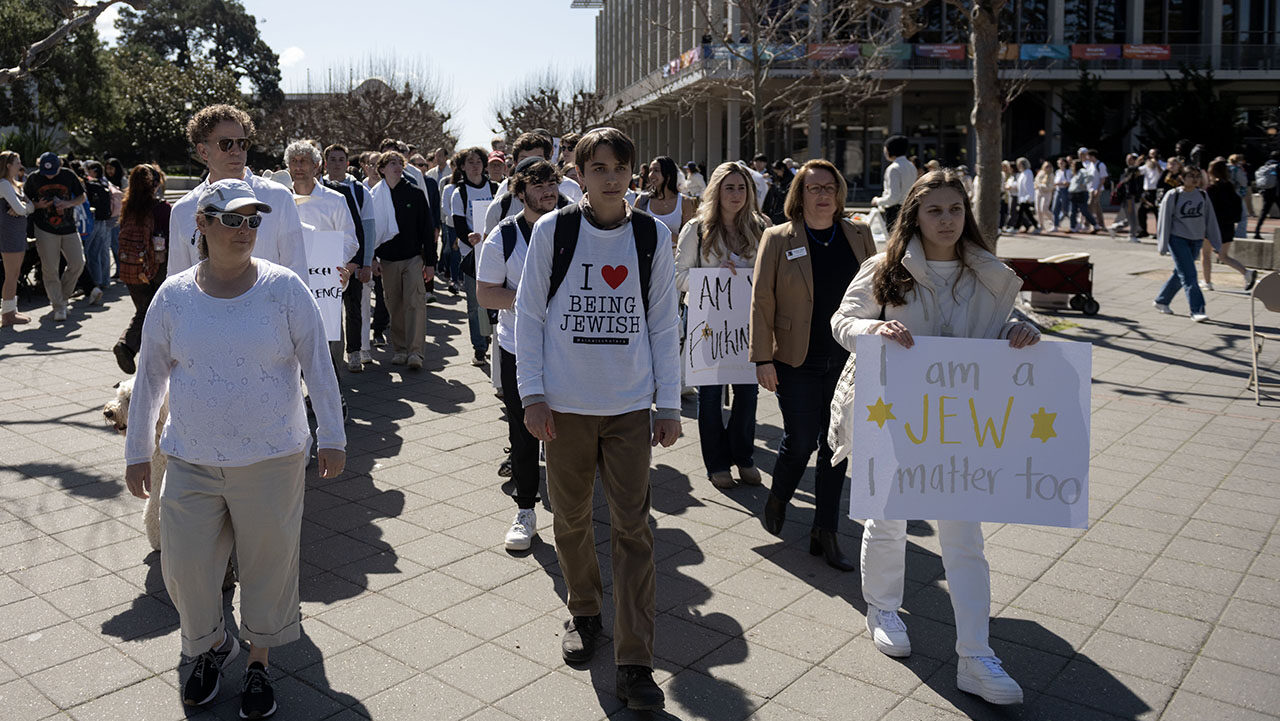
UC Berkeley prides itself on diversity, on inclusion, on making sure every student feels safe and heard. But that doesn’t apply to Jewish students. My professors questioned students’ Jewish identity, questioning whether even the High Holy Days were valid excuses for class exemptions. Student organizations demonized Israel with rhetoric so vile that it bled into verbal attacks on Jewish students regardless of their observance level, community affiliation or views on Israel. Campus groups held forums on justice and liberation, but when Jewish students asked for the same, we were met with silence. The rules that applied to every other minority, every other persecuted group, simply did not apply to us.
The situation wasn’t great before Oct. 7, 2023, but became unbearable after that.
It felt like I was screaming into a void. And when I refused to be silent, the void screamed back.
When I spoke at rallies after Oct. 7 as co-president of the Zionist campus group Bears for Israel, I began receiving death threats over social media. Strangers online told me they knew where I lived and that I deserved to die. Anti-Zionists on social media plastered my face with words meant to strip me of my humanity.
I walked to class wondering if the people who smiled at me might know me from coverage in the San Francisco Chronicle or the New York Post — or if they were the same people sending me threats behind a screen. And the worst part? The university, the place that claimed to protect its students, said nothing. I realized then that for Jewish students, there was no safety net.
But I didn’t back down.
I appeared on national broadcast networks and wrote op-eds in the Jerusalem Post and Times of Israel. I helped organize pro-Israel speakers, including bringing Israeli attorney and military reservist Ran Bar-Yoshafat to Zellerbach Playhouse — the event where verbal attacks on Jews turned into physical ones. I stood on the steps of my own university and demanded that Jewish students be given the same respect, the same safety and the same dignity as everyone else.
I wasn’t asking for special treatment. I was asking for the bare minimum. And still, we were met with excuses, with justifications for hate masquerading as political discourse.
I should have felt defeated. Instead, I became more observant.
At first, it was small — lighting Shabbat candles in my dorm and refraining from certain activities on Friday nights. But then, one week, I decided to keep Shabbat completely. No phone, no laptop, no distractions. Just 25 hours of silence. I found myself staring at the clock at times, counting the hours and wondering why I was putting myself through this. But when Shabbat ended, I felt something I had never felt before: clarity, strength and a connection to something unbreakable.
Over time, Shabbat became my anchor. I even kept it when I visited foreign cities where I didn’t speak the language or know my way around. Every time, I came to the same realization: If I could hold onto Judaism thousands of miles from home, I had no excuse to let go when it got difficult at home.
Now, I am running for the World Zionist Congress on the Aish Ha’am slate because I refuse to take this privilege for granted. My ancestors whispered Psalms in secret, hoping for a future where their descendants could be proudly, unapologetically Jewish.
That future is now, but it is not guaranteed. The fight against antisemitism is happening in lecture halls, on social media and in the streets. The only way to push back is through strength, community and unwavering conviction.
We need a Judaism that is strong, proud and united. Zionism is not just about Israel but about the Jewish people’s right to exist with dignity everywhere. Through the World Zionist Congress, we have the power to direct critical funding and policy decisions that impact Jewish education, security and representation worldwide.
This is not just another election, it is a battle for our collective future. If we do not stand up, others will make decisions for us. If we do not fight for our right to be heard, we will be silenced.
I stand here today because those before me refused to be erased. And I will keep standing so that those who come after me never have to wonder if they belong.
You can vote in the WZC elections through May 4. Vote for a Jewish future rooted in strength and faith so that the next generation will have the same sense of belonging.