

Save our Jewish history
Ever since J. successfully digitized its 125 years of Bay Area Jewish newspapers, we at the San Francisco Bay Area Jewish Genealogical Society have publicized the project to our members and worldwide contact list.
One of the society’s missions has been to index the Bay Area Jewish cemeteries as part of the JewishGen Worldwide Online Burial Registry; we added some 45,000 names to the 4.2 million name list.
All this is part of our work to make Bay Area Jewish records and information available to Jewish genealogists.
At the end of January, the SFBAJGS also unveiled its own newspaper contribution. Working with Brian Geiger and the California Newspaper Project at UC Riverside, the society used its own funds to have The Hebrew newspaper digitized. The run begins with 1864 and goes up to 1906 with gaps (which we hope to fill).
Like you, we were lost for words when Brian contacted us. Stunned! Shocked! In disbelief! How could the state do this? How could the state allow this? (“Our digital archive is threatened by state budget cuts,” April 18).
As I wrote to Sen. John Laird (and I will also write to the UC Riverside chancellor), the California Newspaper Project website does not appeal only to Jewish genealogists, but to academics, authors, historians — in fact, anyone around the world who has a professional interest in California and Bay Area history.

Also, because of the 1906 San Francisco earthquake, we lost pretty much all of the Bay Area vital records for births, marriages and deaths. Hence newspapers, once thought of as ephemera, are now seen as vitally important and the only way we can learn when people were born, got married and died.
Yes, there are censuses, but these are known to be notoriously inaccurate, especially when it comes to recording people’s ages!
Our only hope is to galvanize everyone to write to members of the Senate Budget Subcommittee and get them to reinstate the, dare I say it, paltry $430,000, given that the FY2026 California budget is $332 billion!
Jeremy Frankel
President, S.F. Bay Area Jewish Genealogical Society
A plea to the chancellor
After reading your recent article about the threats to the J. digital archive project, I felt compelled to act. I wrote the following letter to UC Riverside Chancellor Kim A. Wilcox, and I encourage others who care about preserving California’s Jewish history to do the same:
Dear Chancellor Wilcox,
I am writing to urge you to continue supporting the digital archive project of J. The Jewish News of Northern California in the face of proposed state budget cuts. This archive is a treasure trove of California Jewish history and a vital educational and cultural resource for scholars, students, families and community members across generations.
As highlighted in J.’s recent article (“Our digital archive is threatened by state budget cuts,” April 18), decades of California Jewish life — stories of immigration, resilience, community-building and civic engagement — are at risk of being digitally silenced. The archive offers unparalleled insight into a vibrant and diverse community that has helped shape California’s social and cultural fabric.
The University of California’s commitment to diversity, equity and inclusion should extend to preserving community voices historically underrepresented in mainstream historical narratives. Backing out of this project now would not only halt a remarkable collaboration but also send a discouraging signal about the value of community-based histories.
I respectfully request continued funding for the digital archive project. Let’s not lose this opportunity to preserve and share a rich, enduring legacy that belongs to all Californians. With appreciation for your leadership and consideration.
Angela Ingel
Burlingame
Criticize in private, support in public
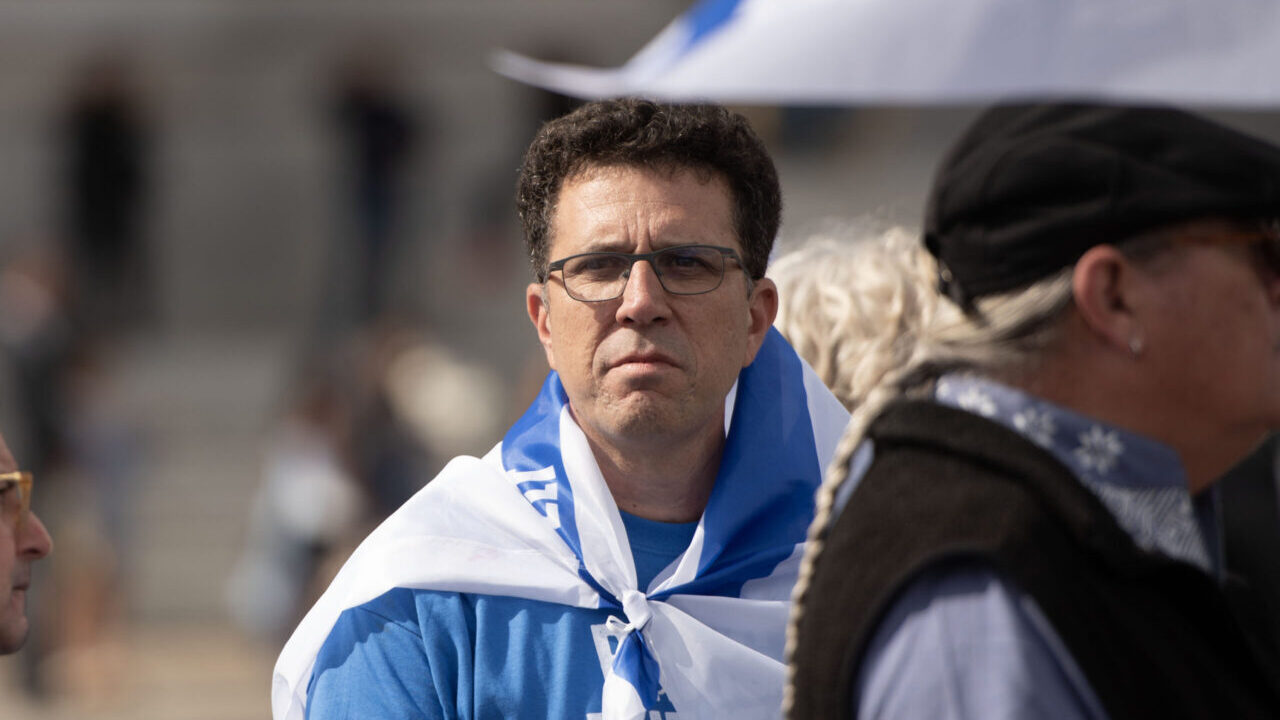
I just finished reading your article about “UnXeptable” and was very disappointed. (“The Palo Alto expat who finds the threat to Israeli democracy ‘unXeptable,” April 18)
The interview makes it seem as if Offir Gutelzon represents a big portion of Israelis, but nothing is further from reality. Many Israelis I know in the Bay Area disapprove of his actions. I do, too.
I am an Israeli who served in the army, but I was born and grew up in the diaspora, moving to Israel at age 22. One of the most important things I was taught at home, in Jewish school and my youth movement was not to criticize Israel in public. Obviously, because Mr. Gutelzon grew up in Israel, he wasn’t exposed to these teachings.

Israel has been an example of democracy and free speech since its Declaration of Independence in 1948. Thousands demonstrate in Israel every week, but there is a big difference between doing it inside and outside of Israel.
While UnXeptable claims the demonstrations are against the prime minister and not against Israel, I need to remind them that the prime minister was elected by the people in free and democratic elections, and that by demonstrating against him in public, they are weakening the image of Israel in the world.
Ariel Goldstein
Berkeley
Stop using the Jews
I write in support of Offir Gutelzon and his UnXeptable group, featured in the “Spotlight on Israel” section (“The Palo Alto expat who finds the threat to Israeli democracy ‘unXeptable,” April 18). I attended one demonstration that UnXeptable mounted in S.F. after Oct 7. Gutezon’s stand against Netanyahu’s corrupt behavior and UnXeptable’s active global movement for the preservation of Israeli democracy parallel what Americans, particularly Jewish Americans, must do to stand together and resist in all ways possible the cruel, often illegal actions of the Trump administration.
Now, when it seems the battle against Trump’s executive orders is being carried out in our courts, we could let these judges know how grateful we are for their positions and rulings to protect the Constitution and our democracy. The same is true for voices in Congress opposing his legislative maneuverings.
Speak out against Trump’s exploitation of Jews and his claims that these actions are in response to antisemitism. He’s just using us for his own deviant purposes.
Bonnie Lindauer
San Francisco
UnXeptable’s goals are suspect
The laudatory article about Offir Gutelzon of UnXeptable (“The Palo Alto expat who finds the threat to Israeli democracy ‘unXeptable,” April 18) is consistent with the J. policy of continually amplifying voices of the far left while marginalizing those of the right.
The question the article failed to ask is whether UnXeptable is really interested in preserving democracy in Israel, or whether its real goal is to preserve continued leftist domination of the legal system and continued marginalization of religious believers.
Gutelzon says it’s unacceptable for Benjamin Netanyahu, who is under indictment for illegal actions, to serve as prime minister. But the Israeli electorate evidently disagreed when they exercised their democratic right to return him to power. If Gutelzon is really a champion of democracy, he should accept the democratic will of the people and oppose the current government only at the ballot box instead of trying to overthrow it by inciting massive civil disorder.
Regarding Netanyahu, many in Israel consider the charges against him to be based more on politics than a desire for justice. Prosecutors always have broad latitude to decide which cases to pursue, and many legitimate cases are never pursued at all due to lack of interest. There’s a widespread suspicion that if a leftist politician were accused of the relatively minor infractions Netanyahu is accused of, leftist prosecutors would never have brought charges.
Martin Wasserman
Palo Alto
Let’s make the polluters pay
At the end of Passover, we stop praying for rain because the rainy season is over and, hopefully, grains have started to grow. Here in California, the dry season has started, which should be a cause for celebration. Yet because of climate change, our dry season is now significantly hotter and longer. This means more burning forests, heat-related deaths, crop loss and migration. The dry season is here, but it isn’t a cause for much celebration.
This past January, the L.A. fires killed 30 people and destroyed more than 12,000 homes, countless other structures and the historic Pasadena Jewish Temple and Center. The estimated cost is between $250 billion and $275 billion, likely the most costly wildfire in U.S. history. What happened in L.A. is hardly an outlier. California’s 2018 Camp Fire, for instance, took 85 lives and destroyed roughly 19,000 structures, including the town of Paradise. The damage then was also in the billions.

We know that climate change is caused by fossil-fuel emissions. Yet, the oil and gas companies that produce these emissions get direct subsidies from the federal government amounting to tens of billions of dollars per year. Tax breaks and indirect subsidies raise that amount into the hundreds of billions. Those subsidies endanger people, forests and economies.
Here in California, our leaders have introduced the “Polluters Pay Climate Superfund Act of 2025.” If passed, this bill would establish a state fund for climate disaster recovery and resilience projects, paid for by fossil-fuel polluters. Our community must demand that our state legislators pass this bill. You can contact yours at dayenu.org/take-action-california.
Let’s give our children and their children hope and a healthy planet.
Michal Strutin, San Jose
Steering committee member, Dayenu Circle of Jewish Silicon Valley
Yom HaShoah’s endurance
Your recent coverage of Yom HaShoah addressed the importance of honoring the memory of the victims and heroes of the Holocaust. (“Hundreds pay respects as local Holocaust survivors are honored on Yom HaShoah,” April 29) However, it omitted a key piece of historical context that helps contextualize the significance of this solemn day.
On April 12, 1951, the Knesset passed a resolution designating the 27th of Nisan as Holocaust and Ghetto Uprising Remembrance Day. This day was later renamed “Yom HaShoah Ve’Hagevurah” in the Holocaust Heroism Remembrance Law of Yad Vashem in 1953, and was formally established in Israeli law through the Martyrs’ and Heroes’ Remembrance Day Law in 1959.
Including this background in future coverage would deepen public understanding of the day’s origins and its enduring relevance.
Téa Kaiser
Director of Press and Communications,
Consulate of Israel to the Pacific Northwest
So nice I made it twice
I made Amy Siegel’s “Spanikomatzah” twice during Passover (“‘Spanikomatzah’ — an unleavened take on a Greek classic,” April 4). Delicious and not too difficult to make. It was good to have something new to eat using matzah. Mine were not as beautiful as Amy’s, but they ate the same.
Jill Maleson
Fremont
