
Updated May 11
A small group of San Jose State University faculty and a retired librarian are disappointed and frustrated with the administration’s formal response to a display that they say “intended to demonize Jews” last fall in the main library.
SJSU history professor Jonathan Roth filed a complaint in January with the university office that handles allegations of discrimination, harassment or retaliation based on a protected status. The complaint contended that one of the altars in a Day of the Dead display was full of antisemitic tropes.
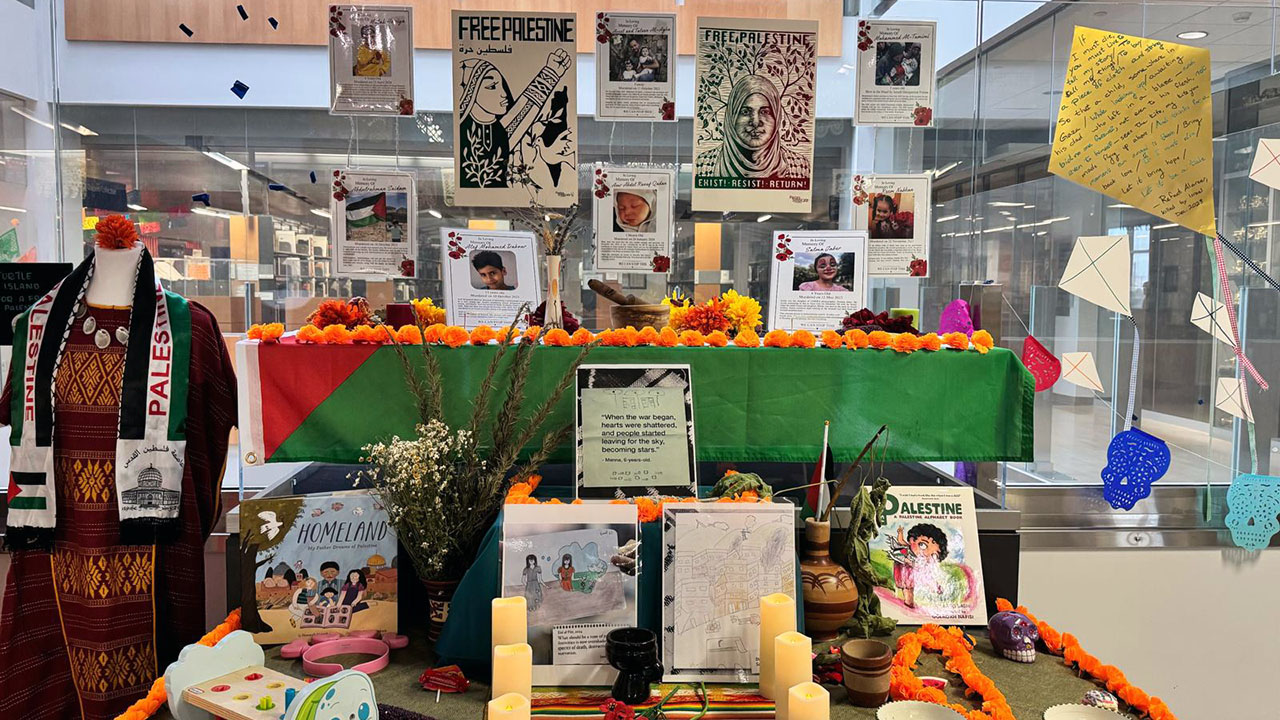
The ofrenda, Spanish for “altar,” displayed 14 photos of Palestinian children killed in the Israel-Hamas war, accompanied by stories of how the “Israel Occupation Forces” — a term used by anti-Zionists in place of the Israel Defense Forces — were responsible for their “murder.”
A small coffin, draped in a Palestinian flag, and two children’s books — “Homeland: My Father Dreams of Palestine” and “P is for Palestine” — were part of the altar. Children’s shoes and sandals were placed at the foot of the altar, part of a weeks-long display at the Martin Luther King Jr. Library, which serves as both SJSU’s sole library and the city of San Jose’s main library.
“It was a punch in the gut,” said Deborah Estreicher, a retired public librarian at King who co-signed the complaint after a friend shared photos of the display with her in October. “It was obvious propaganda from Hamas-aligned individuals.”
The group of six Jewish professionals, all of whom signed the complaint, are still seeking answers from the university. In a May 6 press release, they said they remain “unsure” who created the altar, what resources or staff were involved and why it was allowed to stay up for weeks.
The altar “manifested an age-old antisemitic idea: that the Jewish people are heartless killers of children and innocents, a modern version of the medieval Blood Libel intended to demonize Jews,” Roth, four other faculty and the retired librarian wrote in the press release.
After months of back-and-forth emails between the group and SJSU’s Title IX and Equal Opportunity Office, a final response was issued April 14 and determined that the display did not violate university policy. The response was shared with J.
“The delineation between actionable harassment and free expression is not always clear,” Mary Keating, SJSU’s associate vice president for Title IX and Equal Opportunity, wrote in her response to the complaint. “Nevertheless, our Nondiscrimination Policy and federal and state constitutional principles protect the right of people to air their views, no matter how offensive such views might be to others.”
Keating added that the university “strongly opposes stereotypical, derogatory opinions that are directed at a particular ethnic group” and noted that the library has invited the group to create a display to “counter the speech” for Day of the Dead this fall.
Roth responded to Keating in an April 20 letter co-signed by the same four faculty and retired librarian, expressing their disappointment and frustration with the decision.
“Many Jewish students and faculty have communicated to us their fear of expressing their support of Israel or indeed openly expressing their Jewish identity on campus. Your legalistic and evasive response only exacerbates the perception that the Administration does not grasp or take seriously the widespread antisemitism as SJSU,” they wrote to Keating.
“We do not seek a response. Rather, we expect that the SJSU Administration will acknowledge the serious and pervasive problem of antisemitism on campus, issue unequivocal and public statements condemning this specific incident and antisemitism generally and take decisive and concrete actions to address racism against Jews and Israelis, rather than a continuing pattern of delay, evasion, defensiveness and inaction,” they continued.
Fred Cohen, director of SJSU’s school of music since 2014, is one of the Jewish faculty who co-signed the complaint.
“This one thing at the library — it strikes me as an anomaly. It doesn’t reflect the university at large,” Cohen said. “There are very pro-Zionist faculty, there are very anti-Zionist faculty, they’re at the extremes. I think most Jewish faculty feel the way a lot of Jews do, very conflicted about this whole thing,” he said. Cohen noted that the university is financially supporting his May 10 musical performance, “Nizkor: A Journey of Remembrance,” meant to honor Jewish mourning rituals.
However, other Jewish faculty see antisemitism becoming pervasive at SJSU.
Roth, who spearheaded the complaint, has been on paid administrative leave since February 2024 when pro-Palestinian student protesters filled a hallway and chanted outside a room where a Jewish professor, invited to campus as a guest, was speaking.

Roth began recording a protester with his phone. When the protester put their hand directly in front of the phone, Roth allegedly pushed their hand down. A scuffle ensued, and police intervened. The university has not concluded its investigation of Roth over his alleged role in the altercation. Roth declined an interview with J. while the case remains under review.
Heidi Livingston Eisips, formerly a senior lecturer in SJSU’s school of business, stepped away from that role in fall 2024 when she took a medical leave. The university no longer feels like a safe place for her as a Jew and a Zionist, she told J. She also withdrew from completing her doctorate at SJSU.
“I had it like 99% done, and I left without finishing because I don’t want that university name on my certificate,” Eisips said.
Eisips co-signed the complaint in January.
The university’s response to that complaint was “disappointing,” she said, and came months too late. “To respond … in 2025 is such an insult,” she said. “This was hate speech.”
A Jewish Faculty and Staff Association exists at SJSU, Eisips said, but she knows some Jews who won’t join it or prefer to fly under the radar.
“I think that’s a sign of not being a safe place. If people can’t proudly show who they are, and your group has lies spread about it, and there’s acceptance of those lies, it makes you feel like you have to live under cover,” Eisips said.
“I think there’s a way to fully allow for free speech and fully allow for all ethnicities on campus to be included under the law,” she added. “And that has not been accomplished.”