
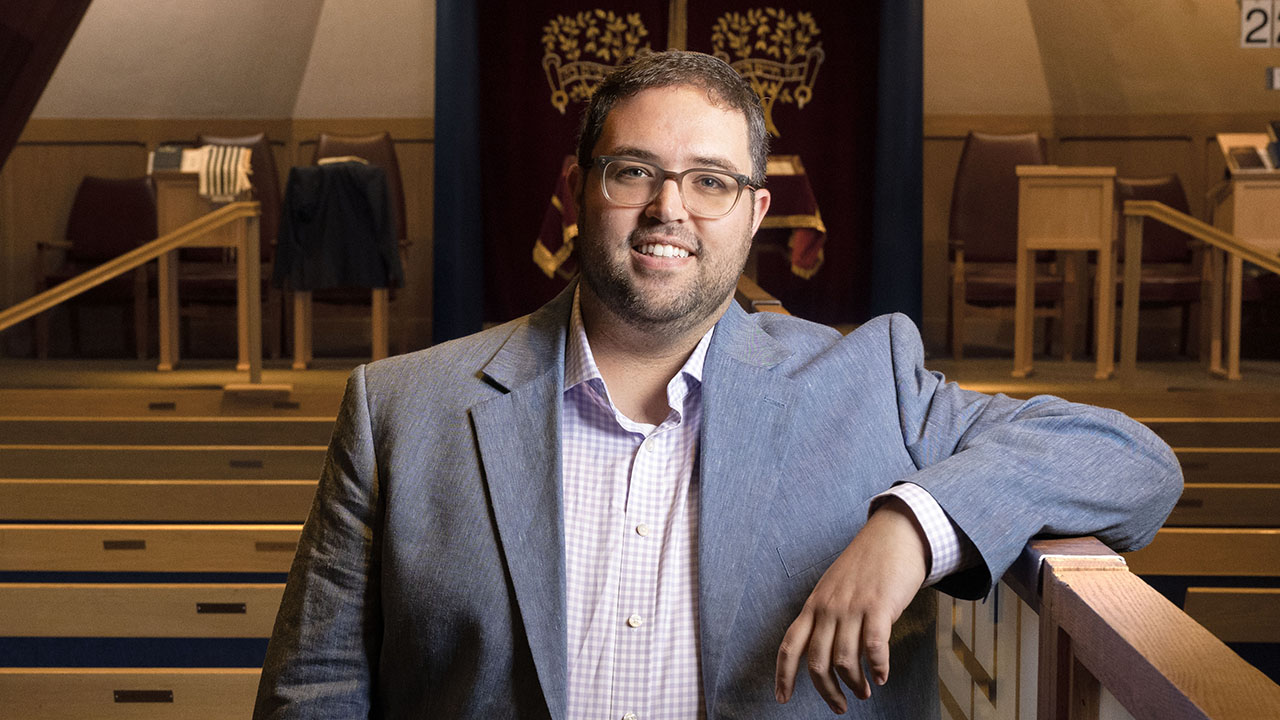
The most striking thing about Rabbi Shua Brick’s nearly five years at Oakland’s Beth Jacob Congregation may be how completely routine they’ve been.
That’s not at all a given. Brick, 31, is believed to be the first openly gay Orthodox rabbi to serve an Orthodox synagogue in the country, or perhaps the world.
He has been doing his job quietly all these years, ever since Senior Rabbi Gershon Albert hired Brick as director of family learning at the Modern Orthodox shul in August 2020 as his ordination approached.
“Our synagogue is not an activist community,” Albert said. “We’re just trying to live our values, and accept every Jew for who they are.”
While that is true, the Bay Area Jewish community is also part of an open and LGBTQ-friendly culture. It’s how Brick ended up here in the first place and not in New York, where the large Orthodox community leans more conservative.
More than two years ago, Brick began the process of coming out more publicly, beyond his congregation, by speaking with Forward reporter Louis Keene. That article was published on Oct. 5, 2023, but it barely made a ripple, coming right before the devastating attack on Israel and the start of the ongoing war with Hamas. Whatever negative or positive reactions there might have been to the article were muted as the Jewish world was plunged into crisis.
Now firmly established in the Bay Area, Brick sat down with J. to talk about how he sees his role — he splits his time between Beth Jacob and the Jewish Community High School of the Bay in San Francisco (JCHS), where he teaches Talmud and Jewish ethics — and what he hopes to achieve going forward.
On one hand, he made clear that his communal responsibilities are a higher priority than talking about himself. On the other hand, he is a trailblazer. Working to create an Orthodox world that is more welcoming to LGBTQ Jews like himself is part of his mission.
“Many LGBTQ Jews who grow up Orthodox feel they would be better off if they left for the other, less restrictive movements, or Judaism altogether,” Brick said.

By not doing either and by taking a leadership role, Brick hopes he might help other Orthodox Jews to see themselves reflected in his journey and to believe that the observant world holds a place for them, too.
“It’s nice for me to be safe here,” he said. “But the idea would be for people like me to be safe everywhere.”
Brick always knew he wanted to become a rabbi. His journey toward self-acceptance was a long one.
It was during an internship at Beth Jacob in early 2020, before he was ordained, when Brick shared with Albert that he was gay.

“I had wanted to offer internships to young, future Orthodox clergy who would benefit from the kind of open-minded yet serious Judaism we try to cultivate here at Beth Jacob,” Albert said. “Rav Shua’s background, his intellectual, spiritual and academic pursuits, were all really impressive. When I interviewed him on the phone, he came off as compassionate, thoughtful and creative, and when I spoke to his references, I heard nothing but wonderful things.”
When later that year Albert offered him a job, Brick accepted with the condition that he would be open about his identity. Brick considers his sexual orientation and entire belief system to be fully and halachically within mainstream Orthodoxy.
Albert conferred with the synagogue’s board president and a few key members.
“Of course, I care about my reputation in the Orthodox world and want to make decisions that are halachically responsible,” Albert said, referring to Jewish law. “While I spoke to rabbinic advisers and peers about this, ultimately we all have to face HaShem.”
Albert emphasized that he was also motivated by the desire to reach observant Jews who might be feeling distanced from “Torah and mitzvot.”
“I have an opportunity to create a different path,” he said.
In addition, Albert has a personal reason. He had a gay friend growing up who kept the truth from him for years, and it has bothered Albert to know that his friend struggled alone and felt the need to hide his identity for so long.
Coming out in Oakland
Historically, Beth Jacob has always been a place where people of many different viewpoints and levels of observance congregate and coexist under one roof. Brick has fallen hard for its approach.
“I met this beautiful community, and I’ve been in love with it ever since,” he said.
Brick waited several months after his 2021 ordination from Yeshiva University to come out to Beth Jacob congregants. He and Albert discussed starting with some of the shul’s core members, and Brick began going down the list, emailing congregants and asking if he could stop by to talk about a synagogue project he was working on. Brick laughs about it now, as the language he used had most everyone thinking he was going to ask them for a donation.
Albert helped him craft a response should anyone have a negative reaction, but they needn’t have worried.
“When they learned that I was there to tell them I was gay, they were thrilled,” Brick said. “It was definitely big news to most people, and there were definitely a lot of emotional reactions. But without exception, every single one of them was incredibly excited and overwhelmingly supportive.”
That response continued as he came out more fully to the congregation and experienced only reassurance. Until those conversations, Brick had considered himself a burden or liability to any community that hired him.

“As a human being, to walk in the world and think of yourself as a huge liability is not great,” he said. “Having this community telling me how happy they were to have me was incredibly meaningful and made me see myself differently.”
Warren Mazer, a longtime congregant, expressed a view that he felt was held by many of his fellow Beth Jacob members: “It doesn’t affect my life in any direct way, except that I would like him to be happy and to be able to stay here,” Mazer said.
Single rabbis are quite common in all other movements, but not in the Orthodox world. Unmarried Orthodox rabbis have a harder time finding positions, Brick said, and a rabbi’s personal life is constantly open to remarks. He said he felt none of that intrusion when he arrived at Beth Jacob, both before and after he came out.
Brick’s presence at Beth Jacob also has sent a strong message to queer observant Jews in the area. One of them is Michelle Katznelson, who had ruled out Orthodox synagogues because of her queer family.
Katznelson grew up somewhere between Conservative and Orthodox, and her wife is a secular Israeli American. She had tried nearly every synagogue in the East Bay, she said, and none felt like home. It was after the couple had their son and put him in Beth Jacob’s daycare program that they gradually started to become a part of the community. Then Katznelson began attending services.
She already had been feeling very warmly toward Albert when, less than a year after her family joined, she learned the rabbi had hired Brick with the knowledge that he is gay.
“It meant a lot to me that Rabbi Albert hired Shua knowing that it would come out eventually, and he let him do it in his own time and in his own way,” Katznelson said. “Rather than being the kind of person who takes bold activist stances, Rabbi Albert finds a way to just quietly be a mensch about things and has a really solid sense of Jewish ethics.”
Starting with Yeshiva U
It’s been 25 years since the groundbreaking film “Trembling Before G-d,” which testified to the existence of LGBTQ Orthodox Jews, and more than 25 years since Rabbi Steve Greenberg became the first Yeshiva University rabbi to come out as gay. Brick, however, is the first one known to be hired at an Orthodox synagogue.
YU is the flagship institution and seminary of the Orthodox movement. Brick’s father is a rabbi and attorney, his mother works at YU, and his family is well known in the community. (For years now, LGBTQ students at YU have sought greater acceptance, taking their fight to establish a campus club all the way to the U.S. Supreme Court.)

Brick waited until he had his ordination document in hand before he began coming out to some of his former rabbis and teachers.
“Each one amazed me with how much better on the subject they were than I thought they might have been,” he said. “I don’t think there’s a single [Orthodox] rabbi that hasn’t gotten more progressive over the last 10 years on this subject. But for a variety of reasons, they have no clue how to say it publicly.”
Mazer said it’s only natural that whatever is happening among the movement’s leadership would trickle down to Orthodox congregations, too.
“While Modern Orthodoxy does drag its feet, there’s a realization that we all have family members or people close to us who are gay, and the interest in letting them live their full lives as human beings and keeping them in the community is taking priority over prejudices or strict interpretations over things that are really nobody else’s business,” Mazer said.
In an observant community in New York or New Jersey, if you don’t like the rabbi or his politics, you can just walk down the road to the next one. Here, there are no other Modern Orthodox synagogues within walking distance.
That Brick would end up serving a community where he couldn’t even get a slice of kosher pizza was unfathomable to him before he arrived in Oakland. Yet once he was here, he realized that he had landed at his dream job, splitting his time between his synagogue work and teaching at the high school. It was exactly how he envisioned his career years ago.
At JCHS, he said, “I cannot describe how much no one there cares.”
The high school is nondenominational and welcoming to all, but Brick said his presence on staff might help Orthodox families feel more comfortable sending their children there.
Rabbi Howard Jacoby Ruben, JCHS head of school, called Brick a “fan favorite” of both students and faculty.
“He honors students’ inquiry and invites it without judgment. He models curiosity and inspires both more curiosity and deeper digging on the part of the students. And he’s also a favorite among his colleagues, because without regard to the subjects they teach, he’s fascinated by the craft of teaching and learning from others about how to hone his craft,” Ruben told J.
Ending the silence
Brick’s decision to come out more publicly and participate in the Forward article was largely influenced by the suicide of Herschel Siegel, a classmate at YU who took his life in 2023.
“From that moment,” Brick said, “I felt that leading by quiet example is not sufficient.”
So many of his colleagues stay silent about the existence of LGBTQ people in the Orthodox world because they don’t know what to say, Brick said, and in doing so, they are abandoning religiously observant Jews who need them.
“The LGBTQ community is disappearing themselves from our community, whether they’re choosing to leave or physically killing themselves,” he said.
A spokesperson for New York-based Jewish Queer Youth, which serves the Orthodox community, said that 58 percent of its participants have thought about suicide and 24 percent of them have attempted suicide.
According to Brick, the Orthodox establishment speaks one way publicly and another way behind closed doors. He would like to see the rabbis he’s had frank conversations with say publicly what they’ve said to him privately. Despite their reticence to speak up, he said, “there’s been real growth in the Orthodox rabbinate that people are completely unaware of.”
As for the Biblical passage that is responsible for so much of the way that gay Jews are treated in the Orthodox community — Leviticus 18:22, which states that a man lying with a man as he would lie with a woman is an “abomination” — most Orthodox rabbis interpret it to mean that gay Orthodox Jews must remain celibate to avoid violating halachah. But Brick said that it’s reductive to talk about this passage in too much detail.

Nevertheless, “most serious rabbis I’ve spoken to know that reparative therapy, marrying against your orientation and celibacy are all horrible ideas,” he said. “So at some point, a vision of what’s left needs to be explored halachically.”
One of the projects he’s working on is a curriculum that he hopes can one day be shared with Orthodox schools around the country, spelling out how to approach that Biblical passage and how to respond when a student comes out.
“Rabbis often have the first 100 words, but they don’t have the next 100 words,” Brick said. “They don’t know what to say after that. I want to offer everyone what the next 100 words are. It’s a series of Torah shiurim [lessons] that is content that they’re all familiar with that isn’t at all controversial but deeply speaks to the queer experience.”
Sources abound already for educators, but none come from a Jewish and Torah-observant perspective, he said.
“What is the authentically Jewish way to find an integration between one’s Jewish and queer self?” Brick said. “It’s not just copying and pasting and repeating a bunch of platitudes that you’ve heard at some recent Pride march. There are authentically Jewish ways to do this, and we need to find it from within our Jewish sources and not from without.”
This summer, Brick is transitioning to a different role at Beth Jacob, as resident scholar. He will also be devoting more time to an inclusivity initiative he founded. Called Queerkeit Incubators, its goal is to promote the visibility of queer Orthodox Jews, making it easier for them to find one another.
“There are so many people who know, like, a handful of other happy Jewish Orthodox queer people and don’t realize that there are hundreds of us across the country,” he said.
Brick organized a retreat last August that 40 people from around the U.S. attended in Baltimore. He has organized the Queerkeit participants around writing groups, but creating community is just as important as the writing itself. His intention is to “create the community and to create the kind of Jewish queer canon that I wish I had when I was growing up.”
Just as his self-perception has evolved over time, Brick hopes that the greater Orthodox community will continue to evolve as more of his contemporaries come out and find their own place in the observant world, too.
“These are people who have to decide to choose Orthodoxy against their best interest,” Brick said. “We keep treating them as if they’re liabilities instead of realizing that they are resplendent souls that are definitely closer to God in some way that we haven’t fully appreciated.”