

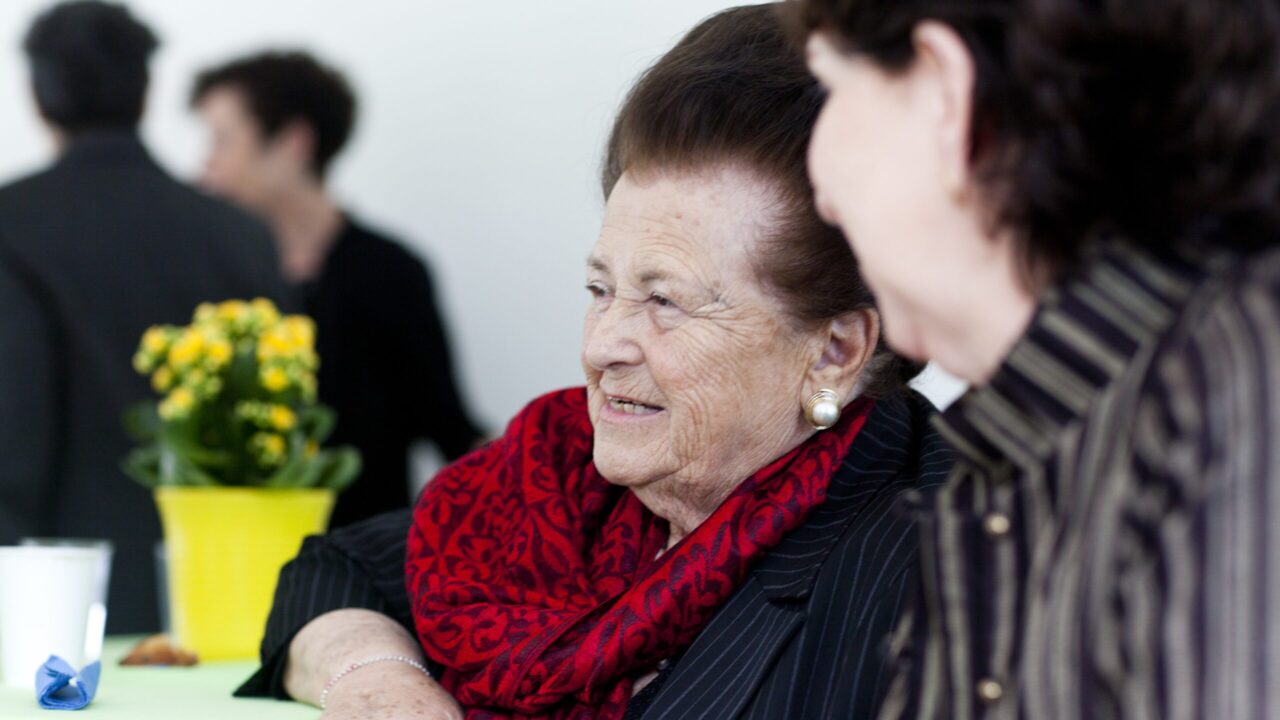
Tauba Weiss survived two ghettos and three concentration camps, all while still in her teens. The trauma left her with fears — of bright lights, of going hungry — but it also made her strong. One thing those experiences did not do, however, was fill her with hate.
“My mom and dad always told me there were good Germans and there were bad Germans. There were good Polish people, there were bad Polish people,” her son Norman Weiss told J. “My parents were very, very good at making friends with everybody. They didn’t care if you were Jewish, if you were Catholic, it didn’t matter. One of the things my mother always told me was: ‘Everything you do, do it from goodness.’”
After nearly 70 years living in the same house in San Francisco — years during which she helped establish the Holocaust Library and Research Center of San Francisco (now the JFCS Holocaust Center), spoke at numerous schools about her life and helped settle Jewish immigrants from the former Soviet Union — Tauba Weiss died on June 7 in her son Allen Weiss’ home in Petaluma, where he had been caring for her in her final years. She was 100.
“Tauba was one of the first survivors who welcomed me when I joined the staff of the Holocaust center in 2005,” said Morgan Blum Schneider, now the center’s director.
“Tauba was always genuine. She spoke from the heart and told you how it was immediately,” Blum Schneider continued. “She was an extremely articulate and passionate person. When she walked into a room, people turned themselves to Tauba, and she earned their respect and their attention in the most genuine way. As a young professional, it was an honor to work with her and to learn from her.”

Tauba Piotrkowski was born Jan. 25, 1925, in Lask, a town in central Poland near Lodz. In an oral history recorded in 1989 by the United States Holocaust Memorial Museum, Tauba said that Lask had about 3,500 Jews, barely 60 of whom remained alive in 1945. She had seven brothers and sisters. Besides Tauba, her father and one brother survived the Holocaust. Her mother and other siblings were gassed to death in Chelmno.
When the Germans invaded Poland in 1939, she and her family were sent first to the Lask ghetto, and then in 1942 to the Lodz ghetto. From Lodz, Tauba, her father and one of her brothers were sent to Auschwitz, Stutthof and Terezin. They survived, she said in her oral history, because her father, a baker, was put to work baking for their Nazi captors.
Many fortuitous events conspired to keep her alive, she related. Once, when she was scheduled to have a breast removed as part of a Nazi medical experiment, the doctor simply did not show up, so she was released.
After the war, she met up with her cousin from Lask, Morris Weiss, and they married. When they were not welcomed back to their hometown, they went to Germany, where they survived by selling food and other necessities on the black market, according to Norman, who was born along with his older brother, Sam, while the family was still in Germany. It was 1951 before they received permission to leave for the United States.
The family settled first in Petaluma, where they had relatives, and then moved to Sebastopol, where they had a chicken farm. Finally in 1958, the family moved to San Francisco, which had been Tauba’s dream since she saw a picture of Golden Gate Park while in a displaced persons camp in Germany.
“Also, she wanted us to have a better chance of finding a Jewish wife,” Norman told J.
Tauba was always “very Jewish,” he said. The family joined Adath Israel, an Orthodox congregation in San Francisco, and Tauba remained a member until her death.
Unlike many survivors, Tauba often spoke to her three children about her wartime experiences. She felt, said Norman, that educating the next generation was imperative. “I would always ask my mother, ‘How can you believe in God after what you suffered in the Holocaust?’” he recalled. “And she said, ‘God was on vacation.’”

In April 1977, the Weiss family made it into the pages of this publication — and the New York Times — when a Nazi bookstore opened in their neighborhood and just across the street from Congregation B’nai Emunah. Tauba organized a group of local survivors to break in and wreck the place. Morris and the couple’s youngest son, Allen, were arrested. But the bookshop closed down.
The city’s “Jewish leadership” had told Morris and Tauba not to act on their own and instead to wait until a lawsuit could be filed against the store, Norman said. “But she was not someone to keep her mouth shut. Neither of them were. They were physically very strong.”
That incident galvanized Tauba and a number of other survivors, who worked with then-San Francisco Supervisor Dianne Feinstein to establish a Holocaust library and research center, which later became the Holocaust Center of Northern California and is now known as the Jewish Family and Children’s Services Holocaust Center. They also worked to create a Holocaust memorial outside the California Palace of the Legion of Honor and an annual local public commemoration of Yom HaShoah. Tauba served for decades on the Holocaust center’s board of directors and was active on its speakers bureau, telling her story in schools and universities throughout the Bay Area.
“The thing she always stressed to the students was, her children never had a grandma, so they should pay attention to their elders,” Norman said.
When Jewish immigrants started arriving in San Francisco from the former Soviet Union in the 1970s and again in the 1990s, Tauba reached out to help many of them. She housed some in an apartment the couple owned on 48th Avenue, Norman said, and some of the immigrants named their children after her.
After Morris died in 1984, the Holocaust center established the Morris Weiss Award, to be given annually first to students, and more recently, to teachers educating about the Holocaust. This week, Blum Schneider asked the permission of surviving sons Norman and Allen (Sam is deceased) to rename it the Tauba and Morris Weiss Award, in honor of both parents’ commitment to Jewish education.
Blum Schneider kept up with Tauba over the years, visiting her in her home as she continued to age and sharing details about the planned expansion of the Holocaust center.
“I brought her pictures and told her about our plans, and it brought her to tears,” Blum Schneider said. “She was overwhelmed with joy. She said, you are creating this space for everyone, just as it should be. I told her, you’re going to be there to cut the ribbon when we open the new Holocaust center. Of course, now she will not be there.”
Blum Schneider can’t stress enough the lessons she learned from Tauba over the years. The essence of those lessons, she said, is “to remember with responsibility.”
“When I say that phrase, I think of Tauba, because remembering the Holocaust is not a passive act,” Blum Schneider said. “It is one that has a great weight and a great responsibility to it. And that was instilled in me by Tauba, and the other survivors, of course.”
Tauba was buried next to her husband, Morris, at Eternal Home Cemetery in Colma.