

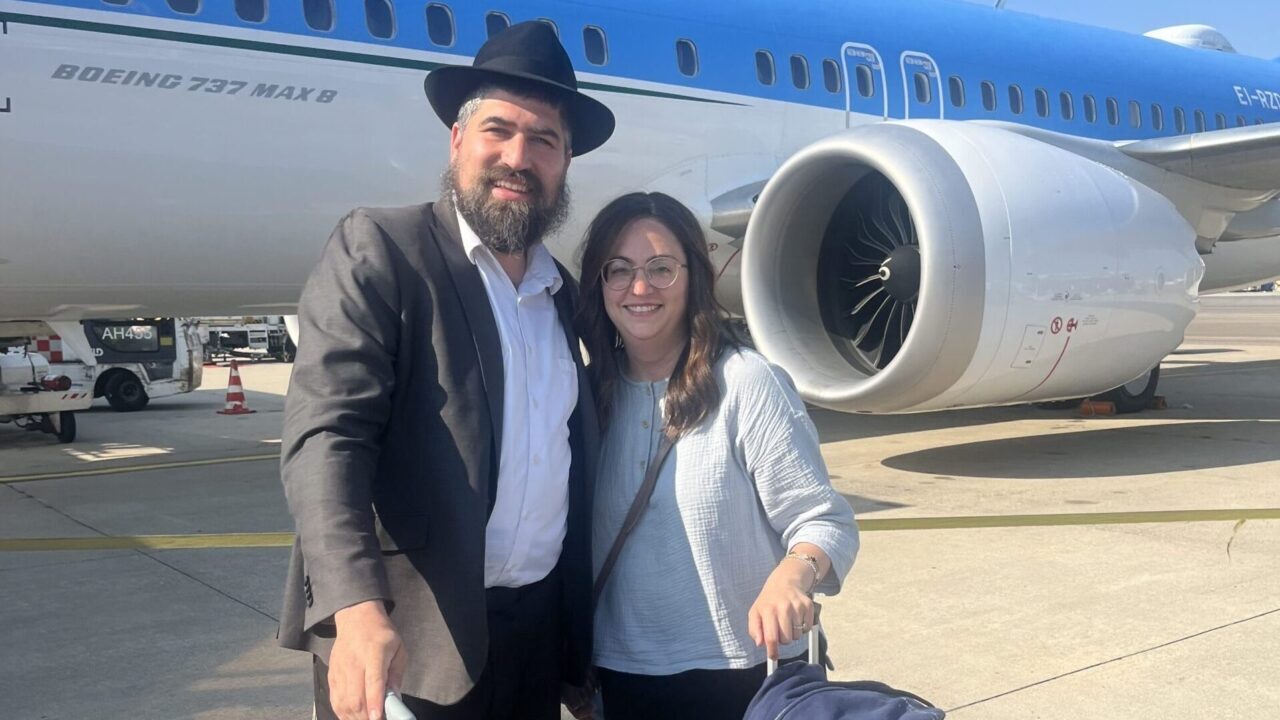
Rabbi Raleigh Resnick had to cancel a community trip to Israel once before, because of Covid lockdowns.
This year’s community trip was impacted for a very different, but no less threatening, reason. The group, affiliated with Pleasanton’s Chabad of the Tri Valley, arrived in Israel on June 9, just days before war broke out with Iran.
On June 17, the Tri Valley group of two dozen people left Israel not from Ben Gurion International Airport, which was mostly closed to air traffic, but via a bus through Egypt and then a plane from Sharm-el-Sheikh. They traveled along with 165 other people, mostly Hasidic Jews, in an operation organized by the New York-based humanitarian aid nonprofit Tzedek Association.
International tourists have been scrambling to leave Israel since June 13 amid the daily barrage of Iranian missiles, most of which have been intercepted by Israel’s missile defense system.
On Monday, Israel’s Ministry of Tourism updated its plans for foreign tourists and Israeli citizens seeking to leave or return. The Israeli government is working with the four Israeli airlines to organize flights for 50 passengers each. The announcement also pointed to five land crossings with Egypt and Jordan and noted that it is also possible to leave via sea. Information is available at iaa.gov.il.
Resnick spoke to J. on June 20, describing the journey as a whirlwind.
It began as a “standard Israel trip,” he said. “Masada, the Dead Sea, the Golan, Jerusalem.” Resnick, his wife Fruma and two of their seven children were joined by 18 to 25 others, as some participants joined up with or left the main group while they were in Israel.
“Our first night was in the north. Everyone was so excited,” he said.

Meanwhile, a separate set of visitors had arrived in Israel too.
Randi Brenowitz of Palo Alto, who travels nearly every summer to Israel, was there with her husband, Dr. Marty Klein. Brenowitz, who is president of the Melton School at Hebrew University, planned to attend a board meeting at the school, visit the Shalom Hartman Institute and see friends.
Brenowitz understood it would be wise to leave the country after Israel attacked, Iran retaliated and the conflict continued to escalate. Still, she had mixed feelings about exiting because of her close ties to the country.
“Leaving felt like, of course, the right thing to do. There was no reason to stay in a warzone in my expensive hotel room, or the bomb shelter,” she said. “But I also felt almost like we were deserting our Israeli brothers and sisters.”
She was staying in Jerusalem and was in contact with her travel agent, who assured her that he could book flights home — provided she and her husband left Israel first. That was the hard part.
So Brenowitz used her network. A friend told her that the “grandparents of her daughter’s colleague” were helping coordinate evacuation flights. Citing a remarkable example of “Jewish geography,” she said, “we were able to join in with them.”
Beginning around 5 a.m. local time on June 18, the group of seven people drove to Tel Aviv, then to Eilat, the coastal city at Israel’s southern tip. From there they crossed on foot into Jordan — it is not permitted to cross by vehicle. Brenowitz said she was glad she had already consolidated her luggage into one bag back in Jerusalem.
The group was driven to the airport in Aqaba, Jordan, then flew by private plane to Cyprus. Then to London and finally to the U.S. In total the journey took roughly 48 hours “almost to the minute,” Brenowitz said, adding that “it was a jarring experience. The whole thing felt surreal.”
For Rabbi Resnick’s group, all went swimmingly during the first few days of their trip.
They visited the Golan Heights, took a boat trip on the Kinneret, toured Tsfat and Akko and then visited Jerusalem and its Old City.
Then in the early hours of June 13, Israel attacked Iran and the first of many sirens sounded.
“For some, there was nervousness when the sirens go off,” said Resnick. But there was also calm and trust. “At breakfast in the hotel there was a certain joy, a confidence that we were all in this together. There was this incredible sense of unity.”
Dr. Laura Silverstein, a group participant, described it as a “long trip” in a phone call with J.
An ob-gyn with the Palo Alto Medical Foundation, she and her husband, University of the Pacific physics and astronomy professor Daniel Jontof-Hutter, took their three children on the community trip to celebrate son Eitan’s bar mitzvah in Jerusalem.
It was their children’s first time in Israel — and the first time Laura and Daniel were visiting there together.

Eitan’s coming-of-age celebration at the Kotel on June 12 was one of the last simchas before the airport and much of Israel shut down entirely.
Like the Silverstein children, many in the group were on their first trip to Israel.
Silverstein noted that theirs was one of the only tour groups in Israel that continued traveling, with their bus and guide, for days after the war began. On June 15, they picked cherries on their guide’s kibbutz in the Gush Etzion area in the West Bank, replacing Palestinians who were not able to get to work due to security lockdowns.

“It felt good to get out of the hotel,” she said, and “our guide told us that otherwise the cherries would go to waste.”
Even so, Resnick knew he had to get the group home. They had plans, they had work, they had medical appointments — it was time. He knew about the Tzedek Association, which had airlifted 1,300 people out of Afghanistan in August 2021, including members of that country’s women’s soccer team.
He called a friend who worked there and found out that Tzedek was organizing an “exodus” through Egypt and that the Tri Valley group was welcome to join.
Tzedek founder Rabbi Moshe Margaretten, speaking to J. from Brooklyn, said his organization already had experience putting together “rescue missions,” first from Afghanistan and then after Oct. 7, 2023, from Israel, primarily helping American visitors get home. When Iran began launching missiles on June 13, American Jews in Israel started calling and asking whether he could get them back to the United States.
“We waited for two days to make sure this was necessary, and then we saw it was a real war and we had to get involved,” Margaretten said.
Meanwhile, earlier in the week some members of the Tri Valley group left separately on a land route through Jordan. Eighteen people joined the four Resnicks and the Tzedek group on five chartered buses to Eilat. The group numbered 189 in total, the number of seats on the plane waiting to take them from Sharm-el-Sheikh at the southern tip of the Sinai to Milan, Italy.
In Eilat, the group walked across the border to Taba in Egypt. They were quite a sight, Resnick said, with the men in tzitzit and payes and the women in long skirts.
“It was like a scene from central casting,” he said. “You couldn’t make it up. Seminary girls coming home after a year in Israel. People going home to weddings. You had Monsey, the Five Towns, Brooklyn, Modern Orthodox, too.”
Lines at the border were long, and people’s luggage was checked and rechecked. The Egyptians were nervous, Resnick said, and kept telling the Jews not to pray, not to take pictures, not to gather together to form a minyan.
Silverstein said security guards confiscated her husband’s binoculars and double-checked her father’s camera to make sure it didn’t have a telephoto lens. “They must have thought we might be spies,” she said.
Finally the large, unwieldy group made it through and boarded five buses that took them all night through the Sinai. Security guards were on every bus, and the convoy was escorted by Egyptian police. Again no praying, no taking of photos.
Still, noted Resnick, “It was beautiful, we saw the sunrise over the Sinai desert.”
The plane took off from Sharm-el-Sheikh and landed in Milan. From there, people arranged for their own flights home. The Resnicks took a United flight back to SFO, landing at 8 p.m. June 19.
It was, Resnick and Silverstein agree, an adventure. Neither of them felt it was a negative experience. Quite the contrary.
“For me, the takeaway is, as I wrote to the group last night, ‘Am Yisrael Chai’ is not just a slogan,” said Resnick. “To be in Israel at a time like this, you feel part of the global Jewish family. It’s unbelievable.”
When Brenowitz arrived in San Francisco with her husband, their driver was carrying flowers. At that point Brenowitz, feeling a whole host of emotions including relief, broke down in tears.
“I just lost it,” she said, describing gratitude about having the financial resources to safely leave the country, and a long and trying journey home. “As nutty as things are in the U.S., I have to say, I felt safe.”
Gabe Stutman contributed to this article.