

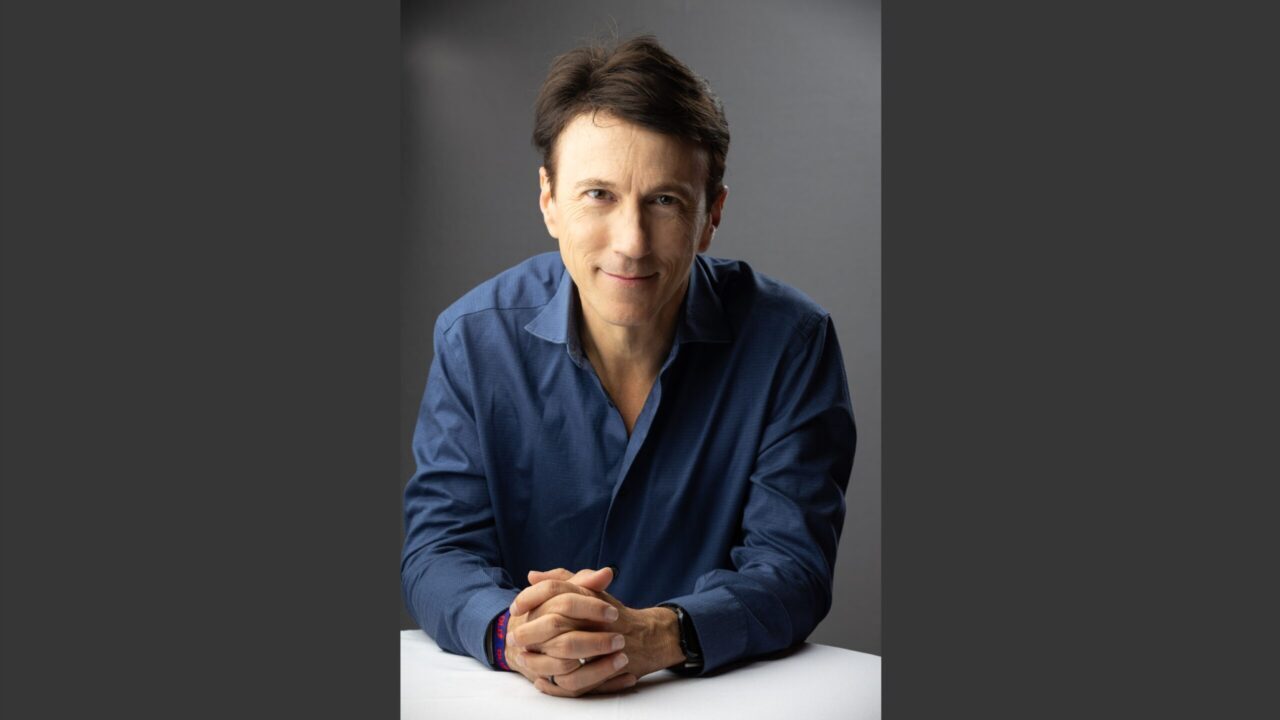
Dr. Daniel Kraft is a physician/scientist/inventor/entrepreneur who managed to earn his pilot’s license and dabble in meditation while attending medical school at Stanford, completing his residency at Harvard and working as a clinician.
Kraft, who is 57 but says his “biological age” is closer to 45, has been focused on health care innovation since 2011 when he founded NextMed Health conferences, which highlight technological advances in health care.
Since 2009, the Portola Valley resident has also given multiple TED Talks on this topic, introducing audiences to emerging technologies.
Kraft spoke on June 18 at the Human + Tech summit in San Francisco about how AI, biosensors and behavioral technology can combine to transform the field of preventive health. He also has two talks scheduled for September related to his work in the Israeli startup scene: first at the ARC Innovation summit in Tel Aviv and then at the ICON innovation week in Palo Alto.
J. spoke to Kraft about his Jewish background, career and vision for the future of medicine.
What was your talk at the Human+Tech Conference about?
The main questions I explored were: What’s next in health and medicine and how do we see what’s cutting edge, how do we help shape a better future.
Moving from sick-care based on intermittent data, collected usually when you’re already sick or visiting the hospital room or the emergency room, to a world of much more proactive, personalized, preventative care.
This conference was not really a medical one. It was more about this idea of human flourishing. For example, how do we think about mental health not as simply Alzheimer’s, depression, schizophrenia, but instead as a way to optimize brain health and human performance?
Did you always know that you were going to be a doctor?
Not always. I liked science. I had good science teachers in high school. I was lucky to do an internship at the National Institute of Health. I was also always interested in aviation and space. When I was a little kid, I went to the Apollo 17 launch. I liked flying enough that I always wanted to be a fighter pilot, but I didn’t have 20/20 vision. I could be a flight surgeon, the doctor for the pilots. Later on when I was a resident at Mass General, I joined the Air National Guard with an F-15 squadron.
What inspired you to get into medicine?
When I was an undergraduate at Brown, they had a very unique program where you could be an ambulance driver or an emergency medical technician. So we would have our own ambulance and drive around, mostly attending to drunken kids, but occasionally we had real [emergencies]. That got me interested in both the science and medicine side, and so I decided to go to medical school and combine the two, taking the physician-scientist path.
After Brown, I came to Stanford for medical school and had some great mentors, including Irving Weissman, who started the Stem Cell and Regenerative Medicine Institute. I did a Howard Hughes fellowship, spent extra time doing research with NASA, going to Nepal and learning to meditate with all these Jews.
Wait, what were you doing in Nepal?
When I was a medical student, I spent three months at a “research expedition clinic” in Kathmandu. I went to the Gompa [Buddhist temple], where they had a course on learning Dharma, which was taught by these Rinpoche lamas [gurus]. I met all these “Jew-Bus” [Buddhist Jews], secular Jews who were also learning Dharma. And it was only after that, when I came from Nepal to Israel, to Jerusalem, that I met folks who were doing Jewish meditation. That opened up my eyes to that whole area of practice.
The challenge of growing up in secular Judaism, you maybe get a fifth-grade level of Jewish education. You miss all that more interesting stuff that you can dive into.
What was your Jewish upbringing and family life like?
My mother is a Holocaust survivor. She was born in Italy in 1938 and got one of the last passes to New Zealand, so she grew up there. But I grew up in Silver Spring, Maryland, as a traditional sort of secular Jew. I went to a Hebrew day school for a couple of years in elementary school. I didn’t like the fact that I had to do the benching after meals for half an hour after lunch instead of having recess.
I got more into the Jewish side of things when I didn’t have to go [to services] when I went to Brown University. I remember as a freshman, going to my first High Holiday services with all these other kids who had never gone by themselves. I was like “Wow, we don’t have to go, but we want to go.”
After medical school and your residency, how did you go from traditional medicine to health innovation?
I liked everything, so I was in emergency medicine, almost did surgery, but I ended up doing internal medicine and pediatrics combined. I also built an early digital health platform called the Online Medical Bookstore that I sold at the height of the bubble, so I got my entrepreneurial thing going then. I later built Digital.Health, which is a free resource that anyone could go to if they want to look for different health products. Now I have a small venture fund called Continuum Health Ventures that invests in early-stage companies that are going to hopefully move the needle.
Finding the right problem is really key, and now there are all these new ways to solve it. There are new ways to build the solutions and scale them in the digital health world. You don’t need … a store. You can send it through your smartphone as a diagnostic tool, or therapy, or a collaborative platform.
What has your experience with Israeli startups been like?
For the past 15, 20 years, I’ve been involved in helping a lot of different startups in Israel. There’s just so many great companies there. The challenge of the Israeli ecosystem is it’s got a lot of great innovation, but a very small market. So you need to help translate that to the U.S. and the rest of the world.
What’s really exciting to see is that many Israeli medical companies aren’t often started by the [medical professionals] but by the technologists. There are a lot of folks who came out of the medical, intelligence and high-tech fields who maybe had their own medical issues and leveraged that to create solutions that have now scaled in very impressive ways.
Do you think that ability to borrow solutions from other industries and apply them to the medical field is particularly characteristic of the Israeli startup scene?
It is a pretty unique, small, but highly chutzpah-enabled community. And they’re not afraid to say “Hey, let’s take this out of Tel Aviv and Jerusalem and bring it to New York and Boston and the rest of the world.” One of the challenges in science is people get very narrow. They know everything about one neuron, or one part of the brain. But the future medicine is getting built at these convergent bridges, where technology gets smaller, cheaper, better. And that fits very well with the sort of technology based out of Israel.
One of your goals is to democratize health. How do you approach that?
The lens through which I have come to work on that is technology. We’re on the cusp of reimagining and recombining technologies to shift how health and medicine are delivered. It’s an exciting time. Medicine is often conservative and slow and has different cultures and regulatory challenges. But what’s often fun for me is being a type of super-connector and converger, to bring people from all these different worlds together and help people see where things are possible.