

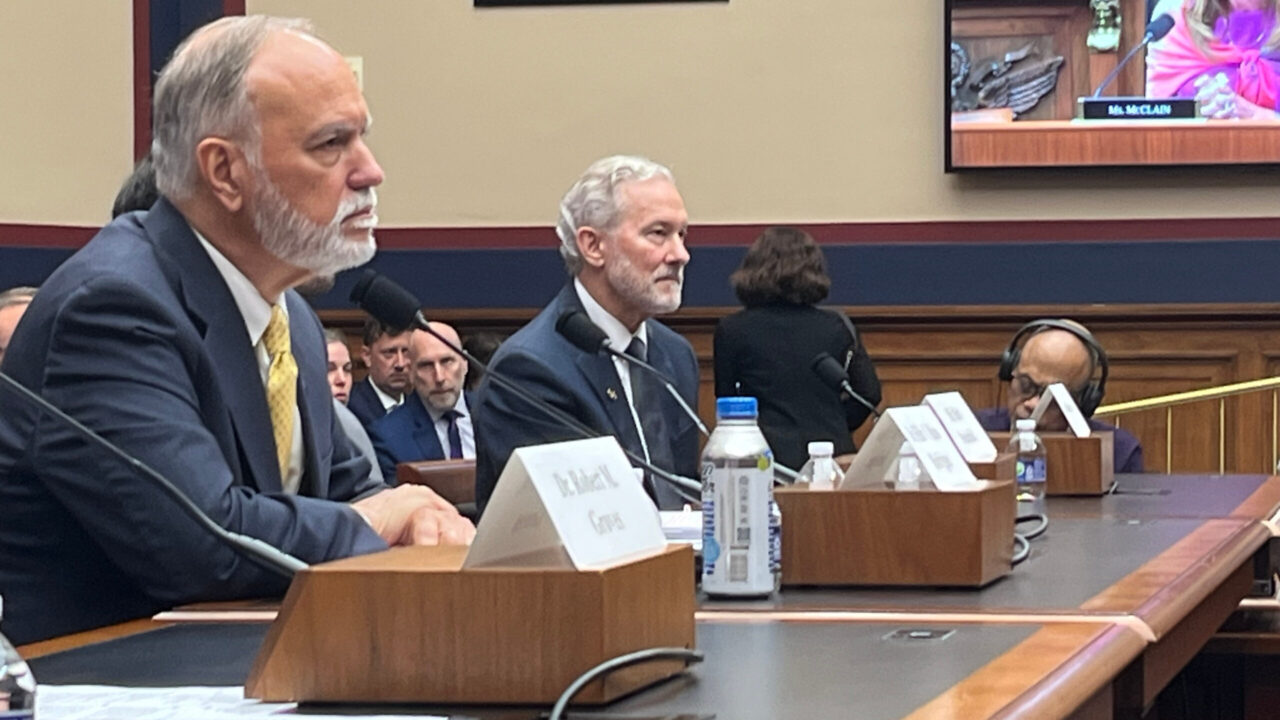
WASHINGTON, D.C. — Cal Chancellor Rich Lyons faced aggressive questioning from Republican lawmakers on Tuesday during a hearing about campus antisemitism that saw Republicans and Democrats diverge sharply on their approach to the issue.
Lyons, who began his term on July 1, 2024, after the turmoil surrounding the campus Gaza encampment had ended, was joined in the hearing room by Ethan Katz, a UC Berkeley associate professor of history and Jewish studies. Katz is a supporter of the chancellor’s who has been influential in campus antisemitism debates and chairs the Chancellor’s Advisory Committee on Jewish Life & Campus Climate.
Lyons also received the support of scores of Jewish faculty members who had submitted a letter to committee leaders on his behalf and on behalf of the Cal administration.
Still, lawmakers grilled Lyons aggressively over the course of a three-hour hearing on what they described as Cal’s failure to respond adequately to antisemitism on campus since the onset of the Israel-Hamas war. Lyons appeared alongside the chancellors of Georgetown University in Washington, D.C., and the City University of New York, who faced similarly tough questioning.
Republicans peppered Lyons with questions on anti-Israel statements made by the UC system’s academic workers union, the UAW 4811, and an incident in 2024 when pro-Palestinian protesters blocked a segment of Sather Gate, the main entrance to campus, and reportedly harassed pro-Israel Jews.
“We have a very clear no-tolerance rule for blocking Sather Gate for any reason,” Lyons said. “And I will enforce it. And we have enforced it.”
Central to Republicans’ line of questioning was one Cal professor, Ussama Makdisi, who published extreme statements but was not disciplined by the university, and was honored with a prestigious chair of a new program.
A history professor and a scholar of the Arab world, Makdisi was named the chair of a new program in Palestinian and Arab studies last year. The program was founded with help from a $3.25 million gift whose donors requested anonymity, and whose identities Cal would not disclose in response to a J. request for information under the California Public Records Act.
Makdisi is an outspoken anti-Zionist and unsparing critic of Israel who wrote earlier this year that Israel has waged a campaign of “meticulous cruelty” against Palestinians since its founding, and is now committing genocide in Gaza.
Makdisi has tens of thousands of social media followers on X, where he has hidden his posts from those who do not follow him.
During the hearing, multiple Republican lawmakers seized upon Makdisi’s X posts.
One, from Feb. 5, 2024, was blown up and displayed on a poster board by Rep. Lisa McClain (R-Michigan). It showed a photo of Palestinians breaking through the border fence into Israel on Oct. 7, 2023, and said, “I could have been one of those who broke through the siege on October 7.” Makdisi was sharing an article and headline from the anti-Israel website Mondoweiss.
“What do you think the professor meant?” McClain asked. Lyons paused.
“Hello?” McClain said sardonically.
“I believe it was a celebration of the terrorist attack on October 7,” Lyons said.
McClain then asked whether Lyons had spoken to Makdisi amid controversy surrounding his social media presence. Lyons said that he had, without going into detail, and referred to Makdisi as “a fine scholar.”
“A fine scholar that spews hate,” McClain responded.
Later, Rep. Tim Walberg (R-Michigan) scolded Lyons for referring to Makdisi as a “fine scholar.”
“That’s something I could not refer to him” as, Walberg said. “He misses a moral issue of humanity.”
Democrats attacked Republicans for what they described as an insincere use of antisemitism to go after higher education more broadly, or to score political points. They also pointed to the administration’s gutting of the Education Department’s civil rights offices, which are responsible for investigating claims of discrimination in schools and universities, calling the lawmakers hypocritical.
“It seems that the majority [party] on this committee is eager to continue enabling this administration’s repressive agenda,” said Rep. Ilhan Omar (D-Minnesota). “President Trump’s attacks on civil liberties and academic freedom are well documented.”
Rep. Suzanne Bonamici (D-Oregon), who is Jewish, expressed concern about antisemitism on campus while criticizing Republicans’ approach.
“If the majority wanted to fight antisemitism and protect Jewish students, they should condemn antisemitism in their own party, and at the highest level of government,” she said.
The hearing room was filled to capacity and a line stretched outside the door. Some outside the hearing room wore kaffiyehs or shirts that said “Not in our name.”
Four times, the hearing was interrupted by pro-Palestinain protesters, who jolted the sober atmosphere in the room with shouts of “Genocide!” or “You have blood on your hands!”

In another charged moment for Lyons, Rep. Kevin Kiley (R-California), who represents a large swath of the state along the Nevada border — and who sang UC Berkeley’s praises as “an enormously important institution for our country” — questioned the chancellor repeatedly about the prevalence of antisemitism at Cal.
“Why do you believe antisemitism is so pervasive at Berkeley?” Kiley asked.
“Antisemitism is pervasive in the world,” and in society, Lyons said. “I think our universities are reflections of society.”
“We’d agree that universities have been where the problem is, probably, most visible,” Kiley said. “And institutions, like Berkeley among a handful of others, have been the worst offenders, in a sense. Why do you think that is?”
“Part of what we see in universities is there’s a freedom to express one’s views, even if there’s some learning that needs to happen through that process,” Lyons said.
“Why does it exist at all?” Kiley fired back. “This is the world’s most retrograde prejudice. It’s the prejudice at the heart of the worst crime in human history.”
“If somebody is expressing pro-Palestinian beliefs, that’s not necessarily antisemitism,” Lyons said. “Part of it has to do with geopolitical events, and a war in Gaza.”
“I’m not sure that’s a full explanation,” Kiley said.
Lyons was also questioned about a February online event hosted by a Cal professor that downplayed evidence of Hamas rapes on Oct. 7 and claimed Zionists had “weaponized” the principles of feminism for political gain.
“Why was this event ever allowed on UC Berkeley’s campus?” Rep. Mary Miller (R-Illinois) asked.
“This was an online event,” Lyons said. “It was organized by one of our fine faculty, a full professor.” He added, “We knew that the ideas might be controversial. We did not know exactly what people were saying. It was a legitimate event.”
Miller called the incident “terrible” and asked Lyons whether the Berkeley professor had disputed speakers’ claims. “They did not,” Lyons said.
“Silence means something,” Miller replied.
In his opening statement, Lyons thanked the committee for inviting him to discuss Berkeley’s efforts “to combat antisemitism and support our Jewish community.”
“I am the first to say we have more work to do,” Lyons said. “Berkeley, like our nation, has not been immune to the disturbing rise in antisemitism. And, as a public university, we have a solemn obligation to protect our community from discrimination and harassment, while also upholding the First Amendment right to free speech.”
A spokesperson for Cal told J. that Lyons left immediately after the hearing for Los Angeles, where a board of regents meeting is taking place.