

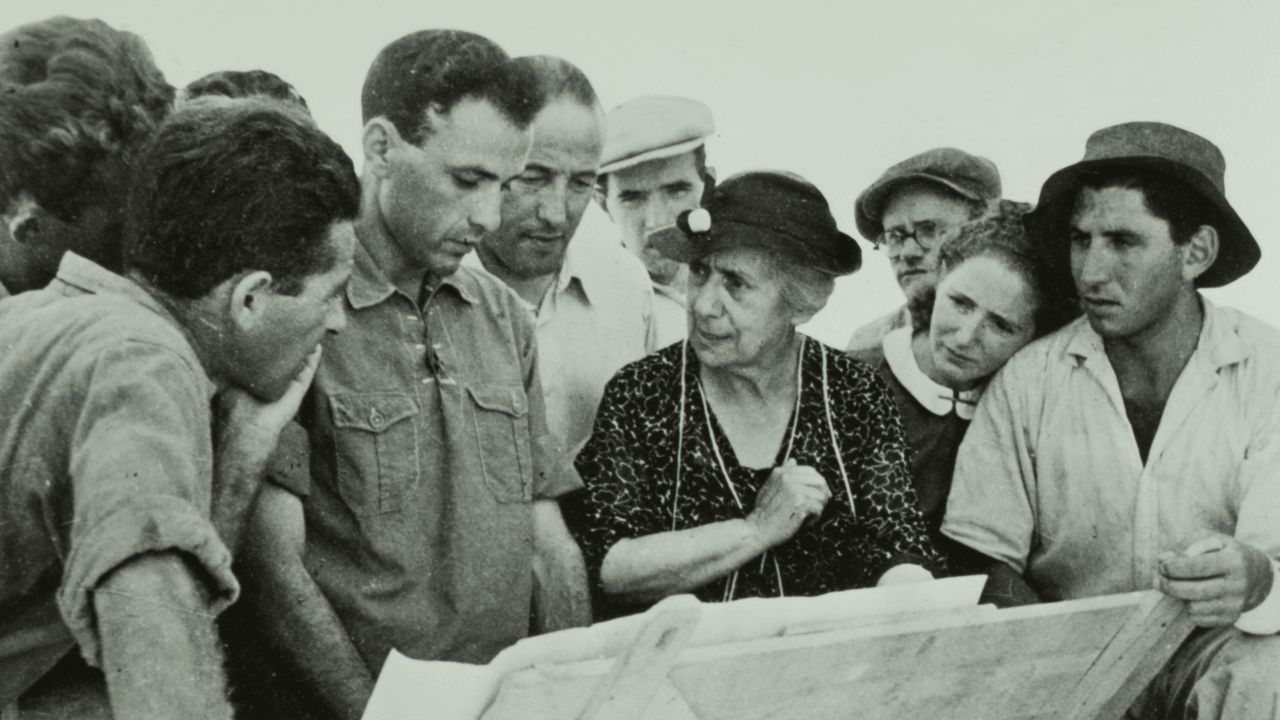
If Talmudic scholar Louis Ginzberg hadn’t spurned Henrietta Szold for another woman, she may never have founded Hadassah, the Women’s Zionist Organization of America, or laid the groundwork for Israel’s Hadassah Hospital and pioneering nursing school that treated both Jews and Arabs.
That is just one of the tidbits we learn about the early American Zionist leader in the new documentary “Labors of Love: The Life and Legacy of Henrietta Szold,” which was written, researched and directed by Peabody Award-winning filmmaker Abby Ginzberg of Berkeley. The film will receive its world premiere this month at the San Francisco Jewish Film Festival.
“Labors of Love” is a compelling portrait of a complex, brilliant Jewish woman who, according to Ginzberg’s interpretation, turned her unrequited love into a passion for bringing health care to British Mandate Palestine and saving thousands of Jewish children from Nazi Europe.
A Baltimore native, Szold died in Jerusalem in 1945 at age 84 before witnessing the end of World War II or the birth of the Jewish state to which she devoted the second half of her life. She never married or had children, yet her yahrzeit is celebrated as Mother’s Day in Israel, where she is known as the “Mother of the Children’s Aliyah.”
“I guess you could say she was the greatest Jewish feminist icon you’ve never heard of,” one interviewee intones in the film’s opening lines.
That theme, of Szold constantly pushing the envelope of what women could and should do in the world, raises what could have been hagiography to another thought-provoking level.
Ginzberg began work on this film more than 20 years ago, as she told this publication in 2004, motivated by her personal connection as the granddaughter of Louis Ginzberg as well as a distant cousin of Szold’s.
“Labors of Love” uses photos and video clips of Szold, combined with interviews and dramatizations of key moments in Szold’s life. Broadway icon Tovah Feldshuh serves as Szold’s voice, often reading passages from her meticulously kept diary.
We hear Supreme Court Justice Ruth Bader Ginsburg speaking of the woman she called one of her “heroes” and retelling this story: When Szold’s mother died in 1916 and a male friend offered to recite Kaddish for her, Szold refused and went on to recite Kaddish herself — something quite rare at the time.
It was Szold’s mother, Ginzberg tells us, who took Szold on her first trip to Palestine in 1909, where Szold was shocked by the poverty and health problems she witnessed, particularly among the Arab population. That same mother urged her to do something about it, setting Szold on her mission to bring good nutrition, health care and American nurses to Jerusalem’s Arab and Jewish communities alike. The photos we see of the country’s Ottoman Empire-era inhabitants are among the most affecting in the film.
Ginzberg makes clear Szold’s universalist approach to Palestine’s future. Szold was an early and public supporter of a binational state, writing letters and making statements pointing out that both Jews and Arabs lived in the land and should run it together.
“The fears of the Arabs are not groundless,” we hear from a 1942 entry in Szold’s diary. “Is it not our business to see the Arab side, too? I believe there is a solution to the Arab-Jewish problem, and if we cannot find it, then I consider that Zionism has failed utterly.”
Still, the main focus of this documentary is on Szold’s feminism, as she suffered indignity after indignity in pursuit of excellence. She worked for years at the Jewish Publication Society, where she was officially a secretary, although she did the work of a managing editor in soliciting and editing manuscripts. In addition, she was accepted to the Conservative movement’s Jewish Theological Seminary only on the condition, we learn, that she would agree not to become a rabbi.
In one of the film’s more pithy quotes, prominent Jewish feminist activist and writer Francine Klagsbrun notes how important it was for Szold that the Hadassah organization remain independent and women-led “because she understood what it meant to be sidelined by men.”
“Labors of Love: The Life and Legacy of Henrietta Szold,” 11 a.m. Saturday, July 26, at JCC of San Francisco and 1 p.m. Tuesday, July 29, at Piedmont Theatre in Oakland. (79 minutes) sfjff.org
J. is a media sponsor of the San Francisco Jewish Film Festival.