

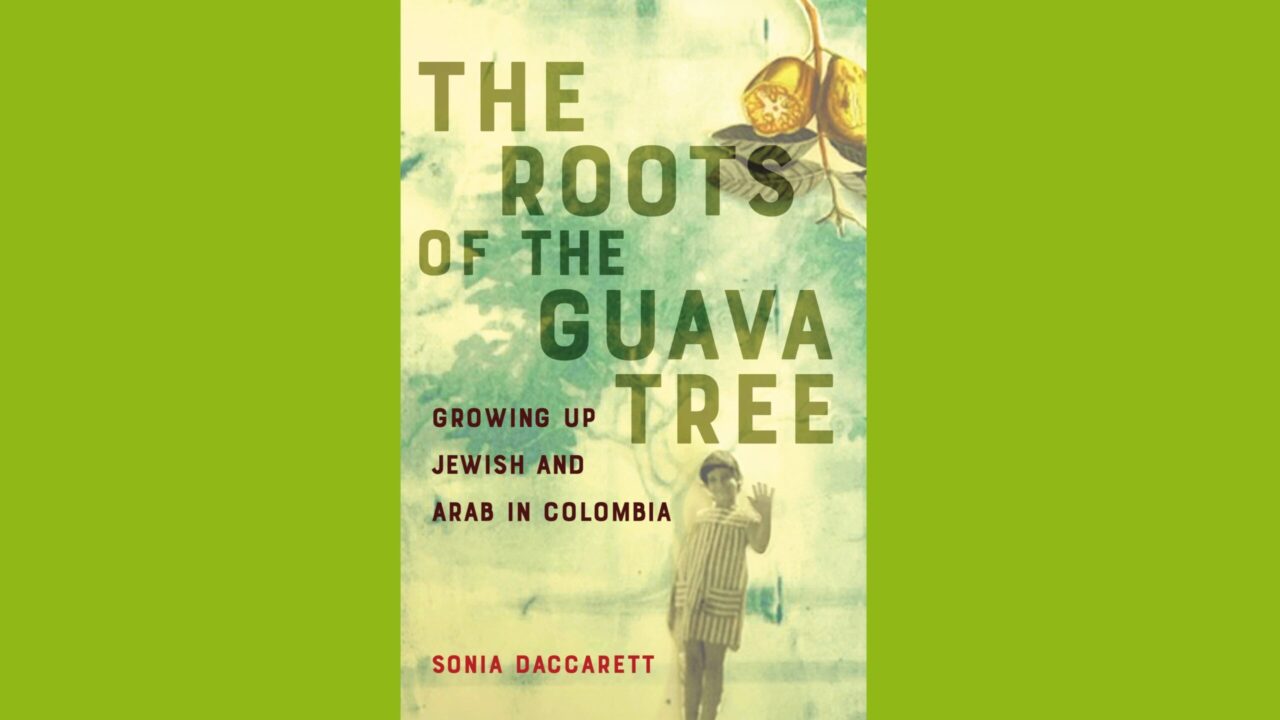
If you were ever to smell guava fruits at their peak of ripening on a tropical evening, you would never forget that perfume 一 or the place where you nearly swooned.
Such is the case for San Francisco writer Sonia Daccarett, whose new memoir, “The Roots of the Guava Tree: Growing Up Jewish and Arab in Colombia,” describes in sensuous detail her enduring memories of a childhood and adolescence in Cali, Colombia, in the 1970s and ’80s.
“Colombia was obviously a very formative part of my growing up,” said Daccarett, who is 57. “The Cali of the 1970s was a much simpler city [than it is today.] The city has grown up around my old neighborhood. It is gone. But I wanted to capture what it felt like, in my memory and in my heart.”
On the lush grounds of their suburban home, the prolific guavas 一 guayabas in Spanish 一 plopped from the trees into the swimming pool and floated, decaying, among forgotten Barbie dolls. The equatorial sun bronzed Daccarett’s young skin. Before the incursion of the cocaine trade with all its violent ramifications in the 1980s, Colombia “felt like an idyllic and lovely place,” she said.
But it was never quite paradise.

As the book’s subtitle informs us, her family was not a typical one in that South American nation, and it suffered tensions as a result. Born to an Ashkenazi Jewish mother whose parents arrived in Colombia before World War II and to a Palestinian Christian father whose parents came from Bethlehem in the early 1900s, Daccarett and her sister, Esther, were anomalies in a society shaped by Spanish colonialism and the Catholic Church.
Despite the fact that her parents were Colombian-born and spoke Spanish socially and at home, “I felt very different than everybody else,” Daccarett said. As her memoir details, their non-Hispanic surname, her curly hair, the Middle Eastern and Eastern European foods they ate and served to guests, and other such identifiers were more important to her than her parents seemed to realize.
“But as I’ve come to know, I think every kid feels very different from everybody else. It’s a universal thing,” said Daccarett, the parent of three U.S.-born children.
The family’s outsider status was complicated by another factor: Not only were her parents of foreign heritage and from different religious backgrounds, they were also agnostics in a traditionally Catholic country. The memoir reads as a back and forth of parent-child questions, as the young Daccarett struggles to understand the meaning of her multiple identities.
The diverse strands of history that entwine to produce a distinct individual and the rewarding work of untangling them in the cause of self-knowledge are the poignant themes of Daccarett’s first book, which was released Tuesday.
A book launch event is set for Aug. 21 at the Oshman Family JCC in Palo Alto. Daccarett will also appear onstage Sept. 18 at the JCCSF, where she will be interviewed by Chanan Tigay, J.’s editor-in-chief and a professor of creative writing at San Francisco State University.
Daccarett, who has a bachelor’s in journalism from the University of Massachusetts at Amherst and a master’s degree in international and public affairs from Columbia University, shaped a career in the U.S. as a communications professional, working with both corporate and nonprofit clients.
In the Bay Area, she has worked for the Brandeis School as its first director of communications and has been associated with the nonprofit organizations JIMENA: Jews Indigenous to the Middle East and North Africa, Be’chol Lashon and Jewtina y Co. She and her husband, J. board member Alex Bernstein, are members of San Francisco’s Congregation Beth Sholom.
Daccarett found the time and desire to explore writing in a more personal vein later in her career, after taking a class in memoir writing at the San Francisco Writers Grotto.
“Out of that I realized there was a lot I had not fully explored about my childhood,” she said. “I think to some extent all immigrants have this bifurcated life: the life they had in their origins, and the life they create in their new country. That was what I wanted to explore, driven by a desire to reconcile my identity and my family.”
The differing backgrounds of Daccarett’s parents could easily have made their marriage untenable. But they had found common ground in their progressive views, which was sufficient to unite them in the Colombia of the 1960s. World events, however, inevitably surfaced loyalties to their respective family origins.
In one vividly recalled chapter, Daccarett describes a family trip to New York City in summer 1982. On the television in their hotel room, they watched Israel’s war in Lebanon explode.
“This is an outrage!” her father shouted as he watched Lebanese civilians flee and Israeli tanks roll in.
“Israel was provoked by the PLO,” her mother responds. “What are they supposed to do, just sit there?”
As the teenage Daccarett witnesses their growing discord, she observes: “Neither of them has answers. Suddenly, they are not as sure and knowledgeable. Until now, in my mind, I was the only one without answers. Now, as reality shifts or perhaps merely comes into focus, my parents seem so small. My parents don’t know everything, or perhaps anything at all.”
The cultural tension seeps into the emotional core of their family life, and Daccarett grows conflict-averse, stifling her own expression and withdrawing to the background of her parents’ drama: “I do not ask questions, for what if we set off the next installment of our very own, do-it-yourself Israeli-Palestinian conflict?” she writes.
Today, having formally studied Mideast history, Jewish religion and the Arab and Palestinian experience, Daccarett is reconciled to a dual identity with “great appreciation for both sides of my family.”
“Many people have trouble with things that are not clear cut, but as we all know, the world isn’t like that … and people aren’t like that,” she said.
Her experience of Jewish and Palestinian families in the Colombian context has, in fact, informed her understanding that these global communities are “not monolithic.”
“I’ve always been fascinated by the diversity of the Arab and Jewish experiences in the diaspora,” she said. “Many people don’t even know that there are Jews in Colombia who speak another language. I never saw a bagel in my life until I came to the U.S.,” she said. “Or that there are giant Arab communities living outside of the Middle East, and many Arabs are not Muslim. I never met any Muslim Palestinians till I was in college in the U.S., for example. My grandparents come from worlds that no longer exist; it was the Ottoman Empire. So I’ve always been interested in those stories, because one of the things we’ve really missed is having an appreciation for variants and differences.”
It’s because of her sensitivity to these nuances and rejection of labels that Daccarett is ultimately able to see her parents as unique individuals with particular histories that shaped them. It will not be lost on the reader that the marriage has lasted for over 60 years.
“One of the things memoir does is, it forces you to think very deeply about the people in your life that you’re writing about, and I was very conscious of being fair. I tried to see my parents as human beings in the time that they were making their decisions in real time, in a world that was what it was. It forced me to think very deeply about them. And in the process, I have to say it made me love them more completely.”