

The weeks before a new school year are filled with preparation: shopping for supplies, organizing carpools and leaning into the excitement.
For some Jewish families, though, there may be a layer of worry about their children potentially facing antisemitism at school.
Seeking advice, with a particular focus on the middle- and high-school years when Jewish children may first encounter antisemitism, J. turned to two professionals at the S.F.-based Jewish Family and Children’s Services for their insights.

(Jeanie Horton Photography / Courtesy JFCS)
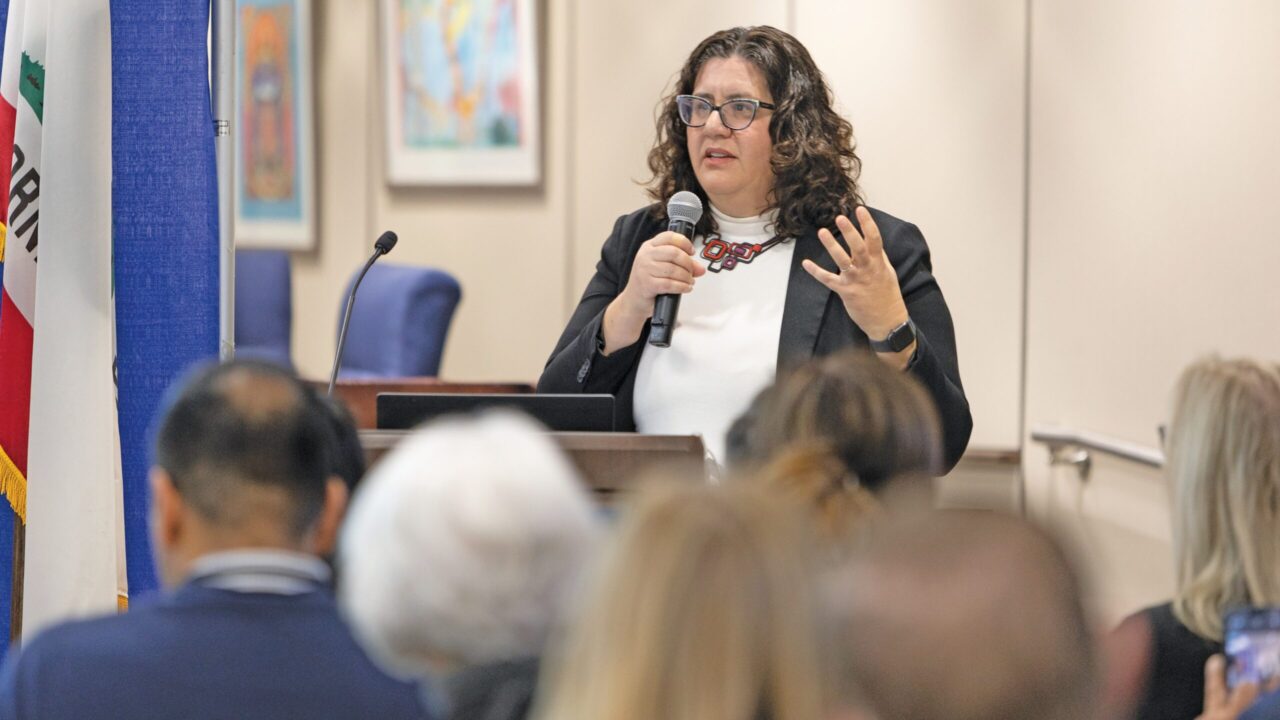
Morgan Blum Schneider is director of the JFCS Holocaust Center, which educates about the Holocaust and other genocides and seeks to eliminate discrimination and hate, including antisemitism, by interacting directly with students and by training teachers.
Ellie Pelc, a licensed clinical child psychologist, is director of clinical services at the JFCS Center for Children and Youth, which serves clients across the Bay Area.
The following Q&A has been edited for clarity and length.
How do you assess the climate for Jewish children in Northern California schools, both public and private, compared with immediately before Oct. 7, 2023?
Morgan Blum Schneider: Antisemitism has been very much on the rise for decades. We were actually working on a project that began in the spring of 2023, six months before Oct. 7. We’d been finding that when a school experienced antisemitism or a family wanted to report something, they didn’t know where to go and what to do first. So we created a response guide. I wanted something very simple for families, for administrators, for rabbis, for whomever.
We had scheduled a workshop for Oct. 18, 2023, when we were going to launch the guide. And then Oct. 7 happened. And we were ready. I mean, nobody was ready for that moment, but our response guide was literally at the printer. The Holocaust Center, Facing History & Ourselves, the Institute for Curriculum Services, the Anti-Defamation League and the Jewish Community Relations Council Bay Area were all part of a writing team and created this. It’s a great guide. It’s very evergreen. I share this timeline to show how significant antisemitism was prior to Oct. 7.
As I come into my 20th year at the Holocaust Center, what has changed significantly are the calls. I used to get [calls like this] on a frequent basis: There was an antisemitic flyer that was put into a mailbox or on a driveway. There was anonymous graffiti on lockers at school.
Now the calls I’m getting are: I feel that it’s my school administration … or my teacher said something in my class that felt antisemitic and that I felt harassed. Or I’m dealing with a school right now where the book that was chosen for summer reading feels as if it was not inclusive of the Jewish experience and was anti-Israel.
We’ve really shifted from anonymous antisemitism to a place where it’s not only very visible, but it’s in everything. It’s coming out of the tap. It’s everywhere around us.
Ellie Pelc: We’re definitely hearing about it more in clinical intakes. Parents are calling, saying my child was exposed to X, Y and Z and is wanting to avoid school or is having more anxiety, difficulty sleeping, just more mental health symptoms — and connecting it to experienced events.
Before [Oct. 7], it wasn’t necessarily on our radar to be regularly asking fully about experiences of antisemitism, whereas now it is critical when we’re doing an initial intake with families who identify as Jewish, asking them about their experience and exposure to antisemitism. That’s becoming more of a routine part of our work.
It’s widely known that Black parents have “the talk” with their adolescent children to prepare them to face racism and racists. Do Jewish parents need to consider something like this?
Schneider: Families often think about a talk introducing the Holocaust: When is the right age to start talking about the Holocaust, and how do I introduce the Holocaust? Now, at this moment in time, it’s a conversation of when do we start to talk to our kids about antisemitism. To me it’s about the same age as I recommend Holocaust education — around b’nai mitzvah age is appropriate to start.
Pelc: Even just from my own experience of being a Jewish child, I remember being exposed to the broader concepts in age-appropriate ways, even younger. That was very much woven into the thread of this narrative of Jewish identity that I had, and it was the perfect setup — being able to grow up knowing, OK, antisemitism is real. So there are ways of prepping kids in a way that it’s not this brand-new information all of a sudden when they become a b’nai mitzvah. There are ways of weaving it in.
Schneider: I like what you say about weaving it in. When we talk about being an upstander — those are conversations we can have with kids as young as kindergarten.
Pelc: You’re preparing kids for life. Whether it’s antisemitism or any other kind of bullying or put-downs that your child will likely face, these skills are universal for how to recognize what feels like an attack, a personal attack, and how to cope with that, how to respond.
What does your resource guide tell people to do first?
Schneider: Our first step is “report,” so report to the ADL. That is our recommendation. The ADL will then often guide you if you should be speaking with local law enforcement.
I also think if we are parents and our kids come to us about something, affirm them: I hear you. We first want to respond to our children. What do you need to feel safe? How does this make you feel? It could be one of their friends, right? It could be a parent of their friend. It could be their partner. It could be a lot of different things. So the first thing we want to do is make sure that we’re creating a safe environment or working toward getting the resources to create a safe environment for our children.
When kids experience antisemitism, how do parents know when to do more than listen and empathize — to take action?
Schneider: It’s very important for all of us who are working with this data that we report everything. And we help our children understand what is antisemitism, what is discrimination, what is hate … in developmentally appropriate language, of course.
One of my suggestions that I do by practice and that I recommend to families I work with is when you start your school year, go and introduce yourself to the principal, to the superintendent. Connect with them and share that you identify as Jewish as a family, and that that’s an important value for your family.
I often suggest you share the calendar of the Jewish holidays, just so they know in advance, and say: These are holidays that are important to our family. My children won’t be in school on these days. Is there anything that I can do to communicate this to the teachers in advance, so that they can be sensitive?
Administrators usually only get bad feedback. They don’t get positive feedback. I say build a relationship. Don’t just be the person that complains. Introduce yourself, give positive feedback and then, should an event come up where your child is on the receiving end of harassment, you already have a relationship with your administrator.
I appreciate that you focused on the principal because one of the issues is that there isn’t always one main teacher to connect with.
Schneider: The administrators at the end of the day are the ones who take responsibility for incidents of this nature on their campus. Not that it shouldn’t be reported to the teacher, but I would actually go first to an administrator. If they know you and they’ve met you, it’s an easier conversation to have, which can often be in a very difficult circumstance.
I always lean in with an olive branch and not a whistle. I get reported incidents from schools now with greater frequency than I wish to share. But my strategy always is: I’ll call up a superintendent or I’ll call up a principal or whomever and say: It was brought to my attention that there was an incident on your campus. How can the Holocaust Center be your partner in next steps and working toward healing in your community? I don’t call and say: I can’t believe this happened on your campus. And how could you let this happen under your jurisdiction? That’s not helpful.
I really believe strongly in the Jewish practice of teshuvah [repentance], and I talk often about it and I share the practice of teshuvah with a lot of administrators. I say teshuvah is about helping a community heal. You can’t expect to earn back the trust of that community overnight. It’s an investment, and it takes time.
What can families do if their kids experience antisemitism at school, but outside the classroom?
Schneider: I worked with a middle school post-Oct. 7 where there was a child who confronted a Jewish student in the lunchroom and said, “Hey, you’re Jewish.” And the child said yes. And he said, “My grandparents were German, and they told me that all Jews have papers. Show me your papers, Jew,” in a very loud voice. This child wanted attention. I worked over the weekend with the [Jewish] parent, who was very upset. There was another child who witnessed it and reported it to the principal, and it was reported in that sense, but the school decided to make it a learning opportunity.
I also worked with the parent of the child who was involved in the hateful language and the antisemitic language, as well as the child who was on the receiving end, and referred them to clinicians.
But I did work with the school to think about how this needed to be a deeper investigation, and what’s happening there. I like to lean into where there’s curiosity. And I brought in scanned documents of passports with the red “J.”
I’m not afraid to kind of go to the belly of the beast. I said, you know, I understand there have been questions and concerns and curiosity around these documents. I want to talk about the significance of these documents, and I walked through a whole lesson and an exploration. Every kid got a scanned copy, and then we did an iceberg lesson where you draw an iceberg and talk about what parts of their identity are above water on the tip of the iceberg and what parts of your identity are below water that people can’t see and what people wanted to share with each other.
I worked with the school on an ability to grow and to heal, and they did eventually hear survivor testimony at the end of their course of study, and I’m pleased to say that there have not been antisemitic incidents reported from that school since. Education is really one of the strongest tools to fight antisemitism, but you can’t be afraid to talk about it. Head on.
What are the mental health implications for Jewish children?
Pelc: What we know is that antisemitism can be experienced like a traumatic event, whether we’re witnessing it or experiencing it, depending on our past experiences. We could see more symptoms of depression — whether that’s withdrawing from social events, wanting to sleep more, not being able to fall asleep, having nightmares … mood fluctuations, anxiety, fears. Their ability to cope with obstacles might be diminished.
Can families specifically turn to JFCS therapists if their children experience antisemitism?
Pelc: People are coming to us for this particular reason more and more so. Yes, we can be a resource. We are here for those who would need it.
Schneider: The other piece is that we really want to be intentional with how we’re guiding our youth, and that all conversations should not just be focused around the negativity of their Jewish identity, but pride as well.
Pelc: The message can be woven in from a young age that we are resilient people. We’ve faced a lot of adversity, and we’ve defied the odds. That narrative became a really prideful piece of my own identity — that I’m part of this group that has survived insurmountable experiences. And let’s keep that up.
Central to Jewish identity is that we have faced generations of struggle and difficulty — that because of our Jewish identity, there is this kind of resilience and healing. There’s a concept of traumatic resilience and traumatic growth, that you can actually develop insights and skills and tools. If we do the work, there is potential to come out stronger.