

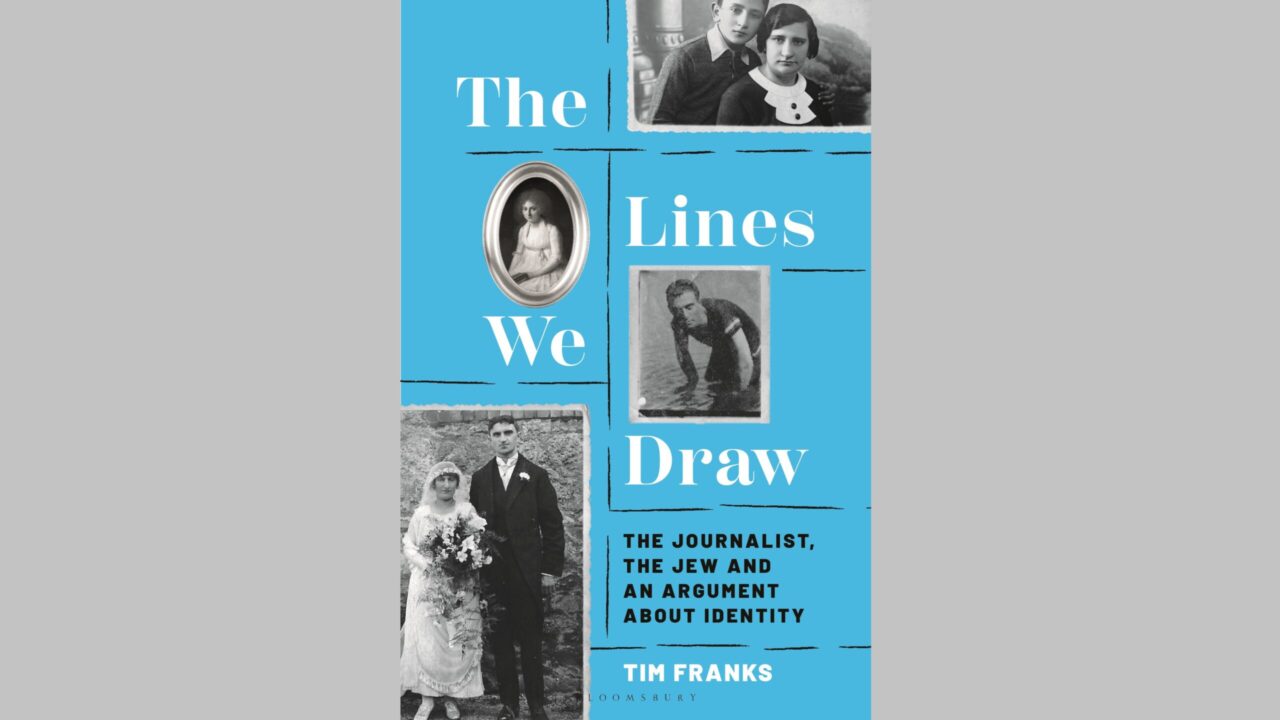
After Tim Franks began reporting from the Middle East for the BBC in 2007, he noticed that questions about his Jewish background constantly cropped up as people made judgments about whose side he would choose. In reality, he was just trying to do his job.
“Lots and lots of people have had lots and lots of assumptions about who I am, and what I must believe, and how I should behave,” he told J.

(Lynn Hammarstrom-Craggs)
Eighteen years later, Franks, now a presenter for the BBC World Service flagship show “Newshour,” has written a memoir about how his career and his Jewish identity have intertwined.
“What I believe is that my Jewishness, I hope, can inform my journalism in a way that is useful to my journalism,” he said. “And, similarly, I think that some of the ways in which I look at the world as a journalist help me think about the world as a Jew.”
“The Lines We Draw: The Journalist, the Jew and an Argument About Identity,” published in July by Bloomsbury, is a deep dive into Jewish history through the filter of Franks’ family, including a long line of globe-trotting Sephardic Jews. It’s also a thoughtful exploration of Franks’ experiences reporting from conflict zones around the world.
Franks will discuss his book on Saturday, Sept. 6, at Manny’s, a café and event space in San Francisco.
In “The Lines We Draw,” he writes about encountering people with deeply held false beliefs about Jews controlling the media and finance.
He faced that right off the bat, as various factions reacted to the BBC’s decision to hire him as a Middle East correspondent.
“People were saying, ‘Oh well, he’s only been appointed because, you know, literally the Israeli prime minister strong-armed the director general,’” he said on a recent episode of the BBC podcast “The Media Show.” “Or ‘he’s been appointed because, thank goodness, the BBC has finally acknowledged the fact that they’re hopelessly anti-Israel in their bias.’”
His response to all of that was simply to do his job.
For a long time he separated his identity as a Jew from his identity as a journalist, but he told J. that he later came to think of these identities as complementary, though he continued to adhere strictly to the lodestar of unbiased reporting.
“I do really feel very strongly that, as journalists, we have a responsibility to be as impartial as possible, as rigorous as possible,” he said.

Franks was raised in Birmingham, England, where his family belonged to an Orthodox synagogue. The Jewish community was tiny in a city of around 1 million people.
“When I was growing up, there were 900 Jewish families,” he said. “I mean, we were an absolutely minuscule minority.”
The Jews of Birmingham lived among people who felt comfortable being openly, if casually, antisemitic, he said. “In some ways, it was not a confident existence.”
While his home life was a tight nucleus of support, he knew little about his family’s background. All that changed when he began to take a deeper look as an adult.
“I just started sort of scuffing away and seeing what I could turn up,” he said. “And what I did turn up was this — to me — extraordinary gallery of characters.”
Through his mother, he was related to argumentative scholars, intrepid travelers and, circuitously, to Benjamin Disraeli, Britain’s only Jewish prime minister, who served in the late 1800s. Franks’ father, a distinguished dentistry researcher, was the child of what Franks describes in the book as “teenaged immigrants from the Russian Empire.”
“Me discovering who they were and reimagining their lives and questioning their lives helped me perhaps think more deeply about who I am and what it is to be Jewish,” he said.
Franks’ book tells his family’s story, taking readers to Spain, Portugal, England, America, Dutch Curaçao and Turkey. It also takes the reader to Auschwitz, as Franks explores those whose stories ended there.
Interspersed are stories from his career. They aren’t the macho anecdotes of a war correspondent, though. Franks has been in plenty of dangerous situations but said he tries to avoid showing off.
“I’m probably sort of quite a shy guy in many ways, for various reasons. And part of it is to do with where I grew up and what it was to be a Jew in Birmingham in the ’70s and ’80s,” he said.
Still, he added, “I had fun writing about some of my journalistic exploits,” such as the time he was covering a story about corruption in Venezuela. He was riding on the back of a motorbike on a busy highway in Caracas when his helmet suddenly flew off. He recited the Shema, held on tight and got the story.
Throughout the book, he interrogates how his Jewish background has shaped him over his decadeslong career.
The book is “my attempt to suggest some ways in which I approach what it means to be Jewish, at least as far as I am concerned, and how that meshes with my day job,” he said.
It’s something he’s been wanting to write about for a while.
“The pot had been simmering,” he said.