

A man who walked into a San Francisco synagogue in 2023 and fired multiple shots from an “imitation” gun while people sat eating and learning has been convicted of six counts of a felony hate crime.
Dmitri Mishin, 53, who prosecutors said posted Nazi-era propaganda online around the time of the attack, as well as photos of himself dressed in costume as a Nazi-era soldier, will be sentenced on Aug. 29.
A San Francisco Superior Court jury took seven days to deliberate before delivering the guilty verdicts, which were reached on Aug. 8, the San Francisco District Attorney’s Office told J. The DA’s office announced the verdicts Wednesday.
In total, Mishin was convicted of six counts of making threats that interfere with religious worship, which falls under California’s “terrorizing” laws. All six counts included hate crime enhancements, which could add one to three years to his sentence.
Mishin was also convicted of six counts of brandishing an “imitation” firearm, which is a misdemeanor. Mishin’s device fired blanks — not bullets — which means they generated a muzzle flash and loud sound but didn’t include projectiles. The case was prosecuted by Abigail Adams, an assistant district attorney.
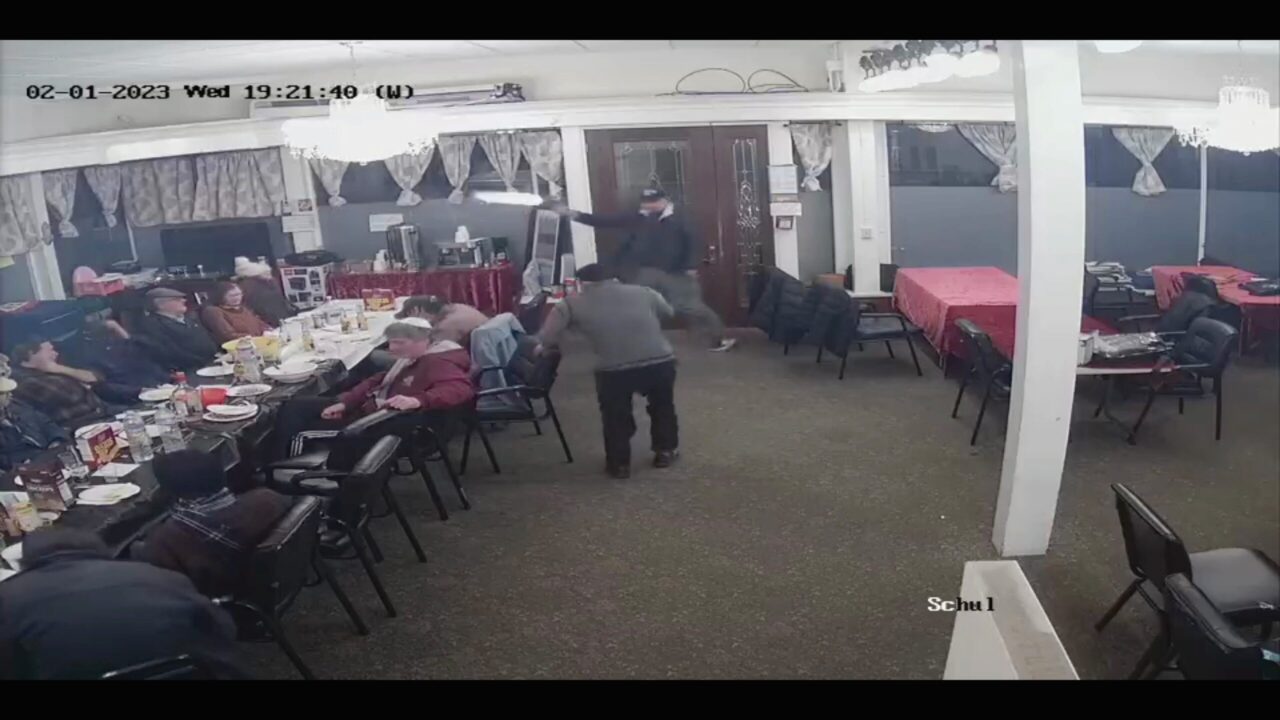
The jarring attack on Feb. 1, 2023, at the Schneerson Center was captured on surveillance video. Excerpts circulated widely in news outlets. A complete video of the incident obtained by J. shows Mishin entering the one-room prayer, study and social area of the small storefront synagogue on Balboa Street on that Wednesday evening.
For about 10 seconds, he appears to address the dozen or so people, including some who were elderly, while gesturing with his arms. He then pulls a weapon out of the left side of his jacket, cocks it and fires approximately eight shots while swinging his arm from his left to his right toward the people sitting just feet away.
“It was very loud. It looked like a real gun,” Rabbi Bentziyon Pil, senior rabbi at the Richmond District congregation, said at the time.
In an interview Thursday he elaborated on the experience. “Personally, I thought, this is the last few seconds of my life,” he said.
Mishin, who spoke in Russian during the attack, said something about “Mossad,” the Israeli intelligence agency, according to multiple witnesses. At one point, he worked in computer engineering in Ukraine, according to a family member who spoke with J. on the condition of anonymity three weeks after the attack. Mishin developed mental health problems, the family member said, adding that he drank alcohol and did not always take his prescribed medication.

During a 2023 court hearing, Mishin’s lawyer, reading from court records, asked an officer to confirm whether Mishin said, after his arrest, “I live in a submarine,” and when asked where he lived said, “I have no idea, I’m traveling in my mind everywhere.”
Mishin’s defense sought to poke holes in the prosecution’s argument that his act was motivated by antisemitism, contending instead that he was not mentally sound. At one point early in the criminal proceedings prior to the trial, Mishin’s mother, Ludmila Mishina, testified that Mishin has a Jewish grandmother. She also said that he, at one point, wanted to become a priest. The family member who spoke with J. said that Mishin did not consider himself to be Jewish.
At the same hearing in 2023, Judge Loretta Giorgi tossed out hate crime enhancements because of Mishin’s mental state. “We’re dealing with a disturbed mind.” she said at the time.
The decision outraged synagogue members and the Anti-Defamation League, whose regional director at the time, Seth Brysk, called the decision “deeply disappointing” and called the attack “the very definition of a hate crime.”
The hate crime enhancements were later re-added.

The Schneerson Center is an Orthodox shul and one of a handful of congregations in the city that convenes a daily minyan, which requires a minimum of 10 Jewish men under Orthodox Judaism.
Members of the synagogue have told J. the shooting had a profound impact on the community. The Schneerson Center serves Russian-speaking emigres from the former Soviet Union who experienced harsh antisemitism in their countries of origin. And like Jews across the U.S. and the world, they were already rattled by antisemitic violence, including the 2018 massacre that killed 11 Jewish worshippers and wounded six more at the Tree of Life synagogue in Pittsburgh, Pennsylvania, and the 2019 shooting that killed one person and wounded three more at Chabad of Poway in Southern California.
The 2023 shooting did not impact the Schneerson Center “physically,” Pil said, but did “psychologically.”
“It’s a miracle none of the older people had a heart attack,” he said. Pil added that a number of attendees stopped coming regularly after the incident “because they were scared.”
“It’s an unpleasant memory,” Matthew Finkelstein, a congregant who prays at the Schneerson Center three to four times per week, told J. “It’s taken a long time to reconstitute the minyan and to regain a sense of normality.”
Pil and Finkelstein said they will be paying close attention to Mishin’s sentencing and worry about the fact that he is believed to live near the synagogue.
Mishin, who is currently in custody, has been in and out of jail since his arrest. In total, he has spent 445 days in custody, which will be subtracted from his sentence, according to a spokesperson for the DA’s office.
DA Brooke Jenkins thanked the jury in a statement.
“Antisemitic incidents like this have lasting impacts and must be addressed,” she said. “Fighting these crimes and getting justice in the courtroom rights these grave wrongs and restores some of the unity, dignity and humanity that is lost when these crimes are committed.”