

Danielle Chetrit’s life didn’t always revolve around connecting the Jewish community.
Now 28, she was raised in Redwood City in a proud Jewish home by a father who’d emigrated from Morocco and a mother of Polish-Russian descent. But her Jewish communal involvement was limited to briefly attending religious school and becoming a bat mitzvah.
She began to make Jewish friends in college. Then two events changed everything.
First, the pandemic awoke Chetrit to her desire to connect with fellow Jews. She began scouring social media for Jewish groups targeting young-adult professionals and regularly attending their events.
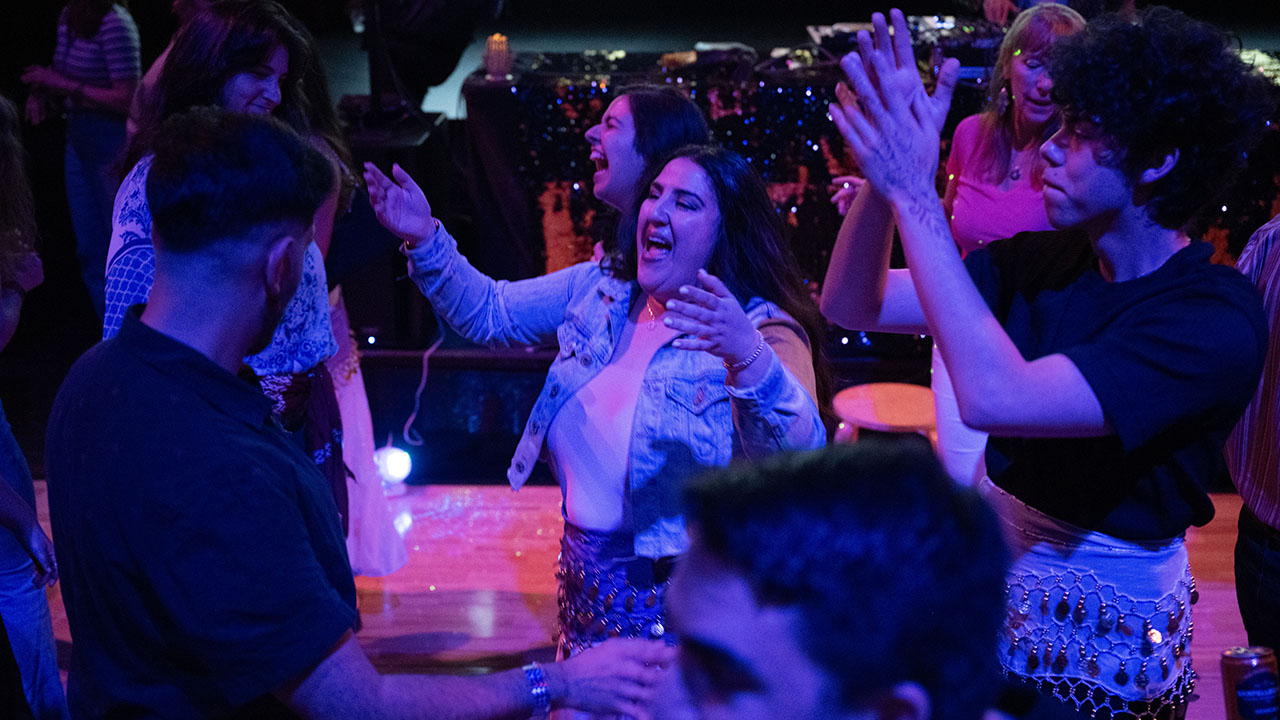
Then after the Oct. 7, 2023, Hamas massacre in Israel, Chetrit decided that the young-adult scene needed a refresh. She and her friend Dyanna Loeb founded Malka Productions and began organizing events, parties and panel discussions that are proudly, even fiercely, Jewish and Zionist.

Anyone familiar with Jewish Instagram will immediately recognize the high-profile activists and influencers that Malka has helped bring to the Bay Area, such as DJ Kosha Dillz for an Israel Independence Day party, Miss Israel Noa Cochva for a Shabbat dinner and content creator Zach Sage Fox for a Q&A. In addition to producing social events, Malka has also helped mark tragedies with memorial events for the six hostages executed last summer and the first anniversary of Oct. 7.
After taking a break from hosting events this summer, Malka plans to kick off the Jewish New Year with an all-night party featuring a lineup of Israeli DJs. Details will be posted on its Instagram account @malka_productions.
Chetrit, a Redwood City resident who works as a personal assistant for executives, spoke with J. about the inspiration behind Malka — Hebrew for “queen” — as well as its challenges and achievements.
This interview has been edited for length and clarity.
How did Malka Productions get its start?
Back when I started attending Moishe House events, someone recommended I meet Zach Nelson. He was on the board of JIMENA [Jews Indigenous to the Middle East and North Africa]. He co-directed the first leadership academy at JLeaders. He’s also Moroccan Jewish. Zach and I became really good friends. When he passed away tragically in January 2023 in a diving accident, it was in the process of trying to organize a vigil for him that I got in touch with Dyanna Loeb, who was also a friend of Zach’s and wanted to do something for Zach’s memory.
We organized a beautiful Shabbat in commemoration for Zach, and so I knew we knew how to pull together an event under really high pressure, under a lot of grief. Zach brought us together after he was gone for a reason, and a year later, we started Malka Productions.
He really set the tone for this community on how to be proud to be Jewish and to be proud of our heritage and where we come from. We dedicated our first event in January 2024 — a talk with Israeli digital activist Adiel Cohen — to Zach and his memory. Dyanna and I very quickly became partners, and within two weeks of planning the talk, she came up with the name “Malka Productions.” Then we established our company, an email address, and we just became a little bit more legitimate. And it’s been a journey ever since.
What does Zionism mean to you?
It’s the right for Jewish people of self-determination in their ancestral homeland. We are an indigenous people. For me, Zionism was kind of the starting point in terms of being a proud Jew on Oct. 8. I feel like it’s been an anchor. That’s not to say that Zionism should be the only thing that should anchor the Jewish people. We have so much more to us. But I think that’s been a huge push, especially when it comes to defending our homeland, quite literally, having our soldiers on the line, as well as our civilians in the line of fire.
You mentioned that you didn’t really have Jewish friends until college. How have you navigated your friendships with Jews vs. non-Jews since Oct. 7?
Honestly, I’ve had a lot of non-Jewish friends fall off. I’ve kept a few non-Jewish friends, but we’re not as close as we used to be. That’s something I catch myself doing, but I don’t want to do that. I don’t want to isolate myself from everyone who isn’t Jewish. I think it’s so important that if you do have non-Jewish friends who are allies to the Jewish community — even though it’s so easy to bundle ourselves up with our Jewish friends — to keep reaching out. Keep pouring energy into those relationships, not just because it’s great to have allies, but because friendship is friendship at the end of the day.
It seems like Malka is dealing with the challenge of trying to be visible and encourage young adult Jews to gather in person, while taking on the risk of becoming a target for antisemitic attacks. For example, your May 2024 event in Oakland was targeted quite aggressively. How do you balance these two challenges?
We found out four hours before the event that people were planning to protest. So we got the Jewish Community Federation involved and the Oakland Police Department. We also already had our own private security. The venue we were working with had their own layer of security. It was really sad and really scary. These agitators threw glass bottles of red stain. Someone got hurt, and people had stain all over them. But in the face of all that, everyone who emailed us after the event said, “We are so glad we stayed for that event. It made us feel more empowered.”
We can’t let them scare us. We are the Jews of today. We have a homeland. We have a right to be here. We fought for rights in this country. We are not going anywhere. And if anything, this only pushed us forward to be even more loud, more proud — obviously with safety precautions, which we take regularly.
Malka doesn’t have a website and instead operates mainly through its Instagram account. Does that make it more prone to antisemitic harassment online?
Yes, we absolutely face antisemitism online. Granted, with that, it boosts our engagement. I really love using Instagram as an outreach tool. That’s where it’s all happening. “Jinsta” is what we call the world of Jewish Instagram, where you can find all the influencers that Malka has brought here, and other smaller creators who are making equally important content.
How would you describe the environment that Jews are navigating on social media?
On TikTok, the censorship is crazy when it comes to Jewish voices and Jewish content that’s pro-Israel. Its algorithm is extremely skewed against anyone who is pro-West, let alone being pro-Jewish. What we’re seeing, especially with Gen Z, is that TikTok is the new newspaper. It’s their new source of information. Half of the Malka [volunteers] are UC Berkeley students, and they’re constantly bringing college kids to Malka events. I think that’s great; these kids aren’t going to believe the TikTok stuff because they’re in front of real people giving them the real information from real experience.