
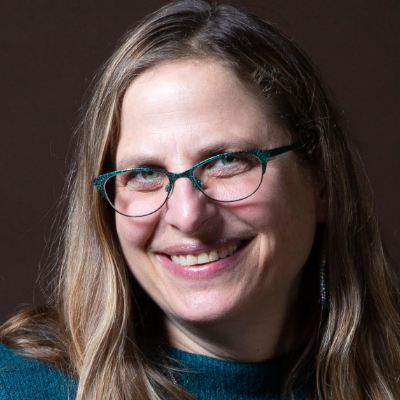
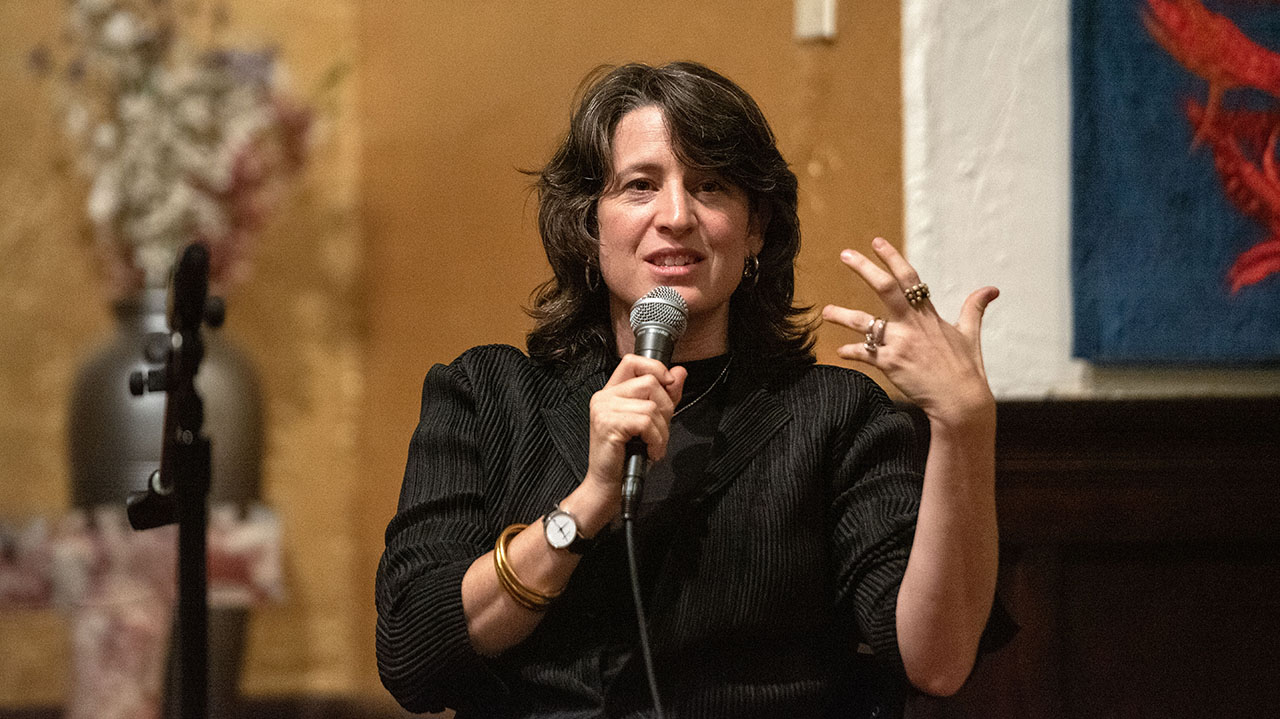
After Kabbalat Shabbat services in Berkeley, Rula Hardal, a Palestinian citizen of Israel now living in Ramallah, and May Pundak, an Israeli Jew, sat on the bimah of Chochmat HaLev, describing their vision for a shared homeland.
A Land for All, described on its website as “a joint Israeli-Palestinian political initiative,” offers a vision that’s “radical” in its approach, said Rabbi Zvika Krieger, who moderated a discussion with Hardal and Pundak, the organization’s co-founders and co-executive directors.
Their vision is based on a confederation model with two states, Israel and Palestine, divided along their 1967 borders, whose citizens have complete freedom of movement.
The proposed solution is “without strict physical and demographic separation,” according to a 20-page vision statement on A Land for All’s website. “In other words: Political separation – yes. Geographic and demographic separation – no. Mutuality, partnership and equality – yes.”
The two activists made a brief stop in the Bay Area before flying to New York to be present during the United Nations General Assembly.
They were introduced at the Sept. 19 event by Orli Bein, senior director of the San Francisco region of New Israel Fund. NIF, an American nonprofit that advocates for equal rights and minority rights in Israel, is a funder of the initiative and co-sponsored the visit.
Hardal laid out the case for A Land for All’s answer to the Israeli-Palestinian conflict, which in the current moment can feel as intractable as it’s ever been.

“We have two national groups who claim they’re belonging to the whole land, between the Jordan and the sea,” Hardal said of the Jordan River and the Mediterranean Sea. “We call it Palestine, you call it Eretz Israel. We argue that all people have the right to claim their belonging to this land.”
Pundak asked the audience to consider the two groups as they would two European Union countries, like France and Germany. Both are distinct nations that share membership in the EU.
“What we’re offering is what we call ‘two states, one homeland.’ It’s a new paradigm in which we have two sovereign, independent, democratic states within the ’67 borders,” she said, “and shared institutions to take care of the things that we have to take care of jointly. … Segregation and separation is not the answer to state insecurity.”
The emotional connection to the land for both peoples cannot be underestimated, Pundak added.
“For Palestinians, Jaffa and Akko and Haifa and Lod will always be Palestine. And for many Jews, Hebron and Beit El and Shiloh are places that are really, really important… If we think that we can disregard that emotional connection, I think we are very mistaken.”
The organization has grown in its international profile since it launched, and the two activists have been featured in press around the world, including in the New York Times and on CNN.
Krieger said he believes trust between Israelis and Palestinians is at a serious low right now. He asked whether in the midst of a brutal war, it was the right time to forward such a radical solution as the one they are proposing.

The activists countered that now was precisely the right time, with no clear plan for “the day after.” They acknowledged that it would take time — generations, perhaps — for their plan to be realized.
The presentation was interrupted numerous times by cheers and applause, coming from a progressive Jewish community open to out-of-the-box ideas for the Israeli-Palestinian conflict, and comfortable with harsh criticisms of Israel.
The fact that Hardal and Pundak are women came up during the question-and-answer phase of the event.
“Yes, we are women, and we are leading this movement, and we are aware that we are acting in a male-dominated world,” Hardal said. “But it’s time to get used to something else.”
The audience roared in approval.
Congregant Donna Gans said the ideas she heard that night were completely new to her, and she found the women “inspiring,” while congregant Shira Shaham said she considered herself a “fangirl” of A Land for All.
“I think a one-state solution is entirely impractical and unsafe, and I think the two-state solutions that have been talked about in the past are unsafe and impractical for both peoples,” Shaham said. “This is the first viable vision for a shared future with safety and liberation for all that I’ve heard.”