
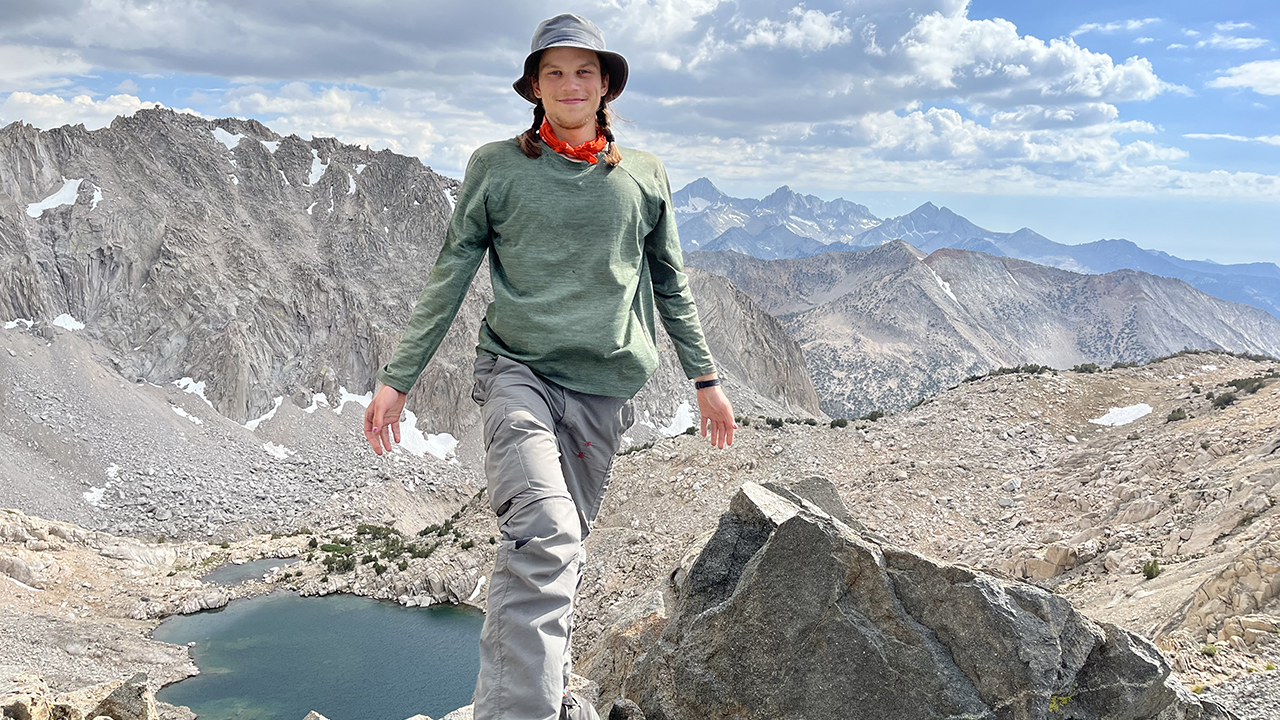
Arlo Blackman-McGrew just spent the summer between high school and college hiking. But not just any hiking: They completed 500 miles on the iconic Pacific Crest Trail. Blackman-McGrew, who uses they/them pronouns, spoke to J. about their experiences right after moving into the dorms at UC Davis.
The trail spans over 2,600 miles as it meanders from north to south, all the way from the U.S.-Mexico border to the 49th parallel in Canada. Hiking the PCT, as it is known, has become a rite of passage for a certain outdoorsy type, and was further popularized by Cheryl Strayed’s 2012 memoir, which became the 2014 film “Wild: From Lost to Found on the Pacific Crest Trail.”
Though Blackman-McGrew initially hoped to cover 700 miles, finishing just over 500 was still an impressive feat. They hiked a total of 43 days, covering a stretch from Kennedy Meadows (about 100 miles northeast of Bakersfield) to the peak of Sierra Buttes (60 miles west of Reno). Hikers must stop along the way in towns to replenish their food supply; Blackman-McGrew also used the opportunity to send friends and family regular email updates about the experience.
Blackman-McGrew, 18, of Oakland, is now enjoying their first year at UC Davis. Their family belongs to Berkeley Renewal congregation Chochmat HaLev, and they grew up attending both B’Hootz and B’Naiture, the Jewish outdoor educational programs of Wilderness Torah. They later served as a mentor in those same programs.
Blackman-McGrew first heard about the PCT from a friend, and the two planned to hike it together. But as the time got closer, the friend dropped out, and Blackman-McGrew decided to proceed and “take it on as a solo challenge between high school and college,” they said.
This interview has been edited for length and clarity.
How did you first fall in love with nature and backpacking?
I’ve loved it ever since I participated in the Neshama Quest with Wilderness Torah. They took us backpacking for a week, all four summers of high school. It means Soul Quest, and more than going far, it’s about finding who you are as a Jew, in nature.
Isn’t there also a kind of initiation ritual in B’Naiture where you stay up all night, tending a fire?
Yes, B’Naiture really helped prepare me, as it was essentially a really big solo challenge. In that ritual, every kid does a fire solo, meaning we tend a fire in the forest. We have to gather our own wood and keep the fire going all night, and set an intention. I really learned about intention setting and how to be alone and how to hold space from that, which supported my journey, just like knowing how to backpack. Intention setting and holding space for myself, by myself, on a solo trip was really important.
You chose not to listen to music or an audiobook at all during this experience. Why?
I knew that if I did, my emotions would be actively manipulated by that external source, and it might aggravate me. All media you consume activates you; it stops you from going into a more settled mode and just relaxing. So instead, I just listened to the sounds of nature and let my thoughts wander. I felt what it feels like to take a step, or a barefoot step sometimes. Every few days, I went barefoot a bit.
How crowded is the trail? How easy is it to meet people?
It’s super easy to meet people. Every time you pass someone, you say hi. The only people who don’t say it back are day hikers. You also can customize your experience, as there are more people going northbound and there are more people earlier in the season.
Were you disappointed that you didn’t reach your goal of 700 miles?
No. I was hoping to do about 20 miles a day, which would have been about 700 miles in a little less than two months, from Kennedy Meadows to Mt. Shasta, which would have been the entirety of the Sierra Nevada range. I realized pretty quickly I didn’t like doing 20 miles a day. Also, I had to take time off.
Why?
My maternal grandfather was sick. I got to spend time with him, and then he died a few days later, once I was back on the trail. I left the trail a second time to attend his celebration of life.
How did mourning someone you loved while on the trail affect your experience?
My Poppa was a total outdoorsman. So, being outdoors, I was able to feel really connected with him. And the trail doesn’t judge; not having deadlines was really nice; I could just be on my own time and have the space to grieve.
When he died, it was just before the start of the month of Av, which is a major month of grieving. I met some Jewish guys, and they taught me about the holiday Tu B’Av. They described it as a celebration of love in the midst of this intense month of sadness, and that was really cool to learn about. I got to feel a bit of light in this niche holiday that I hadn’t celebrated before.
Did you observe Shabbat at all on the trail?
I did twice. One time, I was by myself, and once, I shared it with a new friend of mine who wasn’t Jewish. I didn’t meet many Jews, I think maybe three. Besides the two guys who taught me about Tu B’Av, I met one Israeli finishing up graduate school. He gave me some challah. Sharing Shabbat with the person who had never done it before was cool because she really loved it. I told her about resting on Saturday, and she really took it to heart.
Over what did you say the blessings?
I used my “finger candles,” and I used water with special intentions and a tortilla.
Was it difficult to get your parents on board with you doing this?
At first, they really wanted me to do it with a partner, but then they learned about the culture, that you meet people along the way and hike with them. They aren’t big backpackers, but were so supportive; a big shout-out to them. I used a Garmin GPS device so I could let them know where I was each night.
Will you return to finish the sections you didn’t complete? How did this experience change you?
I cannot imagine myself not going back on the trail. Doing it at this stage of my life was eye-opening in that the experience gave me a lot of chances to meet people I wouldn’t have met otherwise. I met so many people from other countries, and got to know them really quickly, and hear lots of different perspectives. Also, I just love being outside; I’m definitely doing a lot more backpacking.
I imagine you would recommend it to others.
It sounds hard, and it is hard. It’s grittier than the photos you see on Instagram. But it’s a meaningful, potentially life-changing experience. I highly recommend it for any level of skill. I met people there who had never gone backpacking before, and they were having the time of their lives. Of course, it’s easier if you have gone before, but it’s not impossible, and I really suggest it to anyone.