

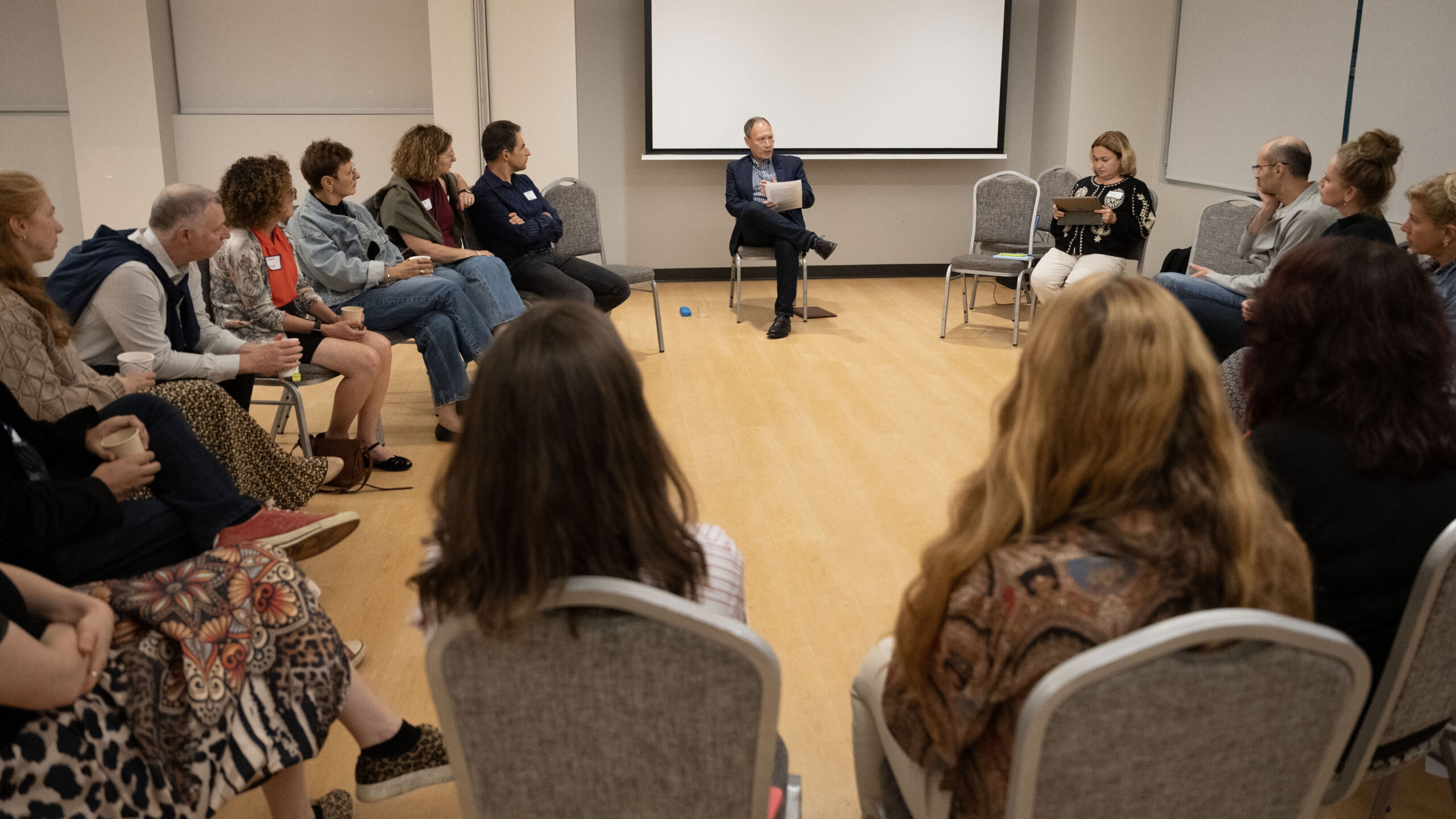
They’d snacked on the zakuskie and schmoozed for a bit. Now the 15 Russian-speaking Jews, most in their 40s, were sitting in a circle at the Oshman Family JCC in Palo Alto preparing to hear from Stanford history professor Amir Weiner.
His topic for the next 2½ hours: Russian and Soviet Jewish history, from soup to nuts.
At the end of the 19th century, he told the group, the 5.3 million Jews in the Russian Empire formed the largest Jewish community in the world. It continued to flourish in the early decades of Communist rule before falling prey to Stalinist purges and antisemitic restrictions, leading to today’s “sad” numbers of some 60,000 people.
“Did it have to be that way? Could things have been different?” an audience member asked. Weiner shrugged, smiling sadly. “History is always hindsight,” he said.
It was the fourth session of the Jewish Parent Academy, a Jewish learning and leadership course that began 10 years ago in Brooklyn and just launched in Palo Alto, its first satellite outside the New York area.
The people who came to hear Weiner were all born in the former Soviet Union. They came to the U.S. as children or young adults, attended top American universities and are now white-collar professionals. Why did they need an Israeli-born professor from Palo Alto to tell them about their own history?
“We never learned this in the Soviet Union,” explained Redwood City resident Alyona Doubrovina, who emigrated from St. Petersburg, Russia, in her early 20s and is now a partner in Freshwater Investments, a socially conscious real-estate investment company. Doubrovina is also part of JPA Palo Alto’s newly formed steering committee.
JPA was started in 2015 by seven Russian-speaking Jewish parents, all of them alumni of Jewish leadership programs. The course, which runs 10 to 12 sessions, gives participants more knowledge about Russian and Soviet Jewish history, Jewish traditions, Israel relations and the infrastructure of their local Jewish communities. The goal is to enable more of their ranks to take leadership roles, not just in their own Russian-speaking Jewish communities but also in mainstream American Jewish organizations.

Another major focus is to help participants give their children a stronger Jewish identity. “Even though we grew up here, we’re very much still products of post-Soviet parents,” said JPA national director Yelena Pogorelsky, a native of Samara, Russia, who immigrated to the New York area in 1996 when she was 15. “The Jewishness that most of us knew came from experiencing antisemitism. This is a way to build up our own identity and knowledge so we can be better educators for our children.”
Pogorelsky spearheaded the creation of the Palo Alto JPA at last year’s Z3 conference at the OFJCC. It is the 17th JPA cohort. The rest were all based in the Greater New York area. There are more than 400 program alumni in all, Pogorelsky said, and many fill board positions in JPA and participate in fundraising. Students pay $500 for the course, which is heavily subsidized, mainly by Eugene Fooksman, a Silicon Valley immigrant and entrepreneur (one reason the first satellite course is being held in Palo Alto). All lectures are in English and are given by professors, rabbis and Jewish communal leaders.
“This is the way to talk to Russian-speaking Jews,” said Pogorelsky. “We come from different ends of the spectrum in terms of our previous knowledge and our Jewish engagement and our religiosity and observance. But if you put a great academic speaker in front of us, we can all sign up for that.”
Palo Alto JPA director Yana Rathman, who emigrated from Kiev in 1989 as a young adult and now works in instructional technology, explains that when the last great wave of Jewish immigrants came to the U.S. in the early 1990s, local organizations and synagogues launched educational programs designed to help the adults integrate into American life.
JPA is designed for the in-between generation, Rathman said — Jews who might speak Russian with their now-aging parents, but English with their children. They are successful in their professions, they know America, and they do not want to be talked down to.
“They do not fit these Russian-speaking programs that target seniors,” Rathman said. “They want something of a different quality. They went to law schools, they went to Stanford Business School.”
Despite their years in America, these Russian-speaking Jews still tend to stick together, those interviewed say.
Sophie Goldberg is taking the new Palo Alto course. A native of Ekaterinoslav (now Dniepro), Ukraine, she moved with her parents to Israel when she was 12 and immigrated to California in 2006 to attend San Jose State University.
“All of my friends are Russian speakers, I don’t know why,” she said. “In Israel it was the same. It’s the imprint you get as a child, I think. I’m not quite Israeli, not quite Russian, not quite American. I feel the most sense of belonging here,” she added, gesturing around the room.

A crucial difference between those earlier integration-focused programs and JPA, Pogorelsky and Rathman each said, is that JPA is created by Russian-speaking Jews for themselves and their peers.
“Socioeconomically and in terms of our career status, we’re doing as well as our American Jewish peers,” Pogorelsky said. “So now is the time that we take responsibility for our own needs, that we create things for ourselves and stop waiting for some organization to guess what we need and bring it to us on a silver platter.”
At the same time, this so-called “1.5 generation,” as Rathman put it, still finds it difficult to break into the American Jewish leadership ranks.
“[We] want to do something in the community, and if you’re not connected, it makes it much harder,” Rathman said. “These people, they don’t have the luxury of, you know, ‘My grandparents and great-grandparents belonged to Temple Emanu-El and so I just know this community.’ These people strive to find a connection.”
Ilya Vinogradsky is another participant in this first Palo Alto cohort. He was 14 when he arrived in San Francisco with his family from Odesa, Ukraine, in December 1989. He was already a San Francisco Giants fan, he said, pointing to a 1990 clipping from the Jewish Bulletin, J.’s predecessor, that shows him in a Giants baseball cap.
Vinogradsky graduated from Lowell High School and UC Davis before getting his master’s in computer science at Stanford. He lives in Hillsborough, is married to another FSU immigrant, runs his own high-tech company and has raised three children.
“I spent 20 years building my life,” he said. “I would have engaged earlier with the Jewish community if anyone had approached me. Russian-speaking Jews have very strong Jewish identities but don’t know much about the history and traditions, the why behind the what.”
Hebrew Free Loan gave him money to attend UC Davis, which is why last year he joined its board. “In the next phase of my life I want to give back to the Jewish community that helped us get here and supported us when we arrived.”
If the Palo Alto pilot course is successful, Pogorelsky hopes to expand to San Francisco and Walnut Creek, and is looking for folks interested in funding that expansion.
“I don’t know if we’ll need JPA 20 years from now, but we need it now,” she said. “I know that for many in our community, if they don’t make this connection now, then chances are that their children won’t have the connection at all to Judaism and to the Jewish community.”