

Updated on Oct. 23: CFA issued an apology, which has been added to the end of this article.
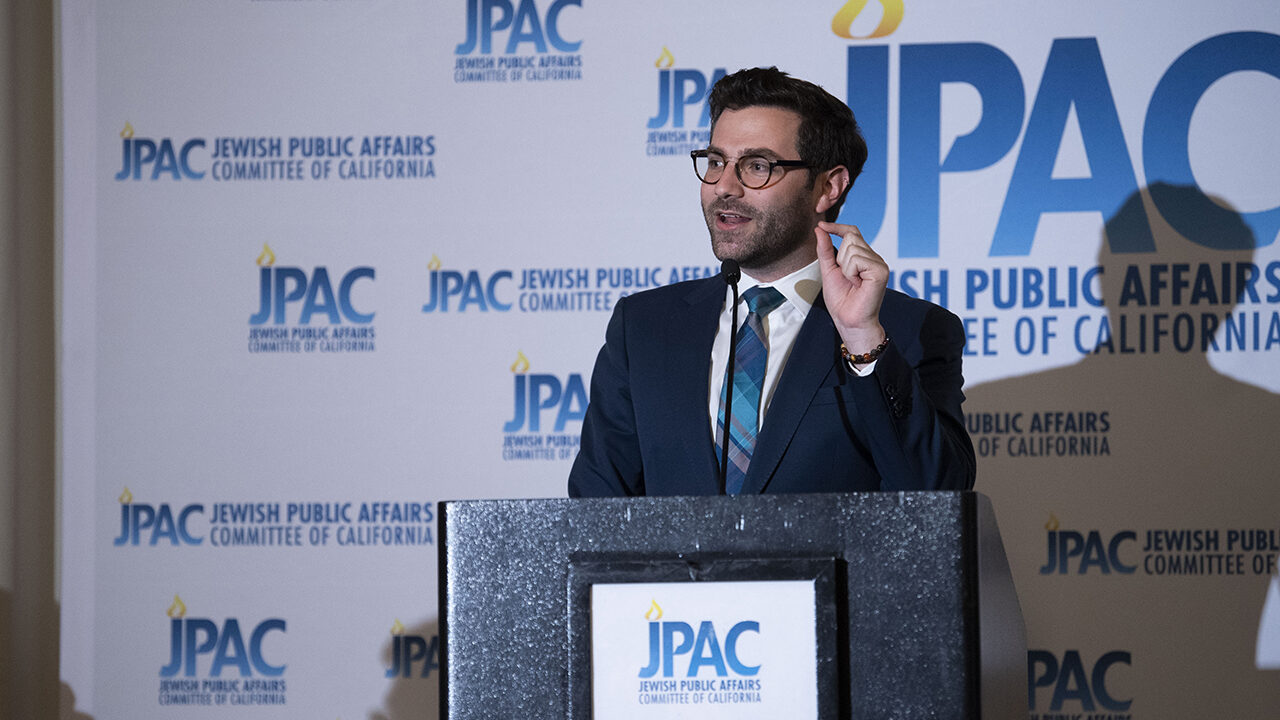
In a move that has drawn swift backlash from Jewish groups, California’s largest university faculty union took aim at the Jewish political lobbying nonprofit JPAC, describing it as an entity that “harm[s] working people.”
The California Faculty Association statement, which lumped the Jewish Public Affairs Committee of California with the oil and tobacco industries, appeared in a CFA questionnaire sent to political candidates for potential endorsement. The union represents 29,000 professors, lecturers and other faculty members across 23 campuses in the California State University system.
“Partnering with the Labor Movement means rejecting campaign contributions and endorsements from groups that harm working people,” the final question on the nine-page questionnaire states. “Do you have endorsements or take contributions from groups and sectors like AIPAC/JPAC, the Oil Industry, the Tobacco Industry, police associations, etc.?”
JPAC is a 501(c)(4) nonprofit that advocates on behalf of the state’s largest Jewish charities, including Jewish Federations in San Francisco, Los Angeles and other major cities, and lobbies on behalf of issues of broad concern to the Jewish community. Unlike AIPAC, it doesn’t endorse candidates, donate money to their campaigns or weigh in on U.S. foreign policy.
Jewish nonprofit leaders said the questionnaire reflected a gross misunderstanding of JPAC’s role in state politics. The Jewish Community Relations Council Bay Area called the language “blatantly antisemitic,” and JPAC executive director David Bocarsly wondered if the CFA was trying to “make sure the Jewish community cannot engage civically in California.”
“It puts a target on our back,” he said. “I worry other people are going to think that’s acceptable to do to Jews.”
The Jewish Federation Bay Area also lambasted CFA, calling on union leadership to apologize publicly.
“We condemn CFA’s shameful anti-Jewish litmus test for political candidates,” according to a statement to J. from antisemitism and advocacy director Nancy Appel. “It is both antisemitic and anti-democratic to single out and sideline Jewish civic participation.”
JPAC’s political priorities align generally with mainstream political values held by many California Jews, such as combating homelessness and increasing resources for refugee resettlement. JPAC also supports Israel, promoting economic and cultural ties between California and Israel and countering campaigns to “delegitimize and demonize” the Jewish state, according to JPAC’s policy framework. Particularly since Oct. 7, 2023, it has played a visible role lobbying for bills to counter antisemitism in universities and public schools.
A bitter political fight between JPAC and teachers unions, including the CFA, took place this year over AB 715, a state bill meant to combat antisemitism in K-12 schools. Opponents said the bill would tamp down on pro-Palestinian speech. JPAC described it as a “landmark” piece of legislation. It passed without opposition on Sept. 13 and was signed into law by the governor on Oct. 7.
AB 715 establishes a statewide “antisemitism coordinator” for K-12 schools and new rules against “bias” and “partisanship” in classroom materials. CFA, the ACLU and others argued that the bill gives undue power to the state to determine which classroom materials are appropriate and which aren’t, and that it wrongly targets speech, particularly pro-Palestinian speech. The measure “does not protect — it silences,” the CFA said on social media in July.
Bocarsly, shocked at the suggestion that JPAC causes “harm [to] working people,” noted that many of its member organizations — groups that rely on JPAC to advocate and lobby on their behalf — are social service providers. They include ETTA, a nonprofit serving people with intellectual disabilities, HIAS, which supports refugees and asylum seekers, and Jewish Vocational Service, which provides job training.
“We support Israel’s right to exist,” Bocarsly said. “That should not preclude our entire community from being able to engage in civic life.”
The JCRC similarly condemned the union statement. “CFA is urging candidates to reject money from ‘the Jews,’” it said in a press release Tuesday. “There’s really no other way to read the blatantly antisemitic language.”
CFA did not respond to J.’s requests for comment.
Melina Abdullah, the chair of CFA’s political action and legislation committee, told Politico that the questionnaire has “nothing to do with whether or not a candidate is Jewish” and that the answer would not determine whether the candidate wins the CFA endorsement, but it could lead to “additional conversation.”
Calling AB 715 a “censorship bill,” Abdullah added that CFA wishes to determine whether candidates “are affiliated in any way with that effort to censor classroom teachers.”
Abdullah is a professor of Pan-African Studies at Cal State LA. She is a progressive activist and shared strong words in opposition to AB 715 while it was being debated earlier this year.The measure “threatens to fire and dox K-12 teachers for teaching #EthnicStudies #Palestine or anything that makes those who identify with Israel feel “uncomfortable,” she wrote on X in September. In another post, Abdullah said legislators who support AB 715 are “clearly bought off by the Israeli lobby” and were “being bribed.”
While some in the Jewish community were taken aback by the conflating of JPAC with the tobacco industry, others said it was of a piece with the union’s prior activism.
Jeffrey Blutinger, a history professor and the director of Jewish studies at Cal State Long Beach, had remained in the union despite a number of “very questionable” one-sided resolutions over the years. But Blutinger, who said he “loathes” the Netanyahu government, resigned from CFA in the spring after it adopted a measure to end all academic partnerships with Israel, including study abroad programs.
“It doesn’t surprise me at all,” Blutinger said of the questionnaire. The union, he said, “has gone down a dark path.”
Blutinger has personally experienced anti-Israel activism in the CSU system. When protesters at San Jose State objected to having a “Zionist” on campus last year, he required a police escort and was moved to a smaller venue to deliver his talk on prospects for a two-state solution to the Israeli-Palestinian conflict.
“Despite the fact that the union supposedly is all about protecting academic freedom,” Blutinger said, “they had no comment after police came into my classroom and ordered me to stop teaching.”
On Tuesday, JPAC sent a letter to CFA demanding that the group revise its questionnaire and apologize to the Jewish community.
“Let’s be clear: JPAC does not make campaign contributions or endorsements,” the letter said. “JPAC is a nonprofit legislative advocacy coalition representing California’s diverse Jewish community through public policy and budget advocacy — not political financing.”
In addition to urging CFA to remove the language about JPAC from the questionnaire, the letter asked CFA to “publicly affirm that California’s Jewish community — like every other community — has a rightful place in civic and political life.”
The day that this article was first published and a day after details about the questionnaire were first reported by Politico, CFA offered an apology for the wording of the question, according to the East Bay Times.
“We apologize for not being more careful with the formulation of that question and the confusion and hurt feelings that this article has caused,” the union said in a statement, according to the news site. “We are taking this opportunity to be clear and on the record that CFA did not say, nor do we believe that, Jewish groups or individuals are harmful to working people. CFA also did not say and does not believe that accepting contributions from Jewish donors simply because of their identity is harmful.”
CFA also told the East Bay Times that it will “more closely” review the questionnaire process and be “more careful and more specific” when writing questions about contentious topics.