
Months before the national leaders of Friends of the IDF resigned in July, the group’s Bay Area chapter paused all fundraising events, according to former chapter board member Ricki Alon.
The temporary interruption stemmed from an abrupt leadership change in the Bay Area chapter. Soon, turmoil would spread across the national organization.
In December 2024, FIDF’s then-CEO Steve Weil terminated Amarelle Green, the Bay Area chapter’s well-liked executive director of more than five years, according to Alon.
“The FIDF simply rejected us,” Alon told J. on Oct. 16. “Once they fired our executive director last December, they ignored the entire board.”
That spurred several Bay Area chapter board members to resign and withdraw their support. Alon, who served on both the national and local FIDF boards, was among them.
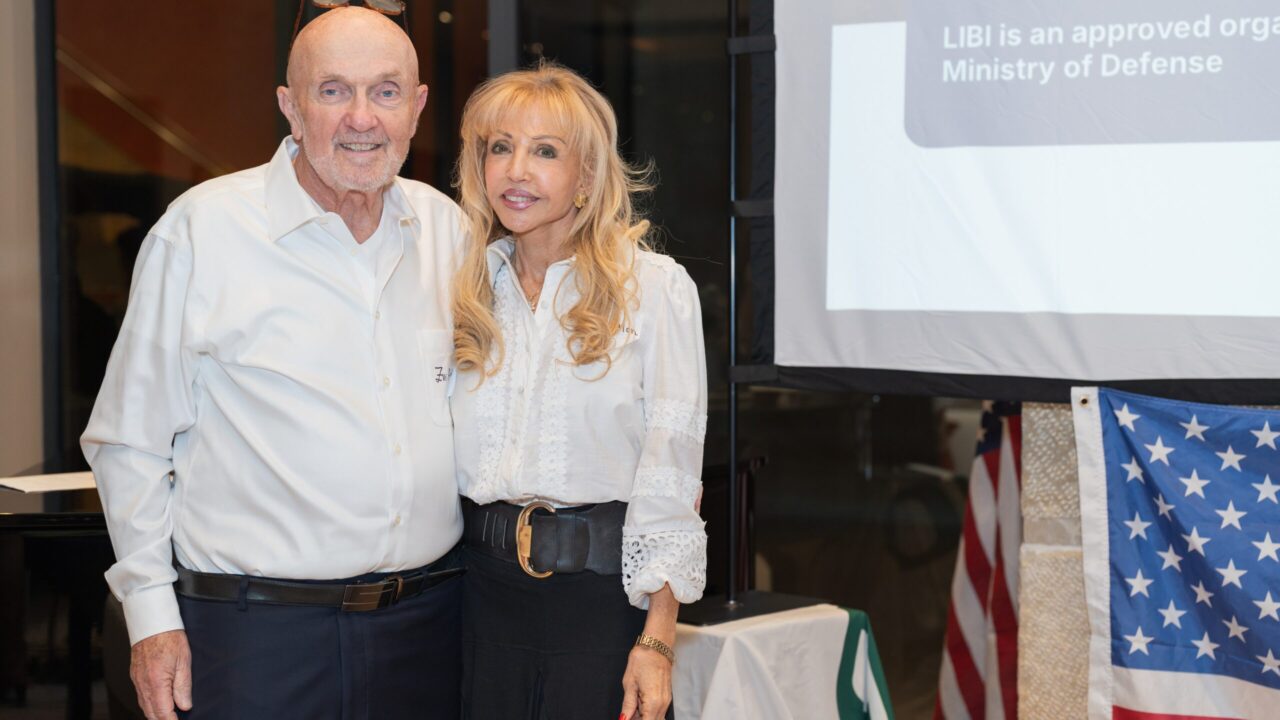
Now, Alon, her husband, Zvi Alon and other former board members of the Bay Area FIDF chapter, are turning to a smaller nonprofit that until now had focused primarily on East Coast fundraising. The Alons, who are both Israeli natives, hope to raise the profile of American Friends of LIBI (AFL) and broaden its donor base.
Three months ago, Zvi Alon, a Silicon Valley tech executive and a longtime supporter of Israeli causes, was recruited to become board chairman of AFL, an entirely volunteer-run nonprofit with the same mission as the FIDF of financially supporting the needs of IDF soldiers, veterans and their families.
LIBI stands for the Hebrew phrase “l’maan bitachon Israel,” meaning “for the benefit of Israel’s security.” “Libi” also means “my heart” in Hebrew.
“It’s almost like a natural transition,” said Ricki Alon, who also joined AFL’s six-member board this summer. “It’s the same mission.”
LIBI was founded in 1980 by then-Israeli Prime Minister Menachem Begin and then-IDF Chief of Staff Rafael Eitan to support soldiers. In 2002, American Friends of LIBI was established in Boston to usher in American fundraising support during the second intifada.
Over the past two decades, AFL has raised $180 million to support social welfare programs for IDF soldiers, veterans and their families that aren’t covered by Israel’s defense budget.

FIDF and LIBI are the only two organizations with the legal authority from Israel’s government to raise money for the IDF, according to Zvi Alon.
“For the longest time the FIDF was trying to convey the message that they were the only one,” he added.
When asked about how FIDF views AFL’s mission, Joshua Steinreich, vice president of the communications firm representing FIDF, responded in an email to J. on Thursday, “FIDF supports and commends any organization that cares for Israel and its soldiers.”
LIBI is well known in Israel, Ricki Alon noted. Of the two organizations, though, FIDF is by far the bigger name in the U.S., with chapters across every region. AFL has no regional chapters.
According to the most recent tax filings available, FIDF raised over $280 million in 2023 with 173 employees and $31.3 million in salaries and other expenses. At the end of that year, FIDF had $288 million in net assets or fund balances.
By contrast, AFLIBI raised $13.6 million in 2023 with no employees and $87,000 in expenses. At the end of that year, AFL had $644,000 in net assets or fund balances.
For LIBI supporters, this means that the organization has lots of room to grow.
David Golden, a San Francisco tech professional, has been on AFL’s board for more than 10 years.
“Until recently, American Friends of LIBI was really more East Coast focused,” Golden told J. on Oct. 21.
Shimshon Erenfeld, a co-founder of American Friends of LIBI, served as board chairman for the past five years. He recruited Zvi Alon to become chairman and has himself stepped into the role of vice chairman.
Instead of hosting large fundraising galas and conferences like FIDF does, Golden said, AFL traditionally gathers supporters in smaller events at people’s homes.
“People can have a kind of intimate feel with the charity,” Golden said.
What specifically sets AFL apart is that it has no employees, Zvi Alon said. Its website states that more than 90% of donations go directly to help soldiers. The rest is used to pay for overhead costs, including legal and financial fees associated with its nonprofit status and other administrative costs, he said.
Both Alons emphasized their hope for FIDF’s future, despite their own decision to branch off.
“We are not in competition with FIDF,” Ricki Alon said. “We are not in conflict with them. We wish them well. We just wanted to make people aware that there are different alternatives.”
As for the Bay Area’s FIDF chapter, new board members have stepped in and fundraising events have resumed, according to Steinreich. “FIDF continues to maintain a vibrant and impactful presence in the Bay Area. Under the staff leadership of FIDF Major Gifts Officer Polina Rubin, and supported by an active Board of Directors comprised of six sitting board members and several nominees whose positions are expected to be formalized at the next board meeting, the chapter continues to thrive,” Steinreich wrote in an email to J.
“A dedicated community of donors remains deeply committed to our mission,” Steinreich added, noting that the chapter has hosted events in the Bay Area this year.
On Oct. 12 — the eve of the release of the 20 living hostages from Gaza — the Alons hosted their first AFL event for about 70 people at their Los Altos Hills home to build local support for the group. The couple covered the cost of the event, which included a catered dinner. Guests sat in the Alons’ living room as two speakers shared personal stories from their time in the IDF, one a former fighter pilot and the other a former artillery officer.
That event brought in “a couple hundred thousand” in donations, with more still coming in, Ricki Alon said. Throughout the evening, guests eagerly checked their phones in anticipation of the imminent release of the hostages.
“It was the most incredible combination of joy and grief,” she said.
“It was a very good beginning,” Zvi Alon said of the reception.
Now, he’s focused on outreach and growth for AFL, with the Bay Area as the testing ground. He said the board has already identified five U.S. cities to expand to next, with a focus on outreach to younger donors. AFL is also working on organizing mission trips to Israel for donors and continuing to bring speakers to the Bay Area for fundraisers.
“There’s a lot of opportunity for LIBI,” Golden said, noting that having a Silicon Valley-based chairman is a real advantage. “Given the growth and the very intense presence on the part of Israeli Americans in the tech industry, it really makes sense to have LIBI build up a greater presence on the West Coast.”