

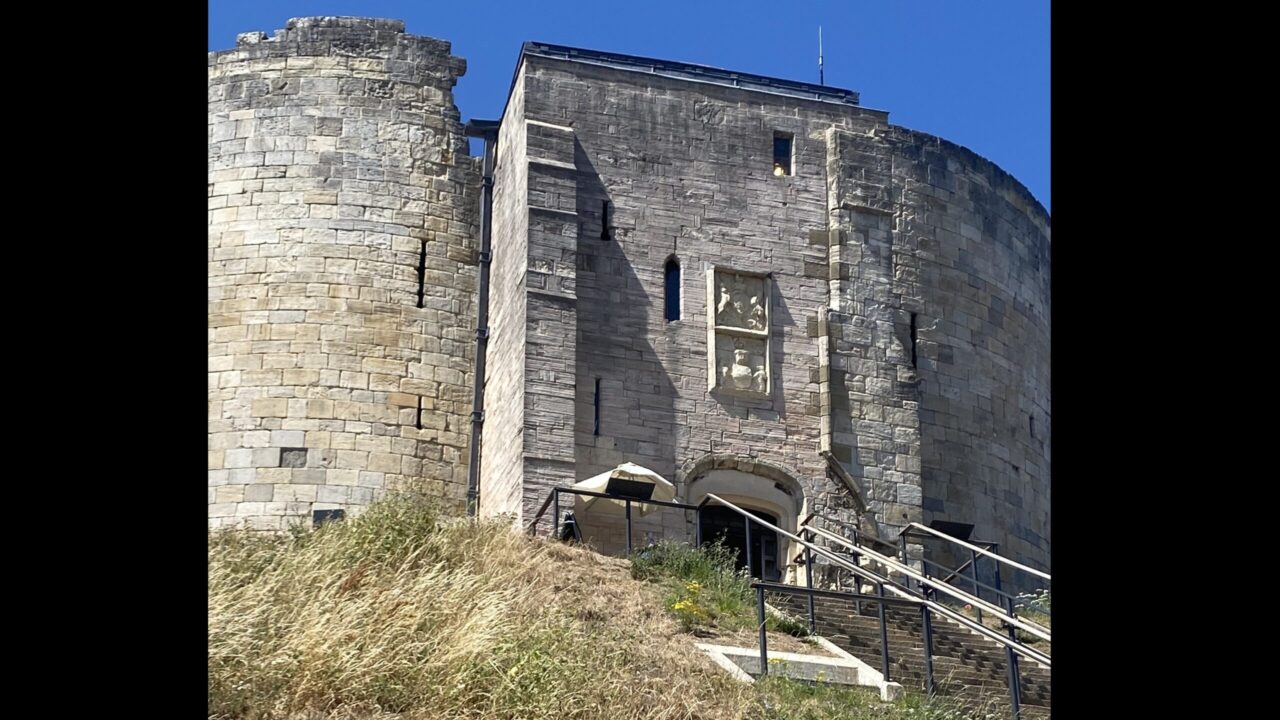
In 1190, Clifford’s Tower became York’s Masada.
On March 16 of that year, some 150 largely French-speaking Jews took refuge there from an angry, violent mob incited by townspeople filled with anti-Jewish religious fervor and local gentry eager to avoid repaying Jewish moneylenders. The Jews, including liturgical poet Rabbi Yom Tov, eventually chose to die together and set the tower’s timbers on fire, rather than allow the mob to kill them or force them to renounce their faith.
The annihilation in this community in northeast England also conveniently wiped out the monarchy’s debts to financiers who helped cover the costs of the Crusades.
The tragic story was largely forgotten until the 1950s, said Avi Rubinstein, a York University student who leads York Jewish Walking Tours through the city, where remnants still stand of walls constructed by Roman invaders 2,000 years ago.
One aim of the tours is to “bring Jewish life back into York” — with its estimated 100 to 200 Jews — while also uncovering York’s “somewhat forgotten Jewish past,” according to the website.
I met Avi this summer during a trip to England to visit my son and his family. I happened upon his tour while I was researching York’s Jewish history online and decided that perhaps I could learn something new.

Carrying sketches illustrating the city’s history, including its Jewish past, Avi met us and our local relatives at the oddly named Whip-Ma-Whop-Ma-Gate in the city center. From there, we walked to the base of Clifford’s Tower for a history lesson. The ruins of the 13th century stone tower are themselves a remnant of an 11th century castle, built in the time of William the Conqueror.
My husband and I first visited York 18 years ago, after my son married a woman from the region. Touring York opened my eyes to history I’d never learned in a classroom. During a spooky evening ghost walk in 2007, the tour guide opined that the blood from the 1190 mass suicide may have resulted in the reddish stains on the walls of Clifford’s Tower. At the time, I shuddered. But Avi laughed at the story about the stains, which he said may have been due to oxidation.
Sitting under an awning at the base of the tower, where a memorial tablet was laid in 1978, Avi told other stories about York’s Jewish history. In 1990, Chief Rabbi Lord Immanuel Jacobovits and Archbishop Stuart Blanche held a ceremony where we stood to symbolically nullify the notion that Jews weren’t welcome in York.
The tragedy in 1190, Avi said, was not the death knell of Jewish life in York. As we walked through town, he pointed out a blue plaque on Coney Street marking the site of both the home and synagogue of Rabbi Aaron of York. In 1237, Aaron became the chief rabbi of England. But calamity arrived before the century’s end.
By 1290, King Edward I had expelled all of England’s Jews, who did not return until Oliver Cromwell lifted the ban in 1656.

York, with a total population of about 220,000 today, never became a thriving Jewish enclave. Geography and the Industrial Revolution, rather than antisemitism, played a role. York, which is not on the coast, was a river port when the Romans built a fortress in 71 CE and when Vikings captured the city in 866 CE. But over time, erosion and flooding made it impossible for large seagoing vessels to navigate the River Ouse or its tributaries. By the time the Industrial Revolution gained momentum in the 19th century, Manchester and cities with strong waterways quickly overtook York as manufacturing centers, and those are the places where Jews migrated.
Perversely, York’s decline as a major commercial center had at least one beneficial effect. By preserving its frozen-in-time past, York has become a major tourist center, drawing more than 9 million visitors a year and bringing in $2.7 billion annually, according to the city. Major attractions include cobbled streets like the narrow Shambles with its overhanging buildings, a magnificent Gothic cathedral and museums that display the heritage of Roman and Viking invaders.
Self-guided Jewish tours of York have long been available. But Avi, who comes from a family of historians, saw the need for a tour led by Jews and recruited fellow York University senior Izzie Solomon to co-lead. They are now preparing younger students to continue their work. The tours for small groups are normally free, but tips are appreciated.
“Most of our customers are Jewish and are actually primarily from England (usually from London coming up to York for a weekend),” Avi said to me in an email. “We do also get a lot of foreign Jews, as well as some non-Jewish York locals who are interested in hearing a new perspective on York’s history.”

All walking tours of York inevitably include Clifford’s Tower, the Shambles, the cathedral and perhaps a walk along the Roman walls. Avi took us to one of the more obscure sites: a hidden courtyard revealing the two surviving walls of Norman House, York’s oldest home. Rediscovered in 1939, the building was the home of Jews in the 12th century, Avi said.
Today York’s Jewish community may be experiencing a small revival, aided by the York University Jewish Society and by Rabbi Elisheva Salamo, a San Francisco native.
In 2023, the York Liberal Jewish Community hired Salamo as its first resident rabbi in more than 800 years. Salamo worked at synagogues and Jewish organizations across the Bay Area for decades, including as a J. Torah columnist.
“Small Jewish communities hold strength beyond their size, and that was what I saw as I interviewed for the post,” the rabbi told me in an email. “It’s a special privilege to be part of navigating the pulls of Jewish life and the secular world here, as I am sure my spiritual ancestors, Rabbi Yom Tov and Aaron of York felt. When I tread the streets they walked on, pass the sites of their synagogues, I feel a special connection to the land and to recreating a vibrant community in a culture with different values. We are proud Jews in York, we believe that hope rises from the ashes, that memory serves to shape but not define us.”