

On a bus ride out of Tel Aviv one summer, Israeli writer Etgar Keret told American podcaster Ira Glass a story about his late mother. It was so moving that Glass decided he wanted to help present it to the public.
The two men were set to begin a speaking tour with Keret’s stories about his mother in late October 2023, with a stop in San Francisco. But the Oct. 7 Hamas attack led them to postpone the whole thing.
In a social media post, Keret made a wish.
“I still fantasize [about] going on this mom tour with Ira on a future date,” Keret wrote. “And that by then the war will be over, and the … people kidnapped to Gaza will return to their families.”
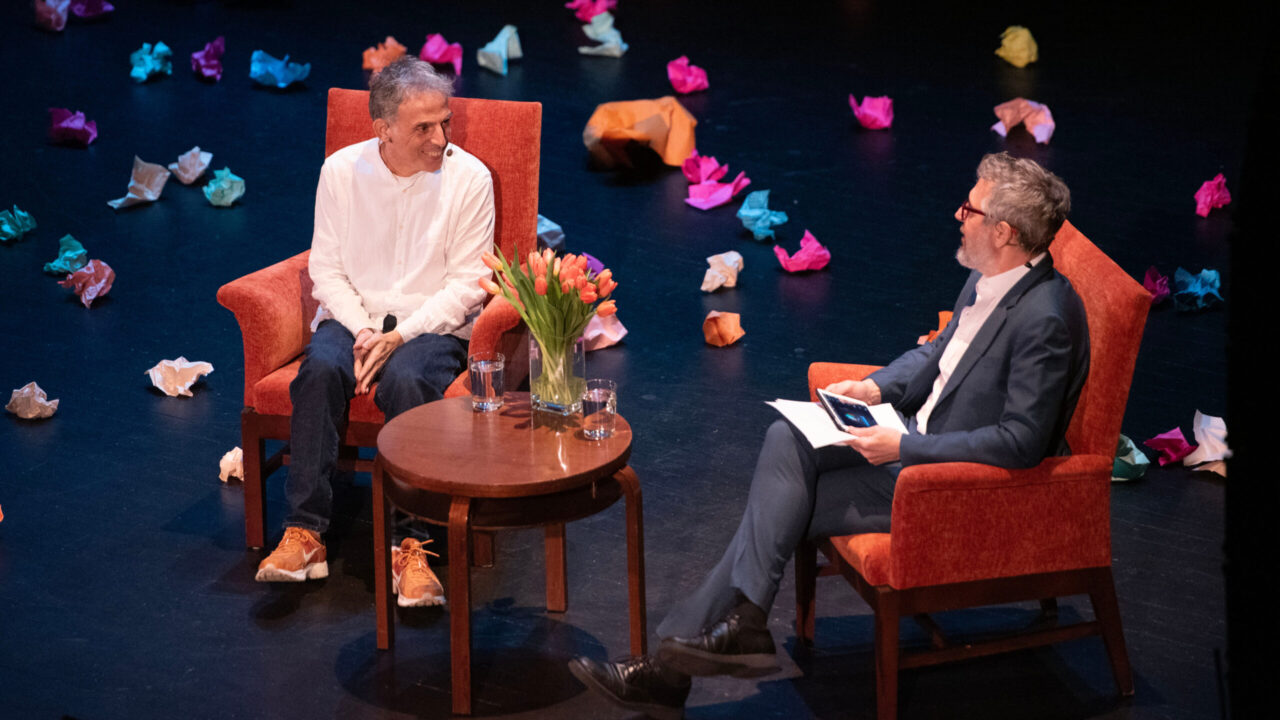
On Sunday evening, 20 days after the final 20 living hostages came home, Keret’s wish came true. He and Glass were reunited at San Francisco’s Sydney Goldstein Theater for a conversation called “Half-Baked Stories About My Dead Mom.”
Over the last 20 years, Keret has become a star in the literary world, both in Israel and abroad. He’s best known for his collections of surreal, absurdist and whimsical short stories, including “The Bus Driver Who Wanted to be God and Other Stories” and “The Girl on the Fridge.”

“The Seven Good Years,” Keret’s 2015 memoir, was inspired in part by his father, Efraim, who died in 2011. Writing about his mother, Orna, who died in 2019, was a more difficult task, he said.
“She’s kind of everything. She’s merciful, vengeful, generous, and spiteful,” Keret told Glass and more than 1,100 audience members. “Every time I’d write something about her, I’d say, ‘Yeah, for sure this is my mother.’ But my mom is so much more than that. I couldn’t write something that would capture all of the conflicting sides of her.”
Between segments of conversation with Glass, Keret rummaged through crumpled pieces of paper scattered across the stage, at times directed by Glass on which to pick up. Each paper contained a story related to Keret’s mother, which he then read aloud.
This use of stories on crumpled paper reflected an exhibition by Keret at the Jewish Museum in Berlin in 2022 and 2023 that featured piles of papers alongside objects from the museum’s collection. Likewise, the January 2023 episode of Glass’ “This American Life” podcast used the same title as the Sunday night event in San Francisco.
Some of the papers held stories of Keret’s own memories of his mother, while others contained bedtime stories his mother had told him, including ones she’d heard from her own parents. For Orna, who survived the Warsaw Ghetto during World War II, they were special memories. The rest of her family, including her parents, died in the Holocaust.
“In the ghetto, there was no food, they couldn’t get her clothes. But they loved her, so what they could put their mind into was telling her every day these amazing stories that always incorporated something that happened on this day. It always made her feel very special,” Keret said. “When she had her own family, she wanted to do the same thing. For her, it was like if you really love your children, then you should come up with a new story every day.”
“No wonder you ended up a short story writer,” Glass said.

Orna made up most of the stories Keret heard as a child. Others were real, including one titled “Bedtime Story,” which Keret read aloud on Sunday. The story tells of a neighbor of Orna’s family before the war who happened to look Jewish, even though he wasn’t. He later took advantage of his appearance to uncover places Jews were hiding and to turn them in. Yet the neighbor ended up brutally beaten to death after he was mistaken for a Jew.
While the Holocaust forever changed the course of his mother’s life, Keret recalled how adamantly she did not want to be solely defined as a “Holocaust survivor.”
“We live in a world where everybody is a victim or a hero, and my mom hated that. She felt this was kind of dehumanizing,” Keret said. “She felt like she was a wild horse that the Nazis had branded. But she was still a wild horse.”
Keret and Glass spoke at length about Orna’s relationship with her son and with the world around her, at times recalling even shorter stories that didn’t make it onto the crumpled pages. Keret also spoke about how these stories took on new meaning after Oct. 7.
“I inherently knew that they were from another world. That she was informing me of what humanity can turn into, what extremity we can reach,” Keret said.
He recalled a visit he paid to off-duty soldiers on the Gaza border a few weeks into the war, and his futile attempt to read his stories aloud, while wearing ear plugs, as hail fell and rockets to and from Gaza flew overhead.
“There was something about this [post-Oct. 7] world that seemed connected with the world my parents told me about,” he said. “This kind of world doesn’t make sense.”
Keret closed out the evening with a reading of “The First Angel You See,” the story that gave birth to the tour. It was also the only story that Keret read in Hebrew (with English projected behind him).
It told of the last words that Orna’s own mother spoke to her before she was murdered by Nazi soldiers: “Right after you die, go up to the first angel you see and tell him ‘I’m going to see my mom,’” Keret read.
The room was silent, save for sounds of stifled weeping, as Keret shared the last words Orna spoke to him.
“I’m going to see my mom.”