

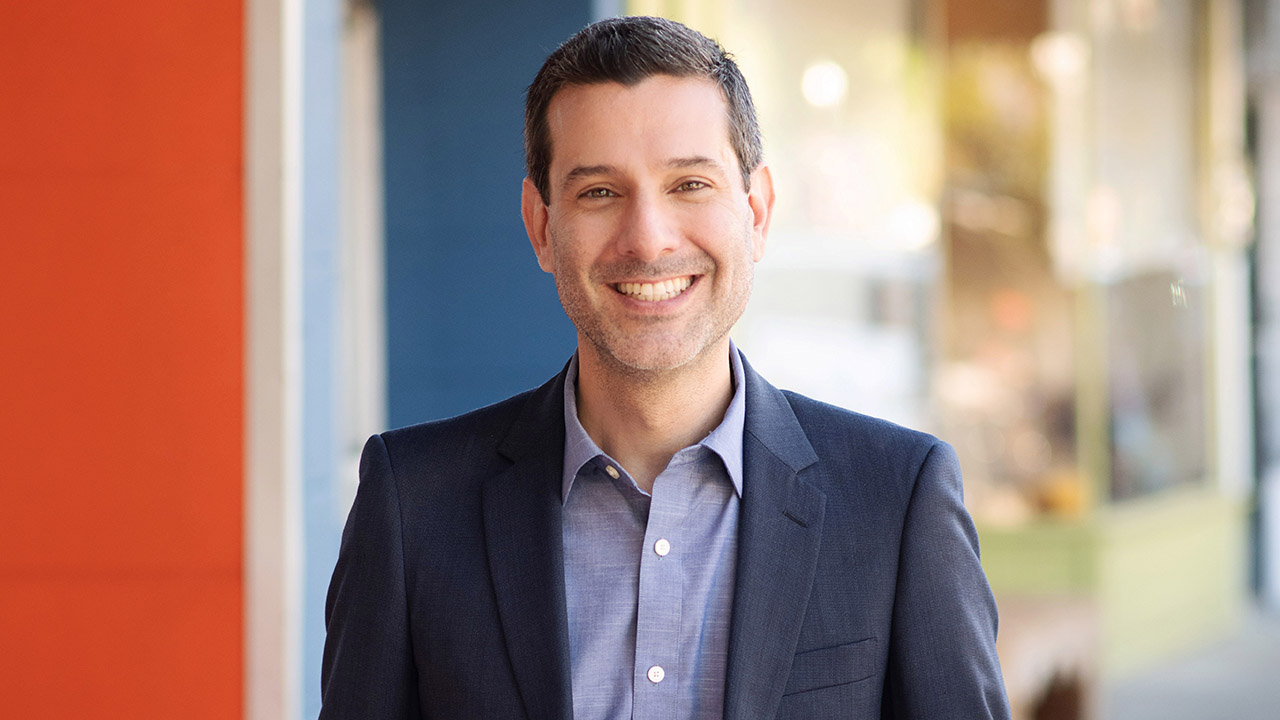
Some people meticulously chart their careers with five-year plans and carefully set goals and milestones. Others, like Yoav Schlesinger, follow a path that’s less about planning and more about curiosity and the willingness to answer when opportunity comes knocking.
Schlesinger describes his career path as “delightfully nonlinear,” and it has led across coasts, through religious studies, nonprofit leadership, tech ethics and civic engagement.
Schlesinger was born in Los Angeles but raised in southern New Jersey where his father served as a Conservative rabbi. He returned to California to attend Stanford University, where he majored in Jewish studies before expanding into explorations of international security, Islamic ethics and religious philosophy. Since then, his career has moved fluidly across sectors, grounded in an interest in values, meaning and community impact.
From fundraising at the JCCSF to co-founding a consulting firm that supported nonprofits across the Bay Area, to executive leadership roles at Reboot and The Kitchen, to launching the most successful Jewish Kickstarter of all time, each chapter of his story builds on the last. More recently, his work has focused on responsible innovation in technology and AI, including leading initiatives at Omidyar Network and Salesforce.
Schlesinger, 46, lives in San Anselmo with his wife, Keely, and their two daughters. Last year he got involved in a new kind of leadership, one close to home: local government. Schlesinger was elected in December 2024 to the San Anselmo Town Council, where his focus on people and values remains central.
Schlesinger spoke with J. about his career path, the role of resilience in a changing world and the cautious optimism that fuels his commitment to building a better future.
This interview has been edited for length and clarity.
How did you decide to major in Jewish studies? Part of a life plan?
I didn’t set out to major in it, but after spending a semester at Hebrew University in Jerusalem during my junior year, studying Hebrew, Talmud, Jewish history and literature, I came back and realized I already had all the credits. I declared the major and wrapped it up quickly, which gave me time in my senior year to explore other interests. That included international security, and I ended up writing my honors thesis on Islamic ethics of war, specifically how Islamic scholars framed the use of chemical weapons in the Iran-Iraq war.
Where did that take you after graduation?
I worked for a year as a USY director at a synagogue in L.A., then tried grad school at Columbia. I’m a proud grad school dropout! I came back to San Francisco and landed my first job at the Jewish Community Center of San Francisco — at the front desk. They knew I was overqualified, but I think they saw some potential. A few months in, the development director asked me if I’d ever considered fundraising. So I joined the capital campaign team and basically went through fundraising bootcamp, which kicked off my professional path in a serious way.
You co-founded a consulting firm and worked with nonprofits across the Bay Area for five years on everything from capital campaigns to strategic planning. What made you then decide to try executive leadership?
I realized I’d spent years advising executive directors without having been one myself. So I moved to New York to lead Reboot, a Jewish cultural incubator. Then my wife and I were expecting our first daughter and decided to return to California. We’re both fifth-generation Californians and we wanted our daughter to also be Californian. Back in San Francisco, I became the inaugural executive director of The Kitchen, a synagogue founded by Rabbi Noa Kushner. I helped grow that from an idea into a thriving community organization. I also launched Hello Mazel, a Jewish-themed quarterly subscription box. It ended up becoming the top Jewish Kickstarter project of all time.
And your next venture went in a very different direction — tech and AI work.
Around 2017, I had this moment where I asked myself, “Am I really having the kind of impact I want to have?” It felt like the world was shifting dramatically, particularly around two existential issues: climate change and the role of technology in our lives. I found a way into the tech world through Omidyar Network, the venture philanthropy founded by eBay’s Pierre Omidyar. There, I helped launch and lead the Tech and Society Solutions Lab, where we explored responsible innovation and created tools like the Ethical OS [Toolkit] for product teams. That work led to a role at Salesforce, where I spent six years on the AI team focused on responsible innovation and how AI intersects with society.
That was a significant pivot. Is there a thread that connects all these different roles?
It’s a question I’ve had to ask myself many times! What connects it all is a deep interest in values, meaning-making, purpose and community. I have an interest in how people come together around shared norms and principles. That thread runs through Jewish studies, Islamic ethics, fundraising, synagogue leadership, cultural innovation and, now, the ethics of technology and AI. At the end of the day, I’ve always cared about how people organize themselves to live meaningfully and ethically.
You recently took on another leadership role, this time in local government. What inspired it?
Another open door, honestly. When a beloved local bookstore was being priced out of their location, I started asking questions: What does it say about us if we let our community institutions die? Is this the kind of town I want to live in? In a last-minute decision, I threw my hat in the ring for San Anselmo Town Council. Three months later, I was elected. I’ve now served for almost a year.
Do you connect with people naturally, or did that grow through your work?
A bit of both. I’ve always enjoyed connecting with people, but each career chapter has helped me develop that skill in new ways, whether it’s listening to donors, understanding tech users or engaging with voters. It’s like building different muscles that all contribute to the same goal: keeping people at the center.
What advice will you give your kids about figuring out their own paths?
This is one of the hardest things for me right now, and the thing that keeps me up at night. The technological change that we are currently facing is only accelerating from here, and it’s already been a wild ride over the last few years. When you think about human-AI interaction and the impact that AI will have on every corner of our lives — from how we work to how we access education, to health care and services and its fundamental integration in every aspect of our lives — it is nearly impossible for any of us to accurately predict the future.
It comes down to things as fundamental as, what is the value of education? Will a college degree matter when my children are in early- to mid-career? If not, what does matter? What are areas where humans are uniquely positioned to flourish, as opposed to places where humans are likely to be displaced or replaced by AI? What are uniquely human capabilities where leaning in will get you further? It’s going to be all about resilience and adaptability to change, because that change is coming, and it’s coming fast.
Are you hopeful for the future?
I’d say I have cautious optimism. The moment we’re in is precarious. It wouldn’t take much for things to tip toward a darker future, but it’s also within our power to tip it in the other direction.
I want people to understand that the work around technology, especially AI, isn’t about doom. It’s about responsibility. AI has tremendous potential to improve lives, but only if we are thoughtful and intentional about how we develop and apply it. If we don’t act deliberately, we risk serious consequences. The stakes are high, which is why we have to keep humans, values, rights and community at the center of it all.