

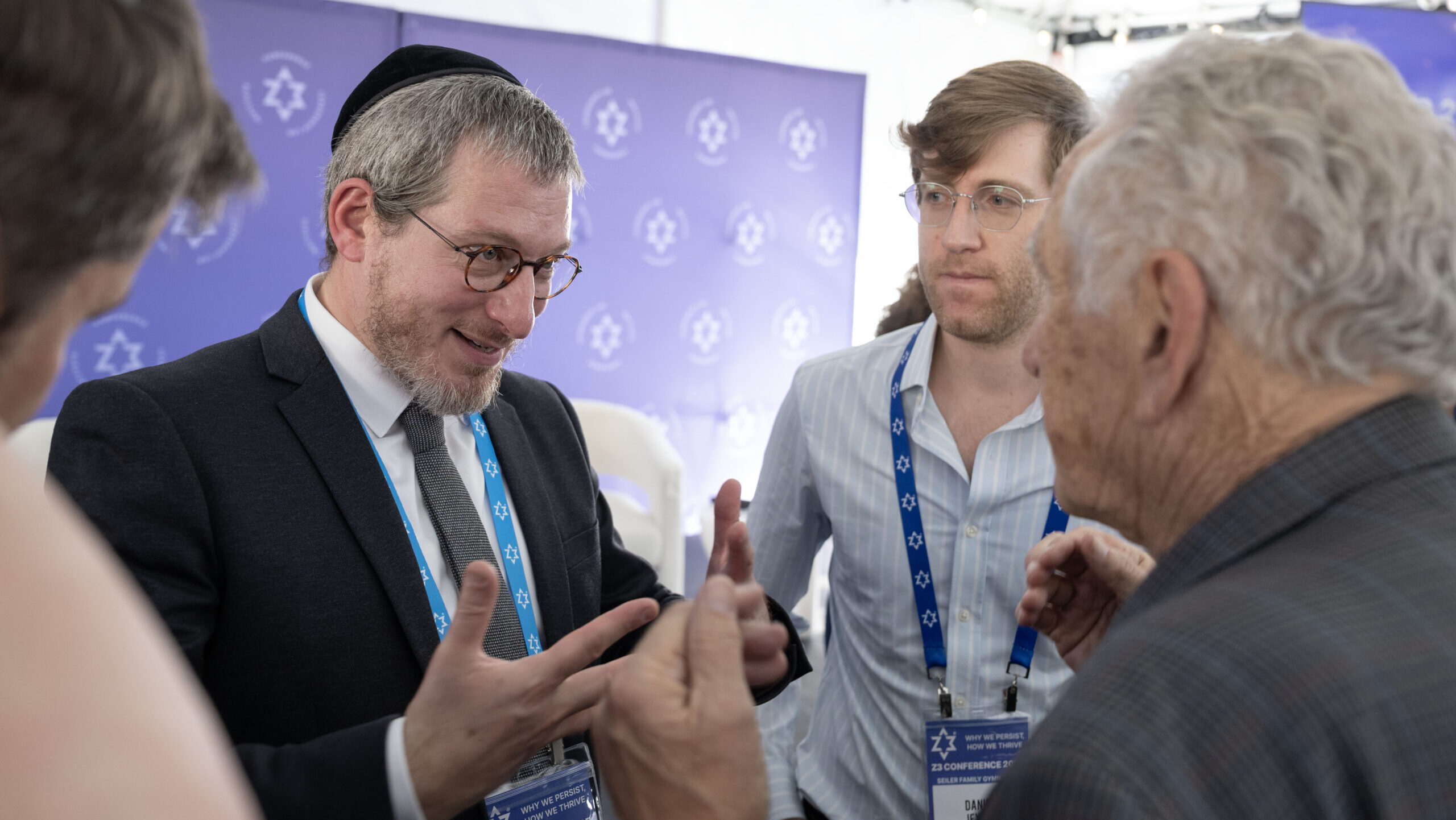
Four Israeli speakers addressing the topic of “Why Israeli Society Feels Fractured and How a New Covenant Can Be Forged” in Palo Alto on Nov. 9 represented many of those very fractures.
All Israeli citizens, they were featured on a panel at the Z3 Conference on the Israel-diaspora relationship, held annually at the Oshman Family JCC.
They were haredi educator Rabbi Menachem Bombach; Rachel Azaria, an Orthodox feminist and former member of Knesset; Maria Jiries, a Christian Arab social activist; and Itamar Kremer, an educator, author and self-described “liberal on the left, left, left.”
Holding this pack together was J. editor-in-chief Chanan Tigay, who asked the panelists how they saw the fractures tearing at the fabric of Israeli society, and how they proposed healing them.
The conversation was free-wheeling, as each panelist headed a different kind of project: Bombach, a network of schools for haredi children that combines secular with religious studies; Azaria, a nonprofit that helps the families of IDF reservists take care of daily tasks; Jiries, CEO of an institute promoting shared Arab-Jewish local leadership; and Kremer in the field of Jewish peoplehood and civic renewal.
All four praised each other for simply showing up for the conversation. “Showing up,” they each said, is the most important first step to solving societal fractures.
Themes of social responsibility ran through the discussion. Bombach’s schools are trying to help haredi youth feel more a part of Israeli society, and he proudly pointed out that 50% of his graduates serve in the IDF. Azaria noted that the typical reservist soldier served 250 days in the past two years, and she marveled at the 30,000 volunteers who have signed up through her organization, HaOgen, to cook meals, take care of children and walk dogs for their families.
“People are there for each other, it’s what makes Israeli society work,” she said.
As the lone Arab Israeli panelist, Jiries emphasized the importance of “seeing the whole person” instead of putting people in boxes such as secular or religious, Arab or Jew. Describing herself as “a person with multiple identities — Arab, Christian, woman, liberal,” she said, “It’s hard for Israeli society to hold complexity. You have to choose a side,” a phenomenon that she says intensified after Oct. 7.
Kremer emphasized the need for a “mutual cause,” something that was strong in the immediate aftermath of Oct. 7 but has since broken down. “The only cause we were united about was survival, and you can’t build a community around that,” he said. “We need to talk about vision, like that in [Israel’s] Declaration of Independence,” which highlights equality and democracy, he said.
But again, he said as the others nodded, what gives him hope for the future is that four such different individuals can get together in Palo Alto to have a civil discussion about their differences. “We four are from the sector of hope, the sector of life,” he said. “What we are trying to build here is trust and respect for each other.”